
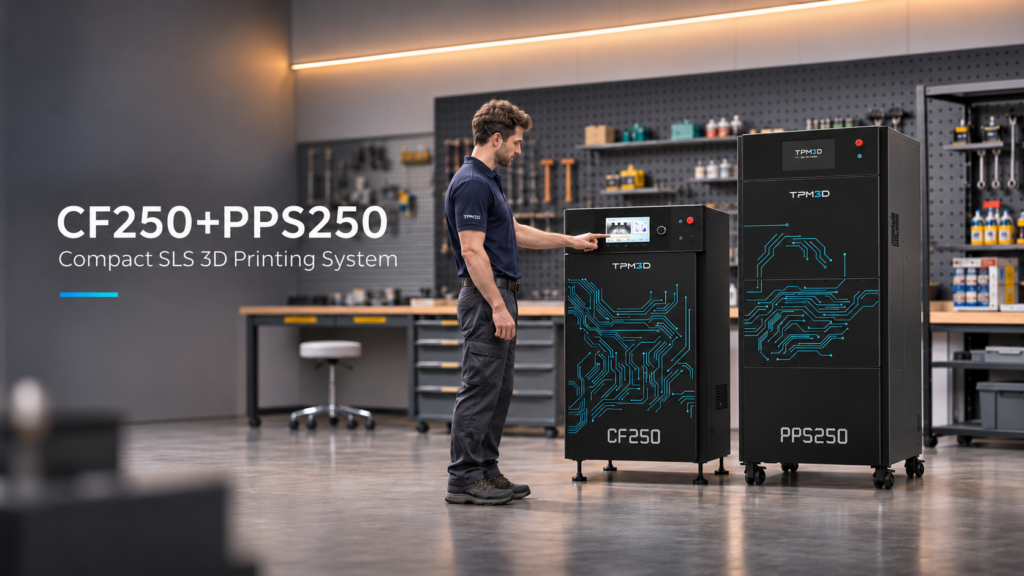
At Formnext 2026 in Frankfurt this week, SLS 3D printer manufacturer TPM3D will be showcasing the CF250+PPS250, its compact, professional SLS system. While the system’s initial launch was at Formnext Asia Shenzhen in August, the international debut of the machine will be at Formnext. This event marks the official introduction of the CF250+PPS250 to the international additive manufacturing (AM) market.
Selective laser sintering, or SLS, is in the powder bed fusion family of 3D printing. There’s a lot of material and geometric freedom in SLS printing, and it doesn’t require any supports. The technology can be used to make strong, functional prints for end-use parts and prototypes in a variety of industries, including medical, manufacturing, and automotive. Because polymers don’t typically experience curling or large residual stresses when melted, SLS is faster and less expensive than metal powder bed fusion.
The market for compact and benchtop SLS systems, like the Formlabs Fuse 1+ 30W, has made polymer printing more accessible, so smaller manufacturing environments can adopt what was previously an extremely expensive technology.
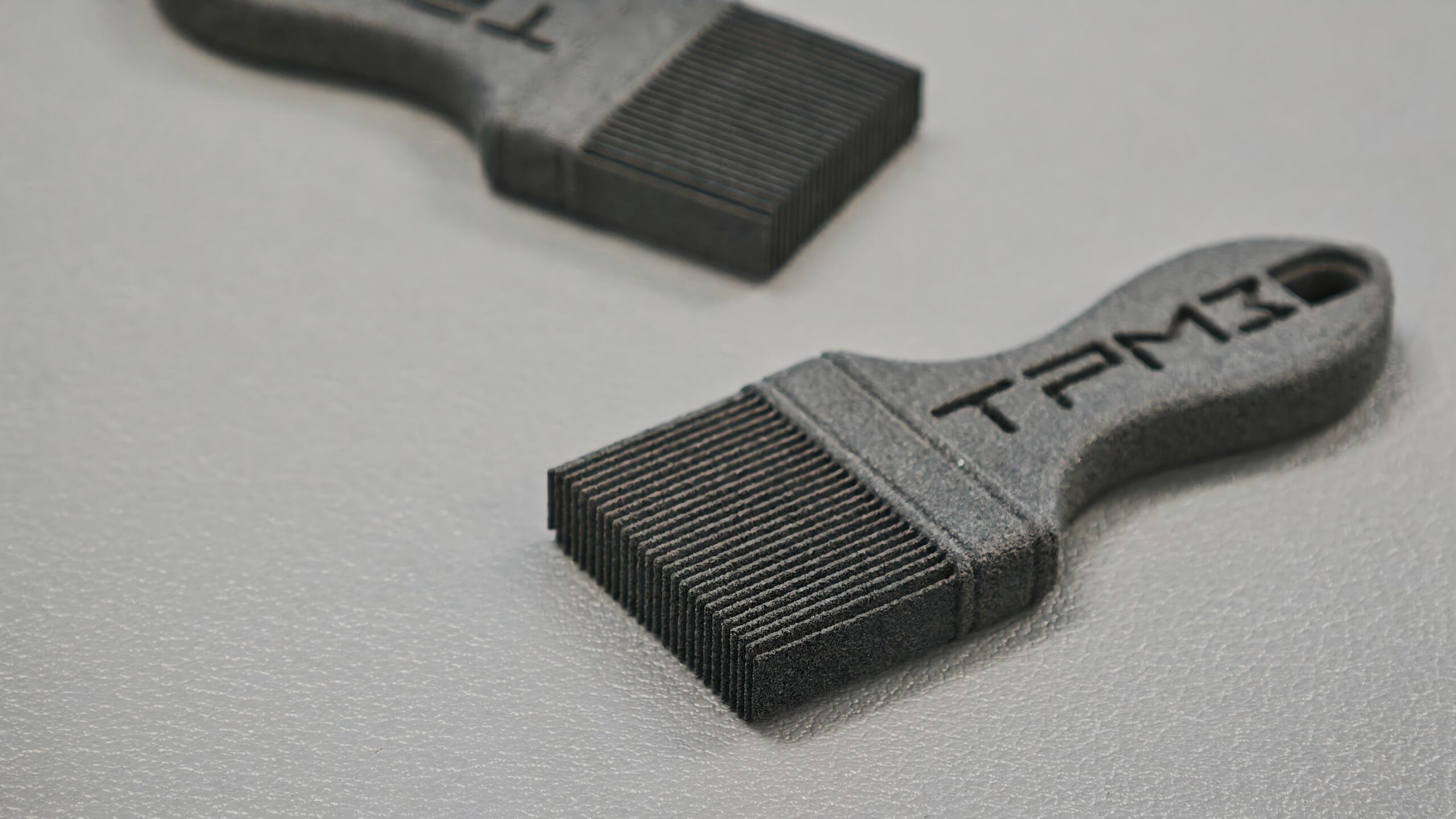
SLS 3D printed polymer brush produced using the TPM3D CF250
However, there are still challenges for professional SLS users, like production capacity, limited workspace, and complex powder handling. This is where TPM3D’s industrial SLS experience comes into play. With roots in SLS research dating back to 1999, the Shanghai-based company has built a portfolio of industrial SLS printers, materials, and powder processing solutions. Its solutions are used by customers around the world, including Dubai-based MicroPolis Robotics for autonomous vehicle components, Spanish orthotics manufacturer Edser, and German additive manufacturing service provider cirp.
Now, TPM3D is bringing its industrial SLS expertise to the compact professional SLS sector with its new CF250+PPS250 solution. One of the main highlights of the system is its compact size. But don’t worry—a decreased footprint doesn’t mean a decreased build capacity.
The CF250 offers an 84% larger recommended printing volume than the Formlabs Fuse 1+ 30W, with a recommended print area of 220 × 220 × 310 mm compared to the Fuse 1+’s 165 × 165 × 300 mm build volume. That’s plenty of room for larger parts or more components in a single build, all within a compact system that takes up just 0.53 m² of floor space. For reference, that’s up to 27 sets of power tool housings, up to 98 pairs of eyeglass frames, or up to 420 coil winding components, per build!
All of this is to say that the new CF250 can accommodate denser production batches, and larger parts, even though it’s not a full-sized industrial SLS system. A higher build capacity can support higher output per print cycle, which makes TPM3D’s new compact SLS system an excellent choice for small-batch manufacturing and repeat production. Its combination of space efficiency and high build capacity is great for users wanting to increase batch production, or print larger parts, in a smaller production space.
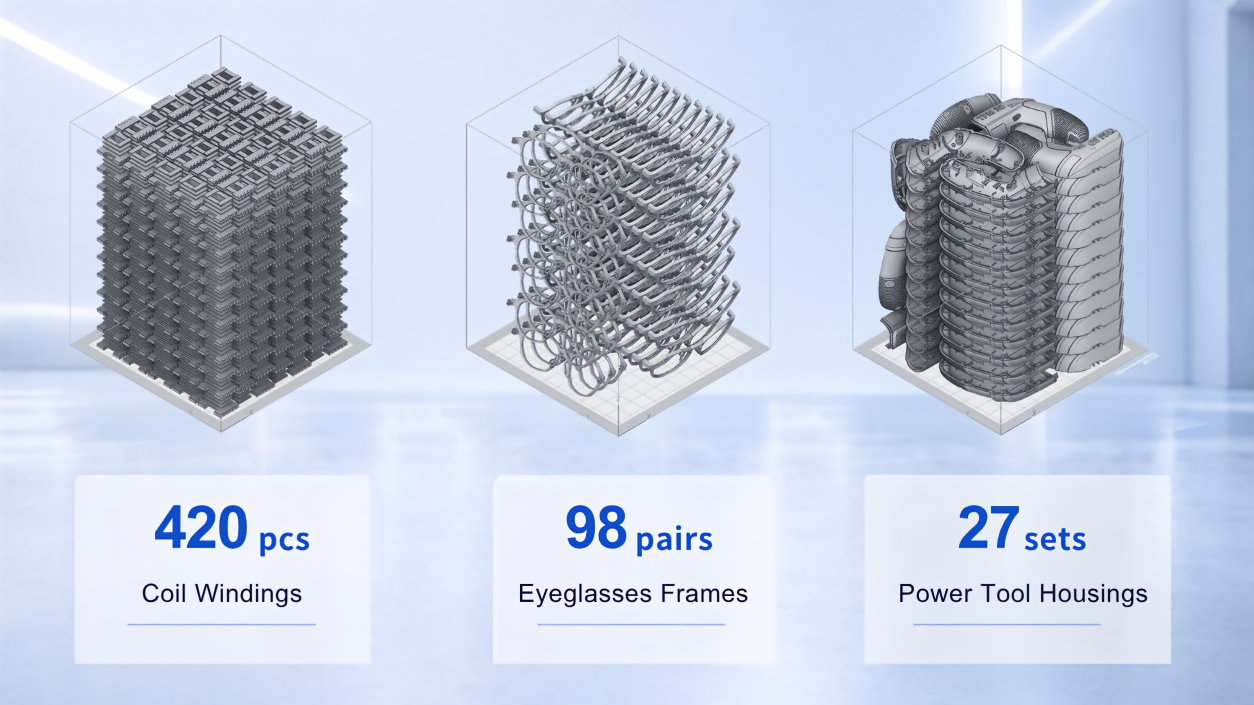
CF250 build capacity examples
In addition to its compact footprint and greater build capacity, the CF250 also offers more automated powder handling, thanks to the PPS250 powder processing station. The PPS250 integrates multiple post-processing and powder recycling functions into one connected workflow, but it’s still compact enough to fit nicely next to the CF250 in a smaller manufacturing environment.
The key functions that the CE-certified PPS250 offers include a rotating basket for automated depowdering, automatic powder sieving and mixing of fresh and recycled powder, automatic powder feeding via an enclosed pipeline, and integrated negative pressure dust collection and filtration system. The mixer can hold 25 L of powder (the same amount as the CF250 itself), and rotates at 120 rpm.
All together, these features help to reduce manual powder transfer between all of the processing steps. If you’re a smaller operation, you don’t need to think professional SLS printing is out of reach for your prototyping or production needs. The CF250+PPS250 was designed specifically to decrease manual operator intervention, simplify daily operations, and support a cleaner, safer, more consistent SLS workflow. Plus, one PPS250 can support multiple CF250 printers, so it’s the perfect setup for a small- to medium-sized SLS farm.
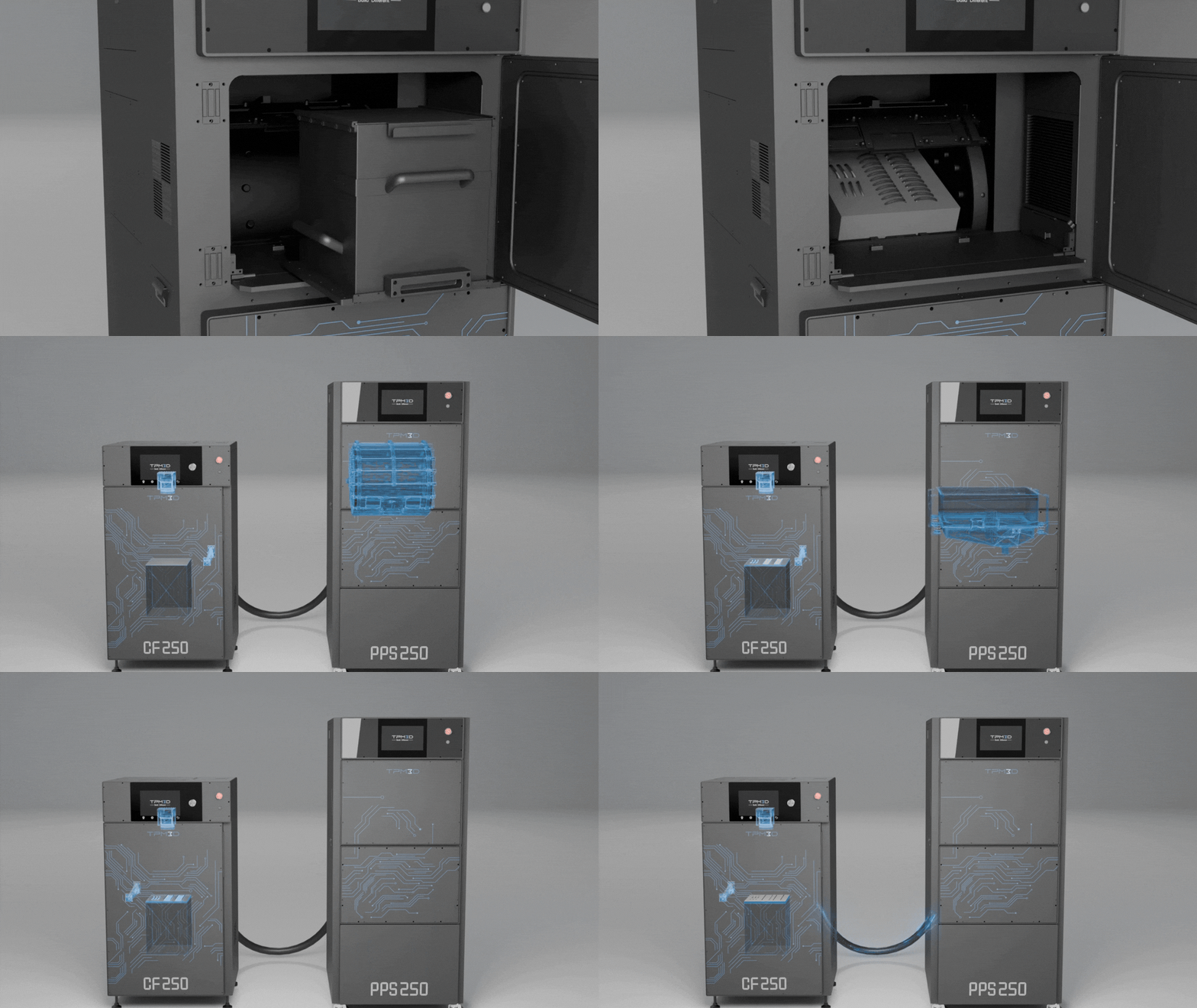
Compared with the Formlabs Fuse Sift, which integrates powder recovery, sieving, and mixing into a single workstation, the PPS250 takes a different approach to workflow automation. It combines automated depowdering, powder sieving, mixing, and enclosed powder feeding to the printer, reducing the need for manual powder handling between processing stages. This integrated workflow is particularly valuable for users seeking to streamline day-to-day SLS operations or scale up production with multiple printers.
Along with its compact footprint and PPS250 automated powder processing station, TPM3D’s CF250 has several other excellent features. There’s its 30W fiber laser with F-θ field lens focus, 10-15mm/h print speed, 20-40% powder refresh rate, and powder recoating roller. The printer achieves a standard 0.1 mm layer thickness, and supports domestic 220 V operation, so it’s easy to plug in and start printing. It supports qualified PA12 and PA12 glass-filled materials, with PA11, TPU and additional engineering materials currently undergoing qualification.
So whatever your manufacturing environment, whether it’s a service bureau, smaller engineering team, or research institution, TPM3D’s compact CF250+PPS250 solution has plenty of practical value to offer. It offers space efficiency, excellent production capacity, and plenty of workflow automation, no matter if you want to expand your existing professional SLS production or finally bring the technology in-house for the first time. The printer and its dedicated powder processing station would be perfect for applications like customized products, small-batch manufacturing, functional prototyping, or engineering components.
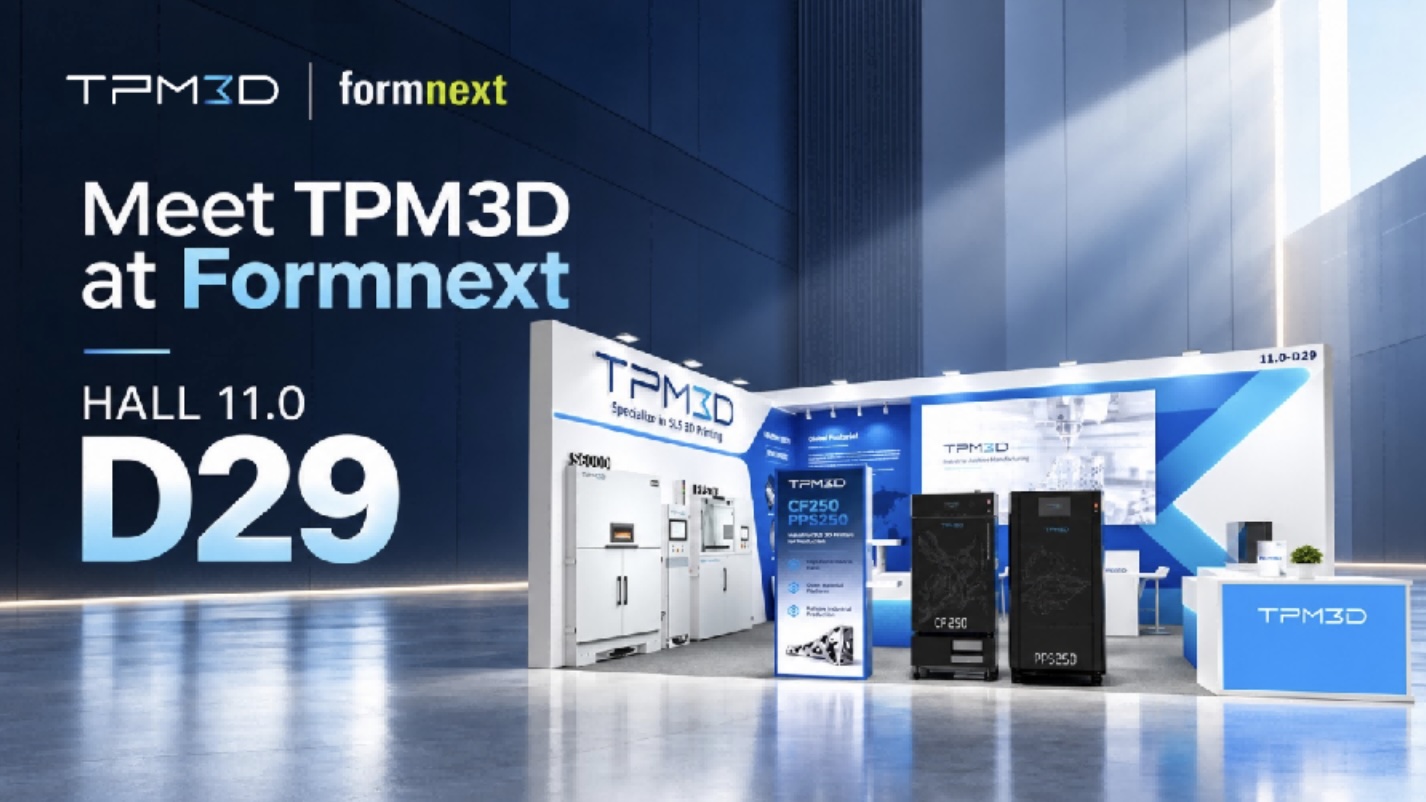
Meet TPM3D at Formnext 2026
At Formnext 2026 this week, visit TPM3D at Booth D29, Hall 11.0. You’ll get to see the CF250+PPS250 system for yourself, and discuss potential polymer SLS applications with the team. TPM3D will be showcasing a range of applications for different industries at the booth, so you can examine 3D printed parts and production samples, and talk about your own production requirements, and how TPM3D can help you meet your goals.