

The additive manufacturing market may be growing again, but one of the more interesting numbers behind that recovery has little to do with selling 3D printers. AM services generated nearly $2.50 billion in revenue during the second quarter of 2026, up from $2.19 billion a year earlier, according to the latest data from Additive Manufacturing Research (AM Research). That puts services at more than half of the industry’s total $4.48 billion quarterly market.
The figures come from AM Research’s new Q2 2026 3DP/AM Market Data and Forecast for the metal and polymer AM markets, along with its accompanying 3DP/AM Market Insights: Q2 2026 report. The firm’s quarterly data tracks the industry by vendor, print technology, geography and application, while the Market Insights report provides additional analysis and commentary on the results.
We recently discussed other numbers from the same dataset, which showed the overall 3D printing market growing 12% year over year and reaching its sixth consecutive quarter of expansion. But beneath that broader recovery, the services business offers another view of where money is actually being generated across additive manufacturing.
In Q2, the metal AM market totaled $1.81 billion, compared with $1.59 billion during the same period last year. Polymer AM reached $2.68 billion, up from $2.42 billion. Combined AM services, meanwhile, climbed to $2.50 billion from $2.19 billion. Services grew about 14% from a year ago, slightly more than the overall AM market, which grew 12%.
The numbers also show how important services have become to the AM market. In fact, not all companies need to own industrial 3D printers to use the technology. Instead, they can outsource production to service providers, avoiding the cost of buying equipment and building their own AM operations. That could become more important as companies remain cautious about capital spending.
In the Market Insights report, AM Research Executive Vice President Scott Dunham said the first half of 2026 had brought “robust growth for many as forecasted,” while attracting some capital back into the sector. But he also pointed to the possibility that growth could stall as capital expenditures come under pressure from interest rates.

For the AM industry, this creates an interesting situation. Higher borrowing costs can make it harder for companies to justify buying new industrial equipment, but that doesn’t mean demand for AM goes away. Companies can still buy printed parts or use outside suppliers instead of bringing the technology in-house.
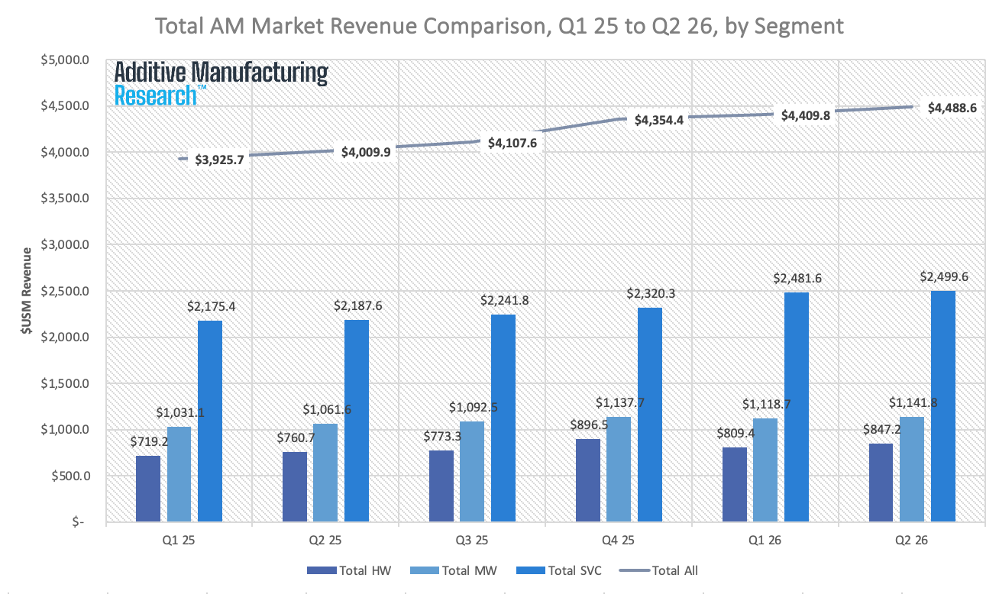
AM Research’s quarterly chart puts services revenue at roughly $2.18 billion in Q1 2025. It increased to about $2.19 billion in Q2, $2.24 billion in Q3 and $2.32 billion in Q4 before jumping to roughly $2.48 billion in the first quarter of 2026 and almost $2.50 billion in Q2. That means services have added more than $300 million in quarterly revenue in roughly a year and a half.
Hardware has grown as well, although at a different pace. According to the same chart, total hardware revenue rose from about $719 million in Q1 2025 to $847 million in Q2 2026, while materials increased from roughly $1.03 billion to $1.14 billion. The data shows how much of the AM market now comes from outside printer sales.
Of course, hardware remains critical. After all, every service bureau and contract manufacturer depends on machines, materials, and software. But a $2.5 billion quarterly services market shows how much of the industry’s business now comes from actually using those systems to manufacture parts. As well as the growing importance of applications. In fact, AM Research has been tracking applications separately and thoroughly. Its latest applications report looks at the production volumes and market value of metal and polymer 3D printed parts across industries, from prototypes and tooling to end-use production parts.
This could become even more important as AM moves further into production. Instead of investing in their own equipment, manufacturers can turn to service providers to produce the parts they need.
AM Research’s Core Metals and Core Polymers datasets include nearly a decade of quarterly historical data and 10-year forward forecasts, while its separate Market Insights report provides additional analysis and charting around the quarterly figures.