

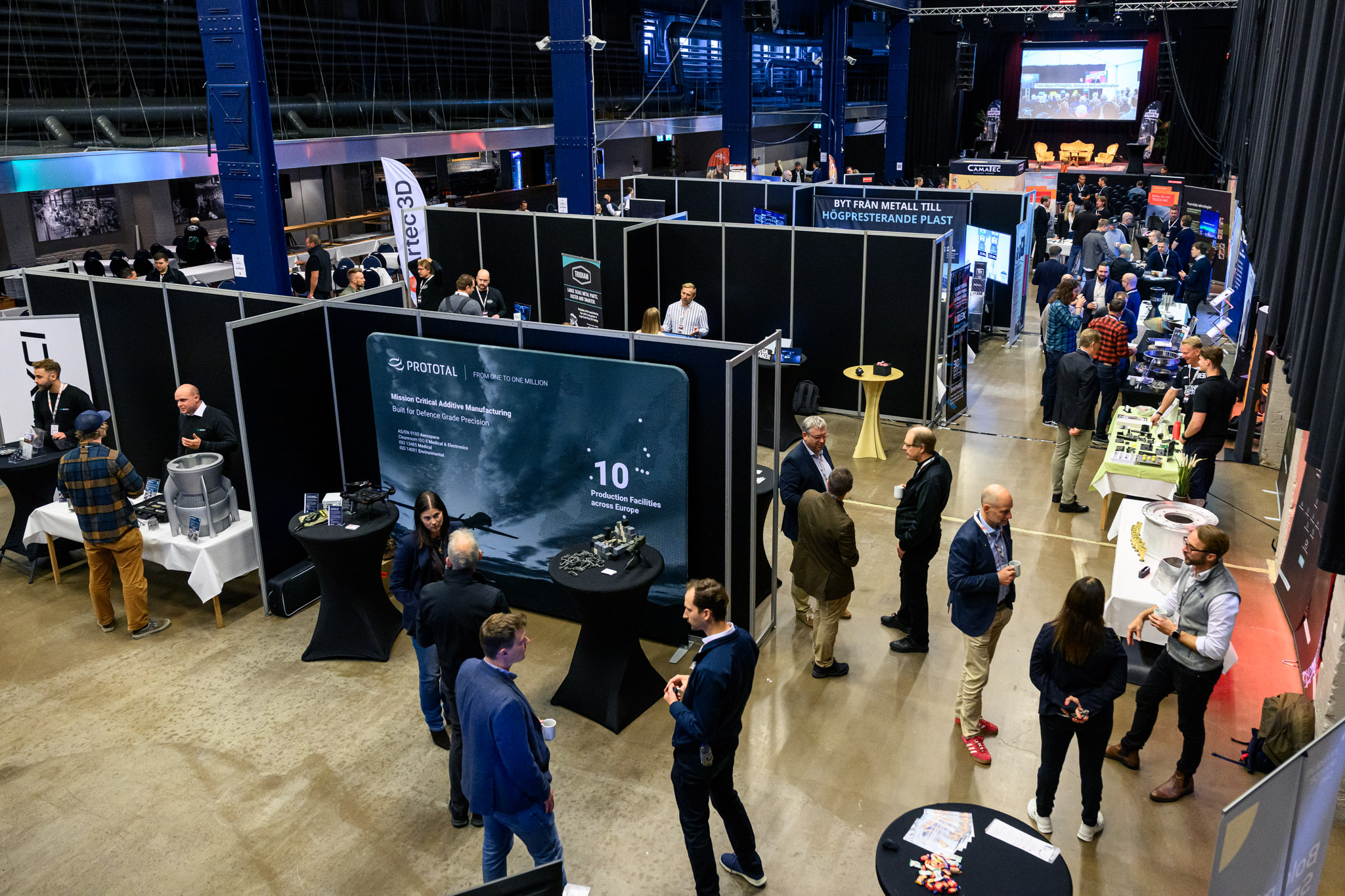
Technology develops in response to forces driving change. That was the starting point for a keynote I presented with Mikael Schuisky at AM Meetup 2026, held in Karlstad, Sweden, on 16–17 September.
On Demand 2033, a Swedish initiative exploring how local, on-demand production of critical spare parts can strengthen industrial resilience, reduce supply-chain dependence, and support more sustainable production, organized the event.
We used the history of metal additive manufacturing to examine which industrial requirements shaped its development, then applied the same reasoning to the forces shaping PBF and DED today.
Rapid prototyping emerged during the 1980s and began to industrialize in the 1990s. Its first clear value was speed: engineers could move from a digital design to a physical model without waiting for tooling. The technology shortened product-development cycles and made design iteration faster and less expensive.
The introduction of metals expanded the technology’s scope. During the early 2000s, improvements in machines, materials, and process control allowed aerospace, medical, and other high-value industries to investigate AM for end-use production. The strongest applications emerged where geometry improved function, expensive material could be used more efficiently, or conventional manufacturing imposed substantial design and production constraints.
Other developments expanded what AM could do. Cheaper electronics, increasing computational power, and wider access to CAD improved machine control, design, and workflow. Across the wider 3D printing industry, open-source development and patent expirations widened access and accelerated experimentation. Lasers, beam control, process monitoring, simulation, and generative design continued to advance.
Metal AM gradually became a viable production route for selected high-value applications. Adoption remained concentrated where the complete industrial case justified the additional process complexity, qualification effort, and cost.
This development took place during an era dominated by global cost optimization. Companies specialized, outsourced, and built long international supply chains because the model reduced cost and provided access to capable suppliers. Metal AM had to compete with casting, forging, and machining routes that benefited from global scale and deeply established supply networks.
That industrial context is changing. The shift from Western dominance towards a more multipolar world is reshaping geopolitics and the requirements placed on manufacturing. Defense readiness, technological sovereignty, regional supply, access to critical materials, and the ability to recover from disruption now influence decisions once dominated by unit cost. China has moved from being primarily a source of lower-cost production to becoming a major supplier and developer of industrial technology. Compute capability is expanding rapidly, capital has become more selective, and industrial customers increasingly expect qualified production routes.
These forces change the problems industry is prepared to pay to solve. Metal AM adoption occurs when an industrial requirement aligns with what the process can do particularly well: porous structures in medical implants, integrated cooling in tooling and propulsion, weight reduction in aerospace, or material-efficient production in expensive alloys.
The requirements are now changing again. The question for the next decade is how PBF and DED will develop in response to a world that values cost, lead time, control, resilience, and regional capacity differently.

Market growth and supplier consolidation
Metal AM is growing while parts of its supplier base are correcting.
Demand continues to expand in aerospace, space, medical, defense, energy, and selected consumer applications. Apple’s move to 3D print all titanium cases for Apple Watch Ultra 3 and the titanium version of Series 11 is a useful recent signal that metal AM can compete in consumer production. The importance is the combination of scale, recycled titanium powder, cosmetic quality, and a complete production system. Apple says the new route uses half the raw material of the previous manufacturing process and will save more than 400 tonnes of titanium in 2025. This is an example of a particular product, company, and supply chain making metal AM economics work at consumer volumes. Recent announcements indicate that Apple is extending its use of metal AM to the hinge for the new foldable iPhone.


Apple iPhone Duo. Image courtesy of Apple.
At the same time, machine manufacturers and service providers have faced insolvencies, restructurings, ownership changes, and margin pressure. The investment assumptions behind parts of the previous expansion were sometimes too optimistic. Capacity was added ahead of stable demand, general-purpose machine propositions proliferated, and technical progress was sometimes presented as evidence of equally rapid commercial traction.
The supplier correction reflects a shift in where value accumulates. Selling machine capacity without owning an application, a qualified process, or a difficult part of the production route is becoming harder.
The market is becoming larger and less forgiving.
Supply-chain risk changes the case for local production
The supply chains built during the period of global cost optimization were efficient under relatively stable conditions. COVID-19, the war in Ukraine, energy volatility, export controls, and growing competition between the United States and China exposed the consequences of concentrated capacity and long dependencies. NATO’s defense production plans now focus explicitly on industrial capacity, production growth, interoperability, and resilient supply. The European Union’s Critical Raw Materials Act is a parallel response to dependence in materials needed for aerospace, defense, digital technology and the energy transition.
For metal AM, this changes the basis for justifying an application. A component produced locally at a higher unit cost may still be attractive if it removes a nine-month lead time, replaces an unavailable forging, restores a critical asset or avoids dependence on a single external source. Defense makes this logic visible because availability and readiness have measurable operational value. The same reasoning applies, with different urgency, to energy, maritime, rail and other industries operating long-lived equipment. Defense increasingly draws on technology developed in faster civilian markets. Testing access, security, qualification and procurement determine how quickly that technology becomes operational.


One of the labs at 6K’s headquarters in Massachusetts. Image courtesy of 3DPrint.com/Vanesa Listek.
Distributed manufacturing will remain selective. Most parts should continue to be made by established methods and established supply chains. AM becomes relevant where the geometry, material, volume, lead time, tooling situation, and qualification route make local or regional production credible. Digital production still requires material, equipment, process knowledge, inspection, approval, and skilled people.
Industrial sovereignty depends on competitiveness, not isolation. Resilience comes from optionality: competitive regional capacity, trusted partners, and alternative supply and production routes.
On Demand 2033 describes this as a shift from storing parts to storing the verified information and production capability needed to make them. A digital inventory requires far more than CAD files: material and process data, quality records, traceability, permissions and an approved production route.
In another presentation at AM Meetup 2026, Per Öster of the Swedish Armed Forces described AM as a tool to replace, repair and rebuild, while stressing that deployed microfactories depend on an established industrial base, qualified technical data packages and secure digital infrastructure.
The likely result is a more regional industrial structure, with overlapping ecosystems in China, North America and Europe. Equipment, software, materials, standards and data requirements may increasingly reflect those priorities. Metal AM may divide into several connected markets with different strengths, cost structures and definitions of strategic value.
China is changing scale, architecture and price
China’s influence on metal AM is still too often reduced to lower machine prices. Price is part of the pressure, but more important factors include supplier density, domestic demand, rapid hardware iteration, access to capital, powder capacity, and the ability to develop several product variants from a common platform.
Chinese suppliers are pushing large build volumes, high laser counts, and aggressive price-performance ratios in laser powder bed fusion. Not every specification translates into stable production, and more lasers are not a substitute for calibration, gas flow, thermal control, process consistency, or qualification. Even so, direction matters, and several leading Chinese suppliers already deliver high-quality equipment. China is testing how quickly PBF platforms can be scaled and how much machine cost can be removed. That will affect customer expectations well beyond China.

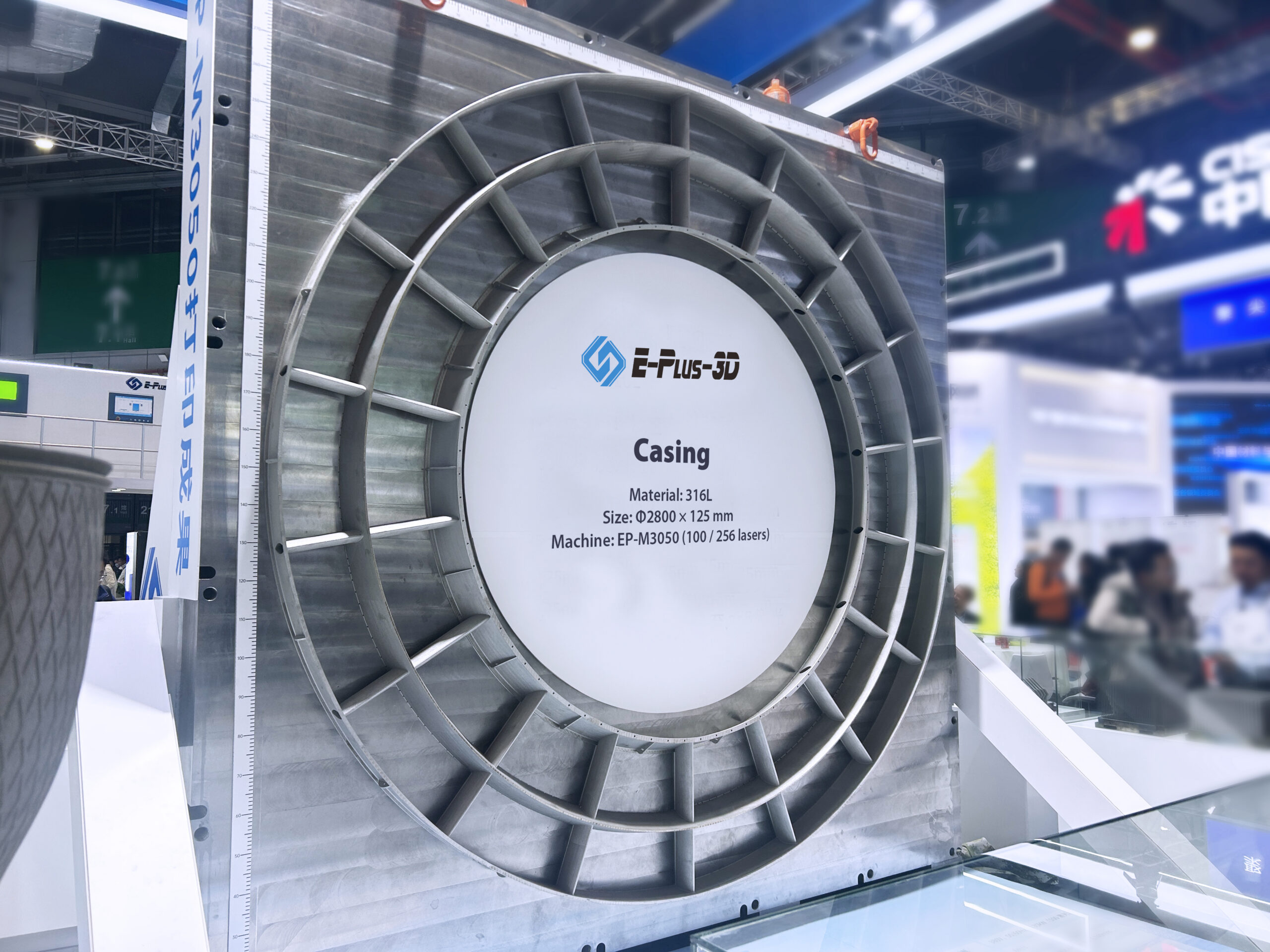
A 2.8-meter casing printed by EP-M3050. Image courtesy of Eplus3D.
Europe and the United States retain strong positions in regulated applications, process knowledge, materials, software, qualification, and installed industrial relationships. Those are substantial advantages, although they should not be treated as permanent protection from competition. Chinese equipment and process capability will improve; some platforms will remain primarily domestic, while others will move into international markets.
We expect PBF to split into more distinct, application-specific races. China is likely to drive scale, hardware iteration and cost. Europe and the United States are likely to place greater emphasis on control, qualification, specialized materials and trusted production. The division will never be absolute, but it provides a more useful view of the competitive direction than a single global machine ranking.
These forces are not only reshaping the metal AM market. They are also changing the technologies themselves. In Part 2, I look at what this means for PBF and DED, materials development, compute, and the path to 2035.
About the Author:


Ulf Lindhe. Image courtesy of The Org.
Ulf Lindhe is a veteran executive in the additive manufacturing industry with decades of experience spanning technology development, industrial strategy, and global market expansion. He has held senior leadership roles within the metal additive manufacturing sector, contributing to the commercialization and international growth of advanced AM systems. Throughout his career, Lindhe has worked closely with aerospace, medical, and high-performance engineering companies, helping bridge the gap between technological capability and practical industrial deployment.
Images courtesy of Solstafoto/On Demand 2033, unless otherwise noted