
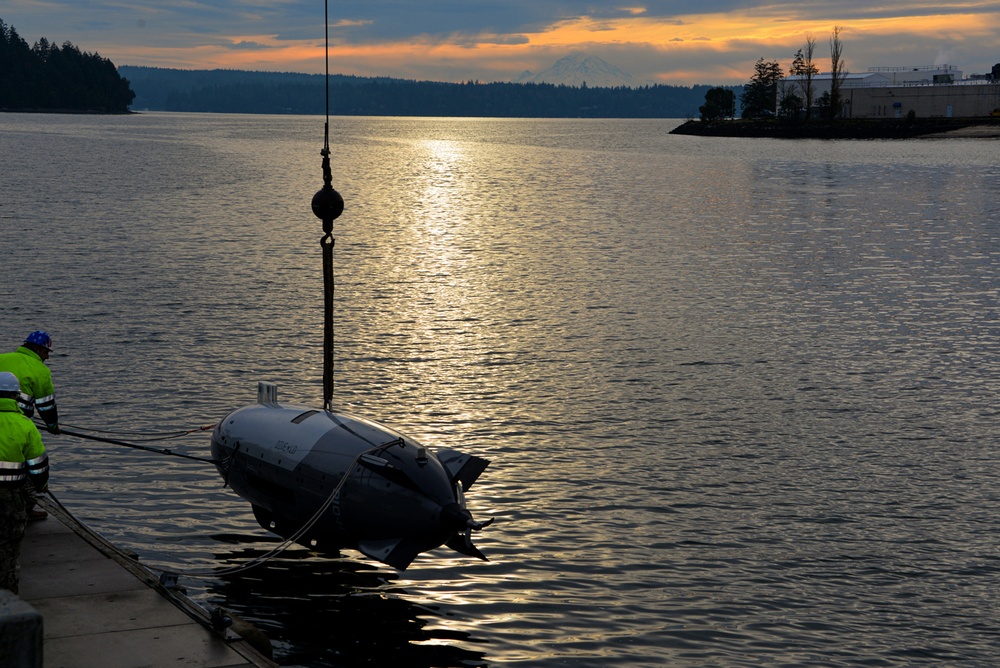
The US says that the drone malfunctioned and that it “was essentially dead in the water for more than a day.” The Navy also clarified that it was an older model. Perhaps it’s the prototype or something? Because since the first Dive entered service in 2025, I wouldn’t call them old necessarily. Classed as a Large Diameter Autonomous Undersea Vehicle (LD-AUV), the unit costs around $2.5 million dry, but whatever sensor package you add will change that amount. It weighs around three tonnes and can sail at up to 7 knots. The drone is highly modular so that it can be reconfigured, refitted, or changed easily. Its main purpose is long exploration and survey missions. If you follow this link, you can see some red markings that may have come from the sub being hit by a boat and leaving behind its antifouling paint. Military ships use grey or black antifouling; dhows tend not to use it, and most of the Iranian Navy is CFRP or aluminum, so I’m guessing it’s from an oil tanker. Also, do note the conformal antenna array (I’m guessing), which looks super 3D printed.

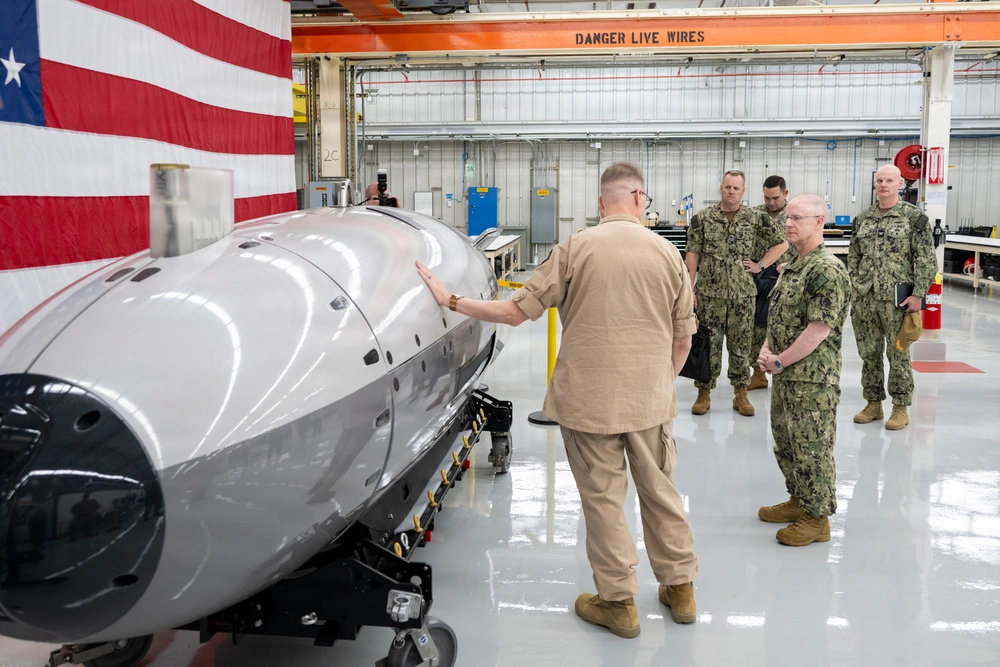
Adm. Daryl Caudle tours Unmanned Undersea Vehicles Group One at Naval Base Kitsap-Keyport, Washington. Image courtesy of US Navy/ John Bellino.
The drone’s depth and endurance make it ideal for mapping the seafloor, listening for ships, or checking undersea cables. The internet and other undersea infrastructure face frequent interference from sabotage and eavesdropping, and the Dive LD is ideal for combating this or patrolling long stretches of water. Operated by Unmanned Undersea Vehicle Group 1 (UUVGRU-1) or its unit Undersea Vehicle Squadron 3 (UUVRON-3), these drones were made under Replicator. Anduril should be able to make 200 to 300 of them a year.
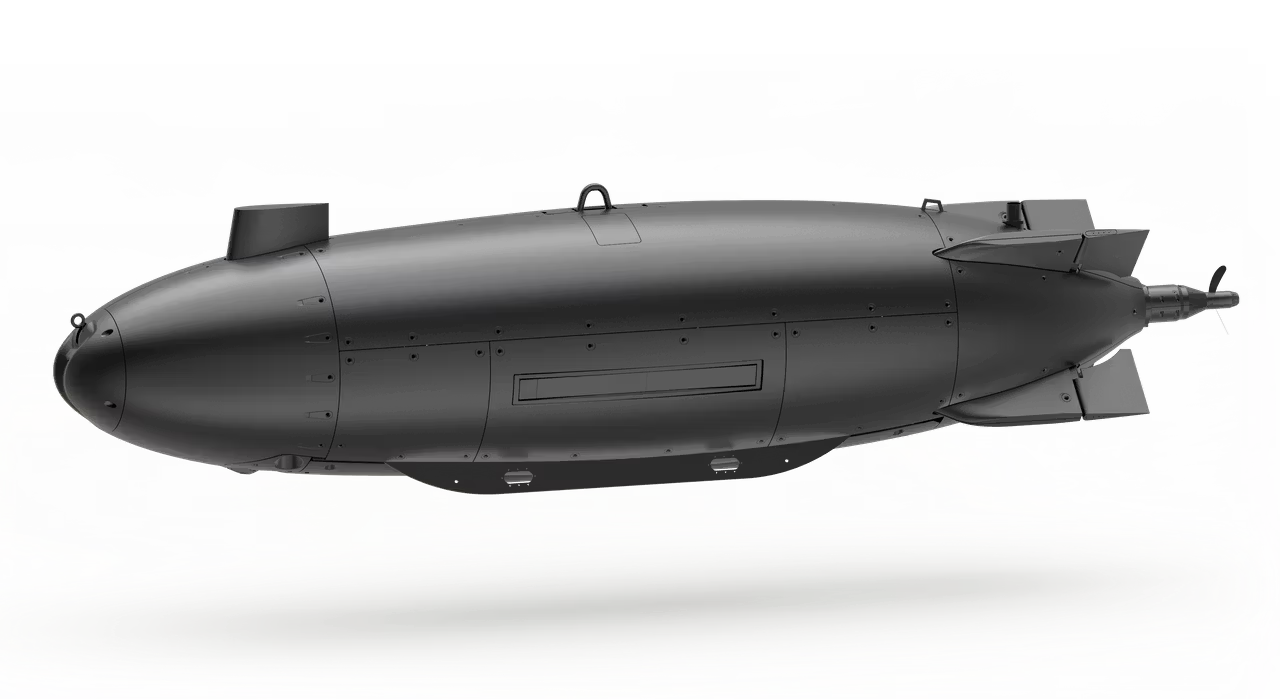
Part of the drone’s novelty is that, rather than using a heavy, expensive, long-to-make pressure hull, it floods its hull. Its free-flooding hull takes on water until pressure equalizes. This is the secret behind its deep-diving capability. It also makes it quick and relatively inexpensive to build. Using 3D printing for the pressure hull and interior components makes production scalable. With much less material, casting time is probably the biggest thing you’re saving here. In a war scenario, you could make loads of these, thousands of them, by just expanding 3D printing capacity. This would be much harder with conventional hulled submarines.
Oak Ridge National Laboratory (ORNL) explored making sub hulls, drone boats, and drones with Big Area Additive Manufacturing (BAAM). We assume the machine used to make this is a Cincinnati BAAM. The technology is ideally suited for this kind of application. The hull does not need to be strong. Only the pressurized parts housing key electronics need to be strong. This helps keep costs low. In a technical report released in 2024, ORNL tested ABS PC, TPU, and TPU ABS GF blends, coating them with XTC-3D resin and epoxy for Anduril submarine panels. They also used Kevlar and other sheet materials. AES, the leading large-format 3D printing service in the US, printed these panels, and they were tested to 9000 PSI. AES has made parts for Anduril, but we don’t know if the company took BAAM in-house subsequently. And Anduril also uses Thermwood’s LSAM systems. So it could be either one, really. These subs were made at Anduril’s Quonset Point facility in Rhode Island, but I can’t seem to figure out if the hulls were made in-house and on which system.
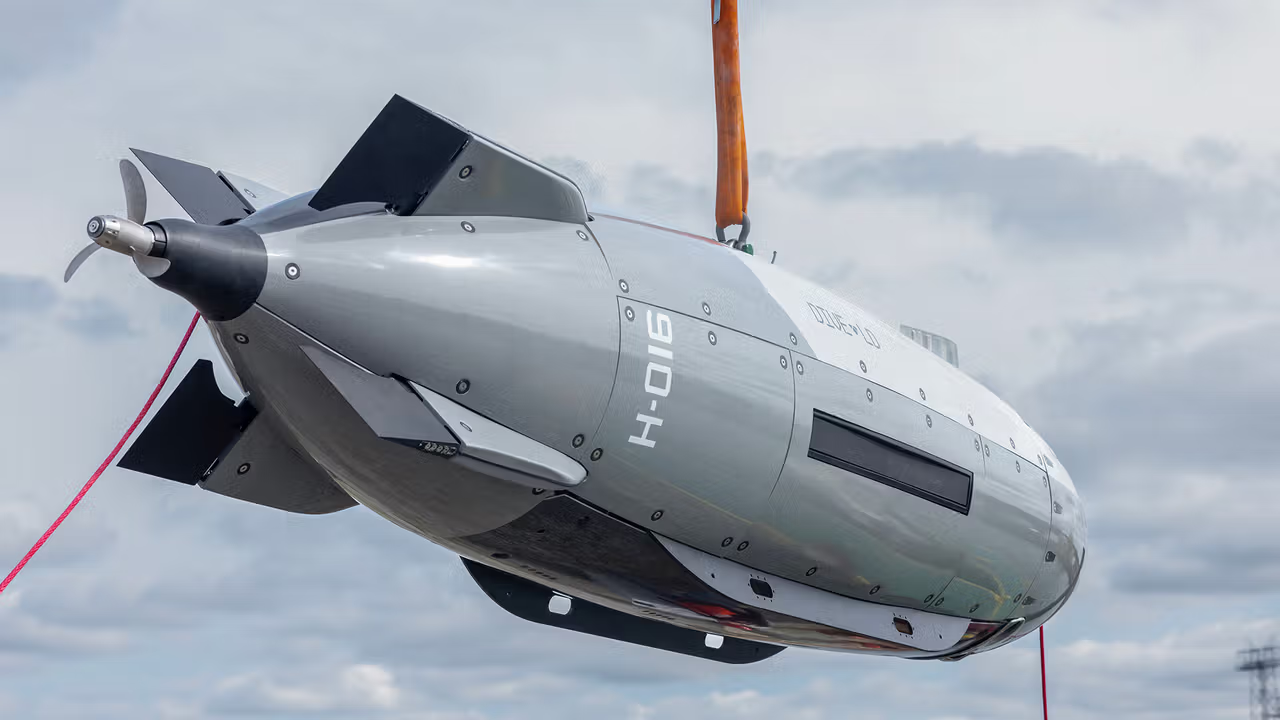
If you’re curious where the smartest Chinese naval engineers will be over the next few days, it will probably be near the Strait of Hormuz. The Chinese will be very curious about what material Anduril used, the concept of this sub, and how it holds up. China will want to know what fiber, polymers, and resins were used, to see if it can learn from that. China is making lots of underwater listening infrastructure close to Taiwan and contested islands. The country will be super curious what kind of adversary the US has in store for it. The Dive seems very suited to planting, spoofing, removing, and finding these kinds of listening devices. While China has made it a national priority to dominate in LPBF and material extrusion, the country has invested a bit less in DED and seemed positively aloof to the prospects of large-format additive manufacturing (LFAM). If we see a whole bunch of machine tool companies in China build large-format 3D Printing solutions in six months or so, we can conclude that Anduril is on to something.
Another thing the Chinese will definitely be curious about is Anduril’s autonomous capabilities, the hardware that enables them, and any comms. If the sub uses Anduril’s AI software, Lattice, they’ll want to know how. They will probably also want to figure out what noise and cavitation signatures it can recreate so these subs will be easier to track in the future. The Russians will probably also be interested, but the Ukrainian undersea loitering munitions and subs that it is dealing with are different and more lethal to its Navy at the moment. But they will want to scan and listen to it if possible, because it could indicate US missions in their area. If the sub were carrying a Copperhead torpedo, both parties would be very interested in exploring Anduril’s square torpedo/sensor platform.
Are any secrets up for grabs here? This is meant to be an attritable vehicle, so I don’t think so. The US has been making Iran-specific drones since the 90s. These aerial vehicles were often nerfed so that they didn’t have the latest and greatest technologies on board. This was specifically done because, at the time, Iran had air defenses, and these drones would have to make low passes to inspect nuclear sites, making the chances of them getting shot down very high. Likewise, in the crowded Strait of Hormuz, it was expected that the US would eventually lose one of these. So I’m pretty sure this isn’t the cutting edge, and that they’ve made the connections to the AI and autonomous software degrade or be erased. Let’s hope that someone didn’t put some super cutting-edge payload in it.
LFAM is ideally suited to mass-producing submarine hulls. And the Iran conflict has shown the US that it needs a hell of a lot of drone boats and torpedoes as well. So we will see a further industrialization of large-format additive manufacturing for hulls in the coming months. Additive is becoming absolutely essential for warfare. Through 3D printing, many production roadblocks to a mass-autonomy future are being eliminated. Also, have you balked at buying an LFAM system because of its high cost? No worries, I have a feeling that they’re about to become a hell of a lot cheaper.