
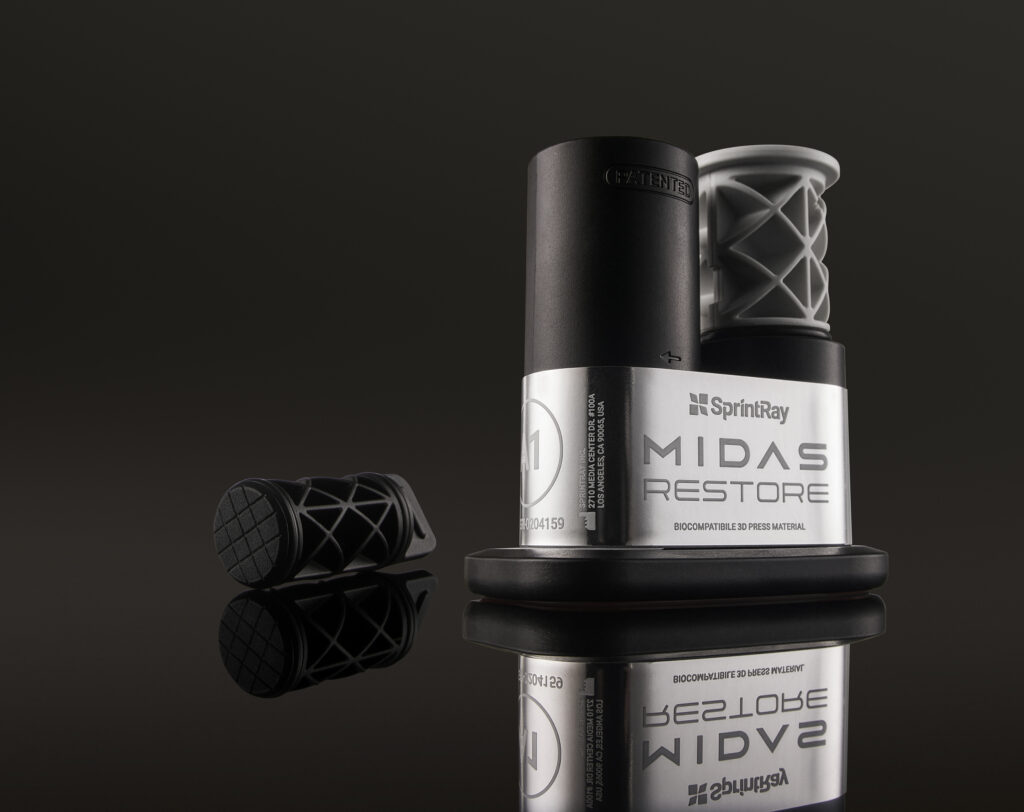
“Traditional dental 3D printing forces a compromise: the material has to be fluid enough to print, which limits how highly filled it can be. Midas Restore was designed in our material science lab to address that limitation. By pairing a highly filled glass ceramic and zirconia formulation with Midas Digital Press, we can give clinicians access to a new class of definitive restorative materials and bring them into an efficient same-visit workflow.”
“We engineered Midas Restore around how a restoration actually behaves once it is bonded to a tooth, not around a single strength number. Filler content, polish retention, wear resistance, modulus and optics are not separate features. They are one system, and the tooth is part of it.”

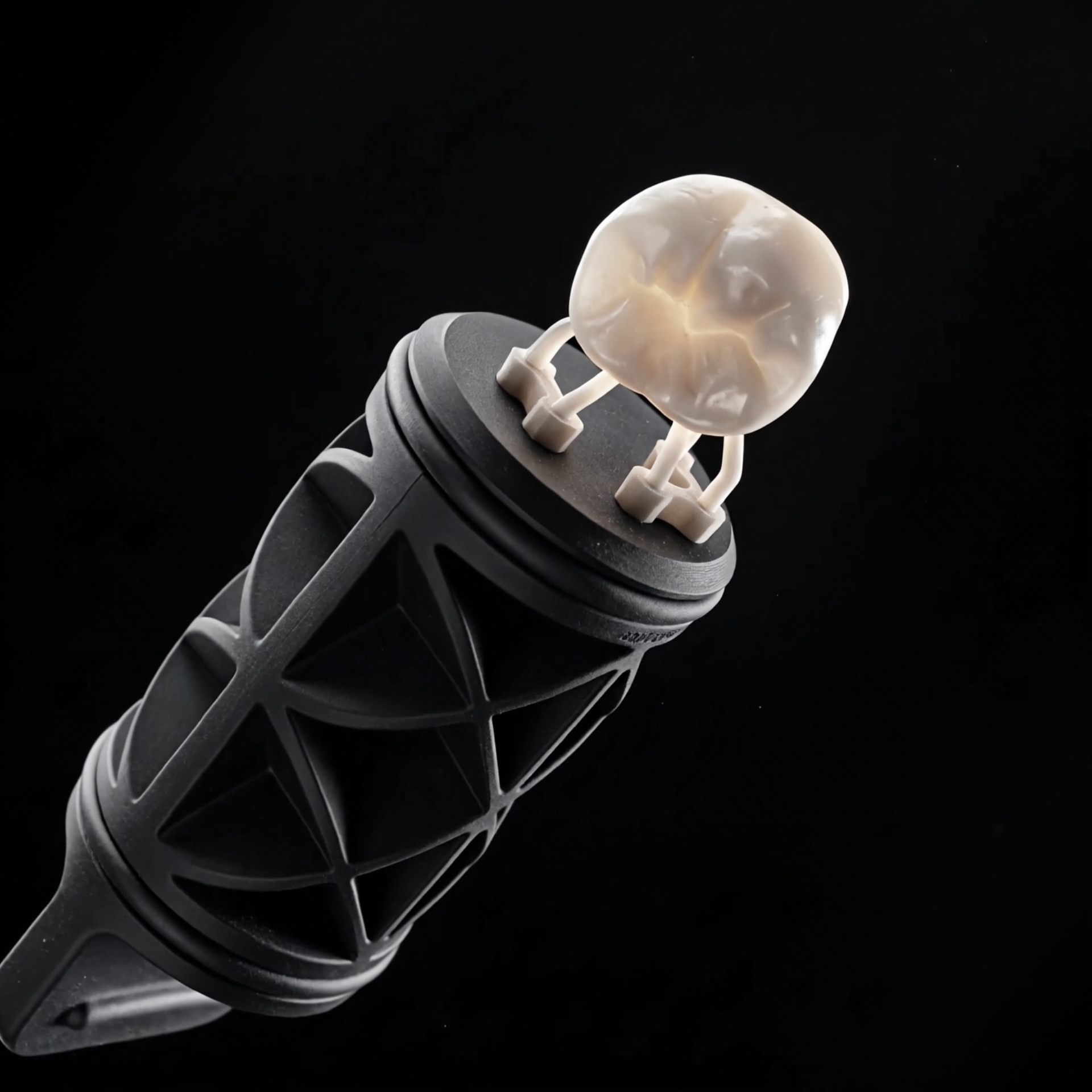
Midas Restore was designed around how a definitive restoration polishes, wears, flexes, and functions once adhesively bonded to remaining tooth structure. Image courtesy of SprintRay.
Midas Restore has been designed to be crack-propagation-resistant, so that, once adhesively bonded to the remaining tooth structure, the restoration becomes part of a system in which the material and tooth distribute function together, rather than concentrating stress at the interface.
I really love SprintRay in that it focuses so much on the dentist and her practice, her day-to-day, and her patients. That way we can really get tools made that perfectly fit dental workflows and practices. That kind of focus, to me, is what makes SprintRay excel.
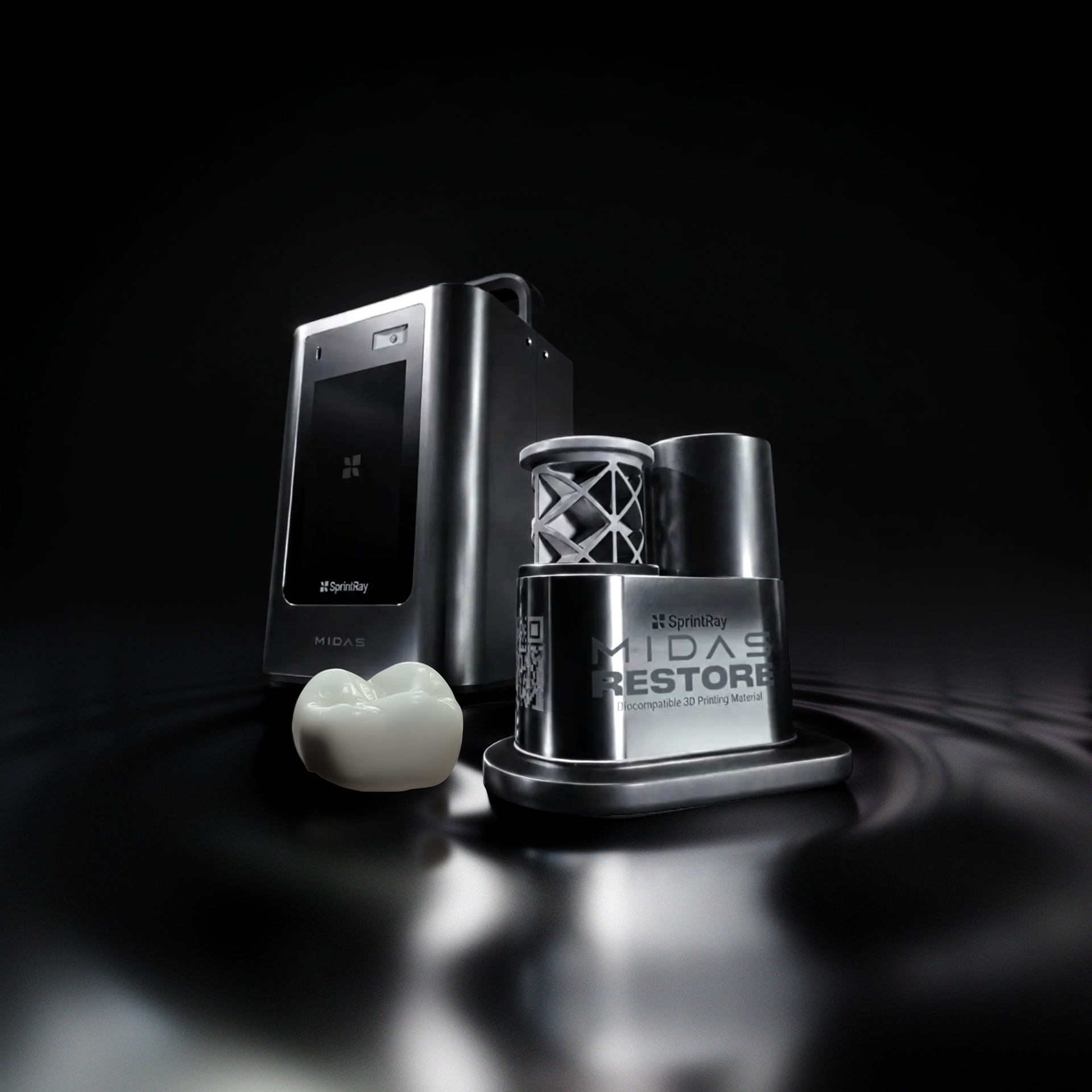
Midas Restore combines glass ceramic and zirconia. Image courtesy of SprintRay.
Tailor-made resins, workflows, and machines for particular people and particular tasks are, for me, an essential way forward. Yes, there will be room for the Philips Head screwdrivers of this world that target broad part families and customer groups. But if you want to build up a defensible market position, then getting to know a particular customer and part is a better approach for more people. More specific solutions, more differentiation, and more de-risking are key.
Now, of course, if I make a printer for everyone, then I can spread out the cost over many more machines and may be able to outcompete you. But if I tweak all the parts of my smaller solution more precisely, I may be able to take on a market better than you can. This doesn’t mean your company needs to stay small. I’m low-key obsessed with Transsion, a company not many have ever heard of. Transsion has $9 billion in mobile phone revenue but focuses on phones for Africa and other emerging economies. By making it better suited to a specific set of circumstances, it has fallen out of the limelight. Too often, people want to outdo Samsung, while for far less money you may just need a better phone for one region or one type of customer. In this case, the Midas comes in capsules, which allow formulation of different, more viscous materials and make the material-loading process less error-prone and easier.
The company says that its parts “retained 98% of their initial gloss after 5,000 simulated toothbrush abrasion cycles…and delivered five times the wear resistance of SprintRay Ceramic Crown over 200,000 cycles.” Now, I don’t have any idea what that means. I only hope there is some kind of automated toothbrush abrasion-cycle machine, because that sounds like it could be tedious.
The company also says that, “In biaxial flexural testing, Midas Restore reached a maximum strength of 215 MPa, the highest of any SprintRay definitive restorative material. The surface hardness was measured to be greater than 80 HV, statistically equivalent to a leading nanofilled direct composite and roughly double that of previous-generation printed restorative resins. Its translucency parameter of 13.5 places it in the same range as milled lithium disilicate HT.” Now again, some of those words I know, but others I’ve never heard of.