
When he showed up on Google Meet for our interview, I could see that Philip Pounds, co-founder of Unlayered 3D, was seated shotgun in a moving car. I wasn’t sure who was driving, but barely a minute later I heard a voice off-screen, at which point Philip tilted his phone to his left:
“I won’t look at the camera for obvious reasons,” said Alex Stedman, the company’s other co-founder, staring straight ahead, “but I originally got into 3D printing because I wanted to make robotics parts in low volumes.”
I started the interview with the cliche question, ‘How did you originally get into 3D printing?’, which I generally try to avoid. In this case though, I was genuinely curious, because Pounds and Stedman are both so young, having just graduated from Rose-Hulman Institute of Technology in Indiana, and Stedman in fact had just turned 22 the day before our interview. Pounds, by the way, initially learned about 3D printing at his school’s makerspace, and bought his first printer for himself to make go-kart parts.
Stedman and Pounds were roommates in their junior and senior years at Rose-Hulman, establishing their startup only last year, in the apartment they shared. By this year, they’d built a pilot unit, which they exhibited at RAPID 2026 in Boston, less than two months before their college graduation. Very soon, they’ll be moving to San Francisco as they look towards their full launch. It’s a lot to take on so early in their lives, and this was the primary reason I’d wanted to talk to the co-founders. But as it turns out, Unlayered 3D would be an interesting company no matter who founded it.

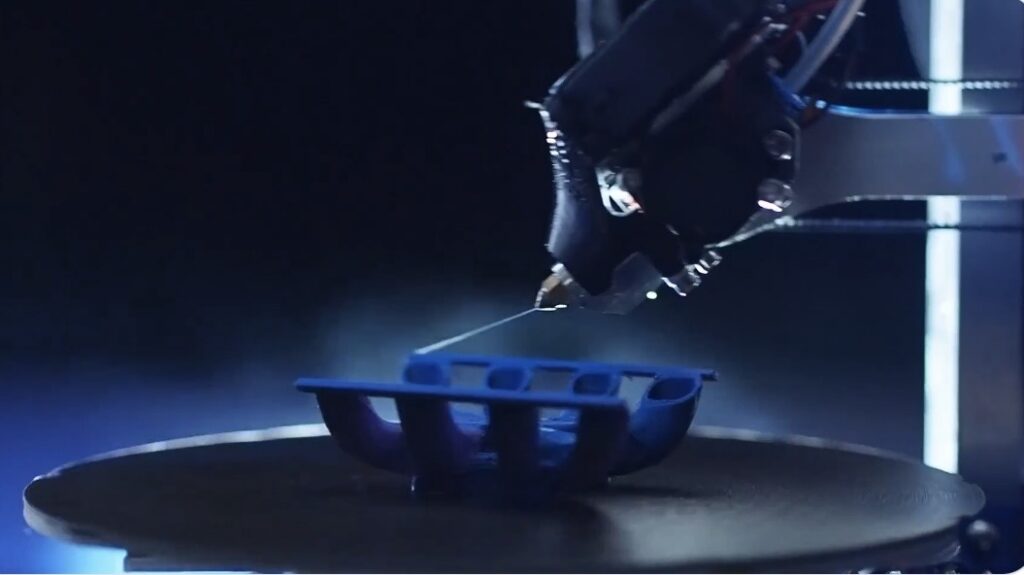
The straightforward differentiator is that it’s a five-axis desktop machine, and while their system may not be the very first on the market, five-axis desktop printers are certainly still rare. Aside from the most touted advantage of being able to print without supports, users can also print stronger parts, cleaner surfaces, and conformal parts.
According to Unlayered 3D’s co-founders, there are so many potential advantages that they foresee five-axis as the point at which the whole desktop market will eventually converge:
“Once the software problem with five-axis slicing is solved, I don’t think there’s any reason why people would continue to use three-axis machines,” said Pounds.
Stedman immediately chimed in, “If you told someone six years ago that you could print nylon or carbon fiber at your desk, on a machine that cost a few hundred dollars and it wouldn’t be a janky build, no one would have believed you. But now that’s where the market is, and now engineers expect to have high-quality machines right at their fingertips.”
While it wouldn’t be quite right to call Unlayered 3D a campus spinout, since the technology was entirely created by the two students in their spare time, they both give Rose-Hulman ample credit for the innovation/entrepreneurial environment that it fosters, and they did get a small but indispensable amount of financial backing.
“We’re lucky because at our school, everything we made is ours,” noted Pounds. “Some schools will demand equity in the company in exchange for any support, or try to have some claim to your IP. Rose-Hulman just wants to see us succeed, and we’re very thankful for that.
“We’ve both always been a little more entrepreneurial, but at first we just wanted to make a 3D printer. Then once we saw it was viable we started to take the company aspect more seriously. Rose-Hulman actually has an angel investor fund, so we got a few thousand bucks last summer to keep developing it and gauge if there was a market for it.”
Rose-Hulman also gave the two students a professional development grant, which is what enabled them to make their first trip to RAPID. Although, as I said, Unlayered 3D is interesting enough in its own right, the whole “founded while in undergrad” angle is still a key point of their story, because I think we’ll see more and more American tech hardware companies emerge in this way in the near future. Pounds and Stedman both agreed that they see more engineers their age gravitating towards hardware, but as Stedman astutely pointed out to me, this is less of an emerging trend and more of a return to fundamentals.
“40 years ago, all engineering more or less revolved around hardware,” he said. “Everyone knew how to fix stuff. So I do think that’s happening again, and part of it is that the career opportunities aren’t so heavily skewed towards software as they have been in the recent past.
“There’s a lot less demand for software professionals, and at our school, at least, computer science enrollment has dropped. But you still need to be able to know how to code!”
With that in mind, they do see their integrated five-axis slicing software as a big differentiator that could set them apart from the rest of a market that’s sure to grow quickly. Meanwhile, given that this is just their second year in operation, they’re naturally still figuring out a lot of the details of their business model. However, they’re getting their cues from precisely the right place: early customer feedback.
That’s why continuously building updated versions of their machine is so important — they’re currently on the fifth iteration — as they learn new ways they can improve from every new user. There’s much to be determined, including how exactly they want to execute the commercial launch, what the specific price point will be for the first machines, and the exact portion of their machines that will be comprised of American-made parts. You get the impression nonetheless that they will figure out the right answers, and that it won’t take them very long.
Pounds and Stedman may be just getting started, but they clearly have many of the traits required to be successful founders, including multi-tasking, as our interview demonstrated to me in a variety of ways, not least of which was the reason why they were in the car in the first place:
“We’re on our way to go pick up a bunch of parts from one of our suppliers,” Pounds told me.
Images courtesy of Unlayered 3D