

Other than workforce development, materials qualification is perhaps the greatest existing barrier to the scale-up of metal additive manufacturing (AM). Moreover, improving access to data on metals qualified for the most widely used AM processes could help address both challenges: validating the underlying technical processes removes a meaningful portion of the risk associated with an enterprise taking on new staff dedicated to building its AM capabilities.
While there aren’t many firms out there with the credentials to lead a qualification campaign for AM metals, the ones that do have such credentials are rightly becoming more integral to the AM industry, at least in the US. Barnes Global Advisors (TBGA), for instance, has a track record this decade of taking on increasingly ambitious projects centered around broadening access to quality metal powders data, rolling each of its wins into even bigger subsequent opportunities.
Its latest opportunity is a contract from Bechtel Plant Machinery Inc. (BPMI) to build and manage a materials and process database for suppliers to the US Navy. A subsidiary of one of the world’s largest private corporations, BPMI has been a contractor for the US Naval Nuclear Propulsion Program almost since its inception. In recent years, the engineering and construction firm has helped the Navy’s AM buildup by managing the buildout of a dedicated metals facility in Florida, commissioned at the beginning of 2025.
TBGA’s work with BPMI involves tested coupons for Alloy 625 (Inconel) and 316L stainless steel, for both PBF and DED. Drawing from data submitted by suppliers and testing partners, TBGA will create a database eligible for public release, providing a pathway to faster metal AM adoption for US Navy suppliers.
In a press release about TBGA’s contract from BPMI to build and manage a materials database for suppliers of metal AM parts to the US Navy, Nathan Weiderspahn, BPMI Executive Manager for Industrial Base Management, said, “Consistent, high-quality design property data is essential to rapid application of AM within the maritime industrial base. This effort is an integral part of our digital manufacturing transition, accelerating delivery of additively manufactured components to the U.S. Navy.”
Meanwhile, Christina Kurth, Business Development Director of Advanced Manufacturing at The Barnes Global Advisors, said, “TBGA is proud to support the generation, analysis, and reporting of material property data that enables confident engineering use of [AM] across naval applications. We value the opportunity to be part of these efforts and to help advance [AM] where it can deliver meaningful impact.”

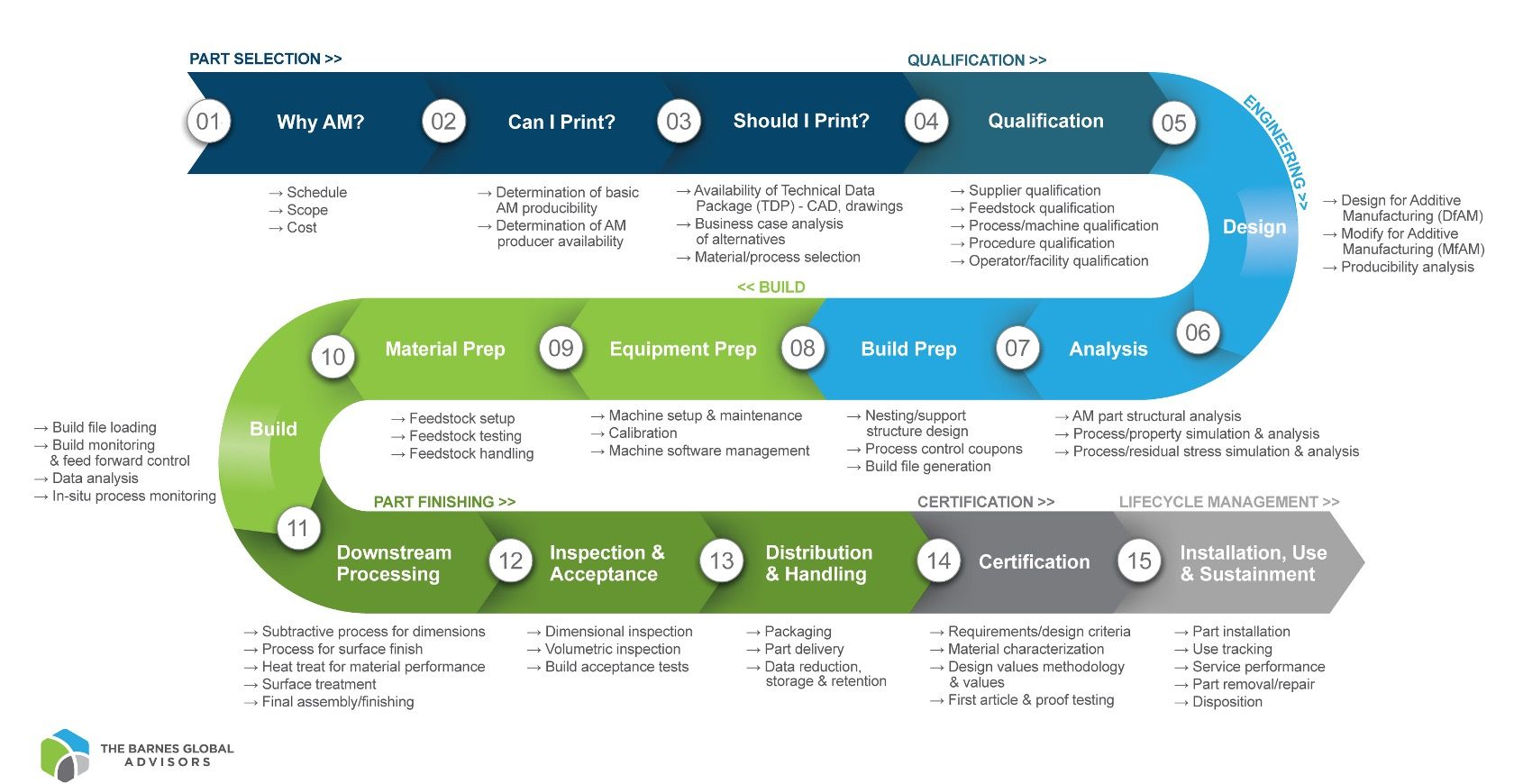
TBGA AM Qualification Value Chain. Image courtesy of TGBA
Earlier this year I wrote about the Digital SEA database that Austal USA has now stood up for the US Navy, which creates a central clearinghouse for sharing AM data across the Navy’s maritime industrial base. I would imagine that, if this project isn’t already related to Digital SEA, then it is destined to become so soon enough.
In any case, the US Navy’s metal AM digital ecosystem is now in place and has started growing. The key thing to pay attention to now is if/when/how suppliers to the other US military branches will be able to gain access to the same database, or at least get their own databases. I suppose it could make sense from a cybersecurity perspective to keep branch-specific databases separate, but I feel like the risk would be manageable.
If the Navy’s digital ecosystem does become the foundation for a larger, cross-branch platform, it would only add to the scalability potential that’s driving US defense contractor activity in this direction. Instead of the Navy being able to tap into the AM capacity of traditional US Navy suppliers, it would be able to benefit from the capacity of the suppliers to the Army, the Air Force, and all the other, more niche neighborhoods within the universe of US military contracting. Just as significantly, it would be a way to enable the Organic Industrial Base (OIB) to coordinate production across services.
Logically, that path seems to make the most sense, but US military contracting tradition would suggest that contractors will jealously guard their historic fiefdoms from all potential competitors. Whether or not that impulse can be overcome will tell us much about how serious the US military is about changing its acquisition culture.
Featured image courtesy of BPMI