
With verticals like defense/space and opportunities like the AI boom dominating so much of the current focus in the additive manufacturing (AM) industry, it’s easy to forget one of the original strategic sectors driving early AM adoption: medical. This is partially due to the fact that for applications like hearing aids and spinal implants, AM is so integral to the broader markets it’s a part of that it’s become less necessary to draw attention to the fundamental business case involved.
However, as the focus within AM for medical starts to shift towards applications that are relatively less mature — but no less intriguing — it seems likely that the medical sector could start to regain its traditional share of the AM industry’s attention span. CurifyLabs, the Finnish original equipment manufacturer (OEM) of pharmaceutical 3D printers, has just provided the industry with a good example along those lines, announcing that it has closed a $14 million Series A round.
Led by Norway-based VC firm Sandwater and Swedish investment fund HealthCap, the Series A financing will go towards a variety of objectives, including CurifyLabs’ expansion of its US operations based in Jacksonville, Florida. The company also plans to bolster its overall supply chain while enhancing both customer service and R&D.
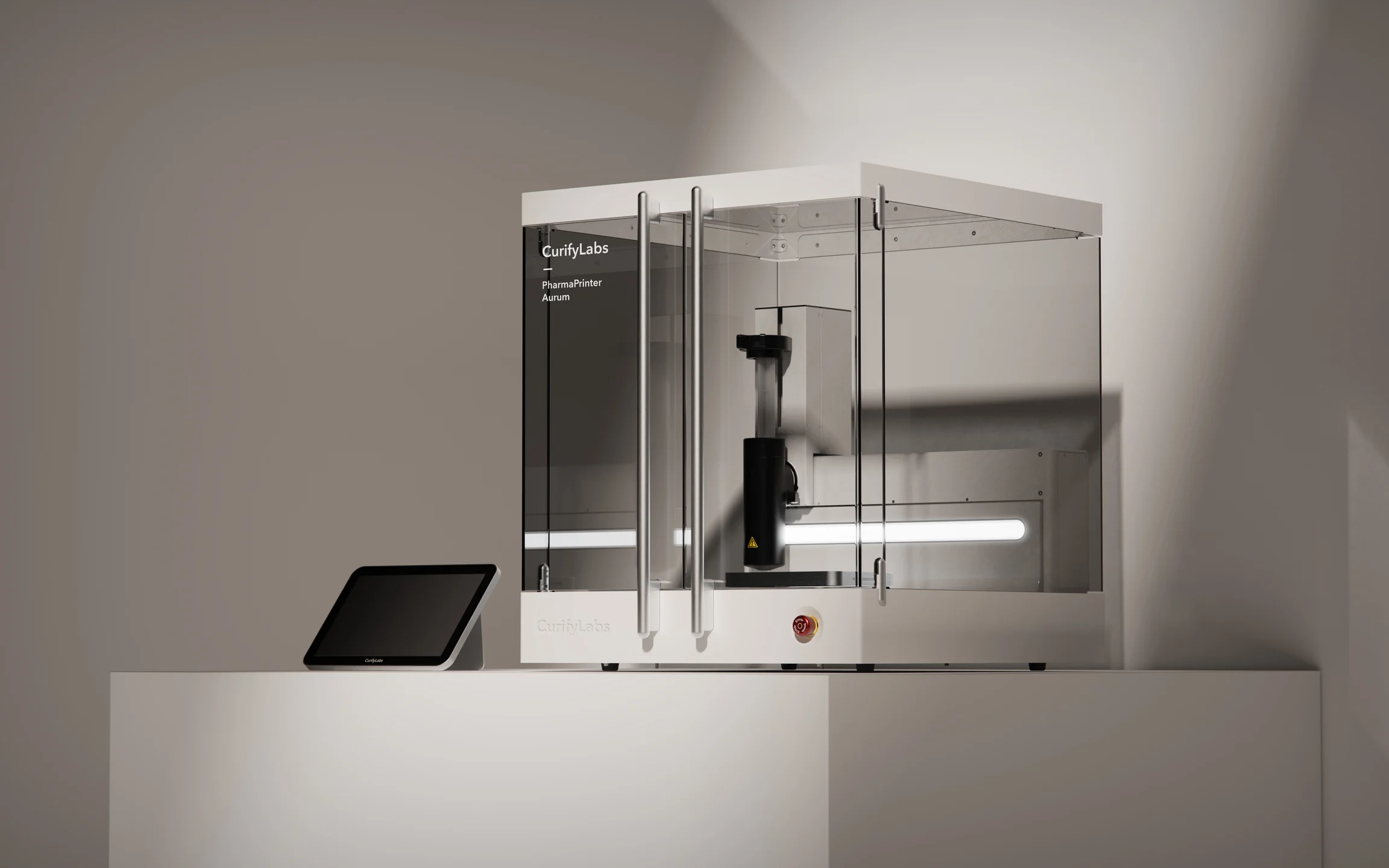
According to CurifyLabs, pharmacies in 21 states use the company’s 3D printers for drug compounding: producing customized doses tailored to specific patient needs. In addition to printers like the Aurum, CurifyLabs also makes the base ingredients required to print pharmaceuticals, and provides the relevant software for its manufacturing ecosystem.
In a press release about CurifyLabs’ $14 million Series A round, Morten E. Iversen, a partner at round leader Sandwater, said, “Personalized medicine is one of the most important frontiers in healthcare enabling better patient outcomes and is experiencing solid growth. We are enabling more pharmacies to deliver personalized medicine in a safer and more efficient way. CurifyLabs has built something rare — technology that combines clinical rigor with the speed and precision that busy pharmacy teams depend on. We are excited to support their rapid growth in the U.S. and beyond.”
Charlotta Topelius, the founder and CEO of CurifyLabs, said, “”This investment reflects the conviction our partners have in what we’re building. We have set a high bar for clinical rigor, product quality, and customer support, and this funding gives us the resources to raise that bar further.”
Beyond AM, personalized pharmaceuticals (and personalized treatments generally) seem to be poised for continued sustained growth in years ahead, after already growing substantially over the last decade. The FDA has stated that, since 2014, 25 percent of all new drug approvals are for personalized treatments, and around 30 percent of patients require personalized medicine.
As personalized treatments become even more commonplace, and as they accumulate a more extensive track record, the associated data and medical consensus may very well push the pharmaceutical industry even further in the direction of personalization. Aside from that, the constantly growing obsession with all things ‘wellness’ should create an increasing number of growth opportunities for personalized over-the-counter supplements.
Against the backdrop of aging populations in all the world’s wealthiest countries, all of the above implies a pretty solid foundation for expanding interest in 3D printed drugs over the long term. One variable that should determine the pace of the adoption curve is how the uniquely robust R&D landscape in the pharmaceutical industry responds to having greater access to 3D printers in the coming decade.
If the CurifyLabs Series A round is any indicator, though, medical sector stakeholders seem to be quite convinced that the growth story for AM pharmaceuticals has room to run. At least in terms of VC for 3D printing, I think pharmaceuticals could rise more and more to the forefront over the next few years.
Images courtesy of CurifyLabs