

We’re starting with a story about a grant for advanced nanoscale 3D printing in this weekend’s 3D Printing News Briefs, and then on to metal additive manufacturing (AM) for defense readiness and shipbuilding. We’ll finish up with industrial X-ray CT scanning.
UCSB Receives NSF Grant for Advanced Nanoscale 3D Printing

Co-PI Andrew Jayich will use the new technology to create ion traps like the one shown here, in which colors indicate independent electrodes to control trapped ions. Image credit: Brian Long
In response to a proposal they submitted, a team of researchers at University of California Santa Barbara (UCSB) recently secured a $1.15 million grant from the National Science Foundation (NSF) to purchase a 3D nanoprinting system. The equipment, which the team wrote will “open the door to new approaches to nano- and micro-manufacturing of complex structures and devices,” is able to print a polymer lens fewer than 50 micrometers wide onto the edge of a chip, and will be housed in the UCSB Nanofabrication Facility. The team consists of lead PI Galan Moody, UCSB professor of electrical and computer engineering, and co-PIs Marley Dewey (bioengineering), Andrew Jayich (physics), Sumita Pennathur (mechanical engineering), and Andrea Young (physics). They will all use the new system for their own projects, like creating new photonic chip designs and patterned biomaterials, microprinting ion trap structures for optical clocks, 3D printing microfluidic channels on chips to use as electrical control, and more. As they explained in their proposal, the team also plans to train UCSB students on the equipment, as well as local community college students.
“There are just a few universities in the U.S. that have tools with these capabilities,” Moody said.
“Ten-nm-resolution lithography is available at off-campus commercial foundries, but none is capable of creating complex 3D structures with nanoscale resolution and high speed for high-throughput prototyping, which are required for next-generation devices. Being able to make structures in true three dimensions opens new capabilities.”
Meltio Developing Ecosystem of Certified Partners for U.S. Defense Readiness

Spanish company Meltio, which specializes in wire-laser metal deposition (W-LMD), is working to strengthen its presence in U.S. defense manufacturing through a growing ecosystem of certified industrial partners. These partners operate under recognized quality and regulatory frameworks, including ITAR registration, Type 7 FFL, SAM Registration and ISO 9001:2015 compliance, and they help reinforce the company’s work to provide advanced technology for metal parts production and repair. Meltio’s adaptable manufacturing capability has been validated by the U.S. Navy and allied defense programs, and is perfect for mission-critical environments, like those in the military sector, that require operational readiness, supply chain resilience, and sovereign production capacity. By having these kinds of certified partners, Meltio can deploy its solutions within secure defense environments. These partners include Force Automation, which operates under ITAR registration; Snowbird Technologies, an ISO 9001:2015 certified small business; Fastech LLC, which operates under ISO 9001:2015 and is registered with the U.S. Department of State under ITAR; and Phillips Corporation, which is an ITAR-registered and ISO 9001-certified organization through its Phillips Federal division.
“Defense organizations are increasingly prioritizing manufacturing sovereignty, resilience, and readiness across distributed environments. Meltio technology, combined with our network of qualified partners in the United States, enables secure and flexible metal part production where it is needed most, supporting mission readiness and reducing dependency on traditional supply chains,” said Jon Grubb, Defense Industry Strategy Manager at Meltio.
AML3D Completes Initial ARCEMY X Order for Newport News Shipbuilding
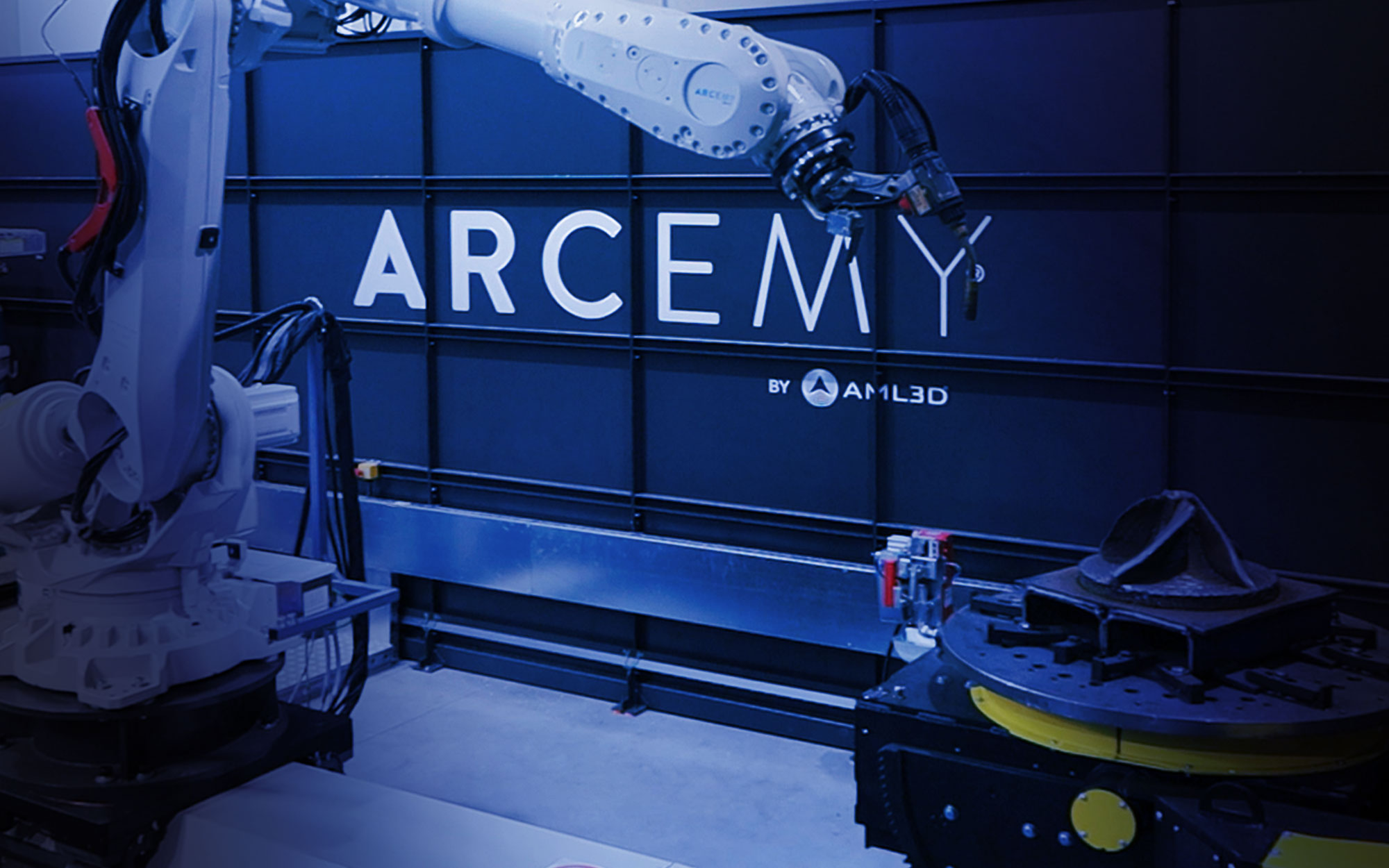
AML3D announced that it has successfully completed an initial order of two of its custom, large-scale ARCEMY X metal AM systems for Newport News Shipbuilding (NNS), a division of America’s largest military shipbuilder, HII. These custom ARCEMY X systems use a 10,886 kg positioner to create “heavy capacity build capability” for shipbuilding applications. They have been commissioned and are now operational at NNS, which completes the initial ~$4.5 million order and triggers the final payment. NNS has already placed an additional ~$9.9 million order for four more ARCEMY X systems, set to be delivered in early 2027 to support the U.S. Navy’s Marine Industrial Base (MIB). This is a major endorsement of AML3D’s WAM technology, and supports the company’s strategic investment plan to double its U.S. manufacturing capacity in order to keep meeting MIB demand.
“The strong and growing demand we are seeing from the US MIB is a ringing endorsement of AML3D’s U.S. scale up strategy. We are doubling the capacity at Stow to ensure we are well positioned to maximize the opportunity outlined in the letter of intent we received from the from the US Navy earlier in the 2026 financial year that indicated a need for up to 100 additive manufacturing systems and 3,400 additively manufactured parts by 2030,” said AML3D CEO Sean Ebert.
“It is also pleasing to see the same demand signals that underpinned AML3D’s strategic push into the U.S. market are emerging in other globally significant defense markets, in particularly the UK where AML3D has already won UK defense contracts. We are looking to leverage our U.S. strategic playbook in Europe, with plans and funds to establish a European Technology and manufacturing hub as we have done is Stow. Establishing a European hub will position AML3D with manufacturing capability to support the USA, UK and Australia, the three signatories to the trilateral AUKUS defense partnership. We will also have the capacity to deliver on our strategic growth driver of accessing non-defense industrial manufacturing sectors across the U.S., Europe and Australia.”
Lumafield Introduces New Tier of Industrial X-Ray CT Scanning Solutions

Lumafield Triton Performance
Industrial X-ray CT scanning can be very useful for detecting internal defects on 3D printed parts. Lumafield specializes in this technology, and recently announced a new tier of high-performance, industrial X-ray CT scanning solutions, connecting metrology-grade 3D measurement to production line inspection. In this shaky economic climate, as manufacturers are dealing with material inflation, trade uncertainty, and energy volatility, the timing of the new Neptune Performance and Triton Performance systems couldn’t be better. Traditional inspection tools can’t inspect hidden internal geometries well, or they’re too slow, but Lumafield says its new system tier offers high accuracy and fast scanning speeds. This helps engineering and quality teams inspect complex assemblies and verify internal dimensions of parts, and helps manufacturers catch defects much earlier, thus protecting their margins.
Lumafield’s Neptune scanner was first introduced back in 2022, making X-ray CT inspection technology accessible to industries that hadn’t been able to use it before. The new Neptune Performance features a major hardware upgrade to offer 12x faster scans and better accuracy, with 4x the data quality compared to the standard Neptune. According to Lumafield, users can now measure critical internal features at micron-level accuracy, even with materials that are transparent. Plus, a measurement template built on the Neptune Performance in the R&D lab is now the automated inspection template for the Triton Performance on the factory floor, and both connect to the cloud-based Voyager software environment for a more unified thread. Speaking of the Triton Performance, the company says it enables users to scan parts at production speed and scale, providing complete volumetric CT reconstructions in as little as 10 seconds per part. It’s supposedly able to catch internal defects, create automated inspection recipes that target known failure modes, and identify parts that deviate from the norm.