
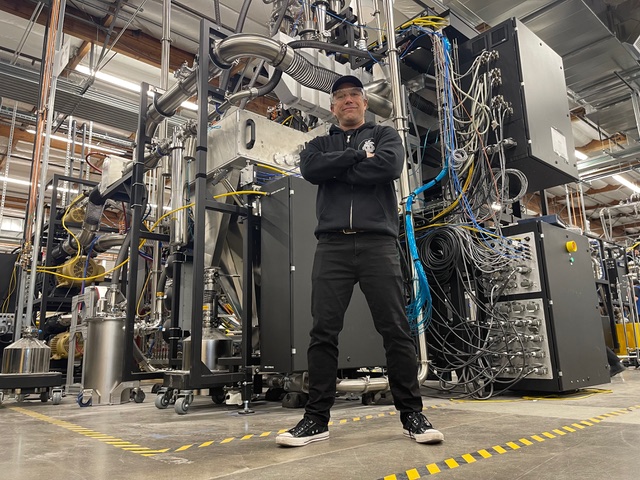
California’s AB 2047, a bill aimed at stopping the use of 3D printers to make firearms and illegal firearm parts, has passed the state Assembly and is now headed to the Senate. The legislation has already gone through amended versions, but critics in the additive manufacturing (AM) community say the changes have not solved the core problem. For David Tobin, who serves as Executive Producer of Joel Telling’s 3D Printing Nerd channel and Executive Director of the Community Manufacturing Initiative, the issue is not whether illegal weapons are a concern. It is whether California is trying to solve that problem by regulating the wrong thing.
“The things they’re trying to make illegal are already illegal. You can’t make them more ‘illegaler’,” Tobin said in an interview with 3DPrint.com. “The focus should be on enforcing existing laws rather than creating regulations that affect everyone who uses a 3D printer.”
AB 2047, known as the California Firearm Printing Prevention Act, would require 3D printers sold or transferred in California to include firearm-blocking technology. Manufacturers would have to certify that their printer models comply with the state’s requirements, and California would publish a list of approved machines. Beginning in 2029, non-compliant printers could no longer be sold or transferred in California.

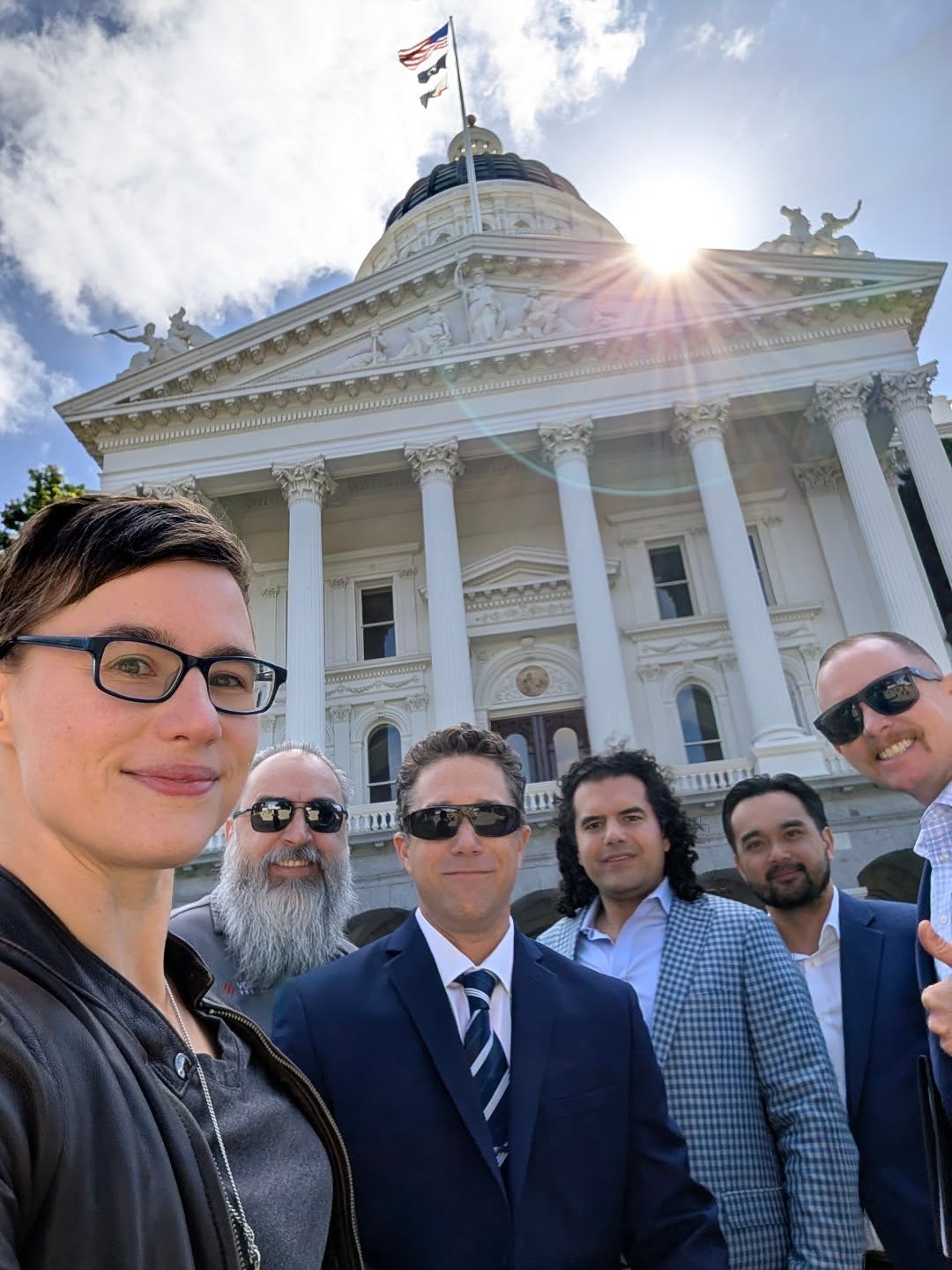
David Tobin (center) and supporters of the campaign against California’s AB 2047 gather at the California State Capitol. Image courtesy of David Tobin via Instagram.
Supporters of the bill say it is needed to address the rise of 3D printed firearms and illegal gun parts. And of course, over the years, 3DPrint.com has tracked arrests and investigations involving 3D printed firearms, including annual reviews of law enforcement cases across the United States. Police agencies in California and other states have reported arrests and seizures involving 3D printed weapons and components. Those incidents have become a growing focus for lawmakers seeking new ways to address illegal firearm production.
At the same time, many experts note that 3D printed firearms still represent a relatively small portion of the broader illegal firearms market, which continues to involve a wide range of traditionally manufactured weapons and illegally modified guns. Tobin said some of the numbers being cited lack important context. While he agrees illegal firearms are a real issue, he noted that “3D printed firearms” can refer to anything from a complete weapon to a single printed component.
“Words matter. When they say ‘3D printed firearms,’ they’re often referring to parts that could be used in a firearm, and those parts could be any shape,” explained Tobin. “The problem is AB 2047 focuses on the 3D printing machines themselves rather than the people committing crimes. This is not a gun issue. People need to look at the bill on its own merits and ask whether it is based on real technology, real science, and real-world manufacturing. As it is right now, the bill contradicts itself and is completely ineffective legislation.”
That point has become key. Tobin said he is trying to keep the conversation focused on the language of AB 2047, rather than on a broader political fight over guns. In his view, the bill should be judged on whether the proposed technology exists, whether it can work as described, and whether the law could affect people far beyond those making illegal weapons.
One concern is that “3D printers do not simply look at a file and understand what an object is. Printers follow instructions. Many users work with open-source software, modified firmware, custom toolpaths, and a range of materials and machines. The idea that a consumer printer can reliably identify and block firearm-related files is being presented too simply to lawmakers and the public. In addition, scary images have also shaped this debate. For example, media clips show a printer appearing to make a full gun, when the object shown was actually a prop. If that were possible, that would be very scary to me too. But it’s not,” said Tobin.
Tobin is not arguing that illegal firearms should be ignored. Instead, he says enforcement should focus on people who manufacture or possess illegal weapons, not on all 3D printer users. He compares 3D printers to other everyday tools that can be misused but are not widely restricted as a result.
“You’re regulating a tool instead of the crime,” Tobin said. “The bigger concern is the precedent. California is often viewed as a leader on technology issues, and if this becomes the model, other states could follow with similar legislation.”

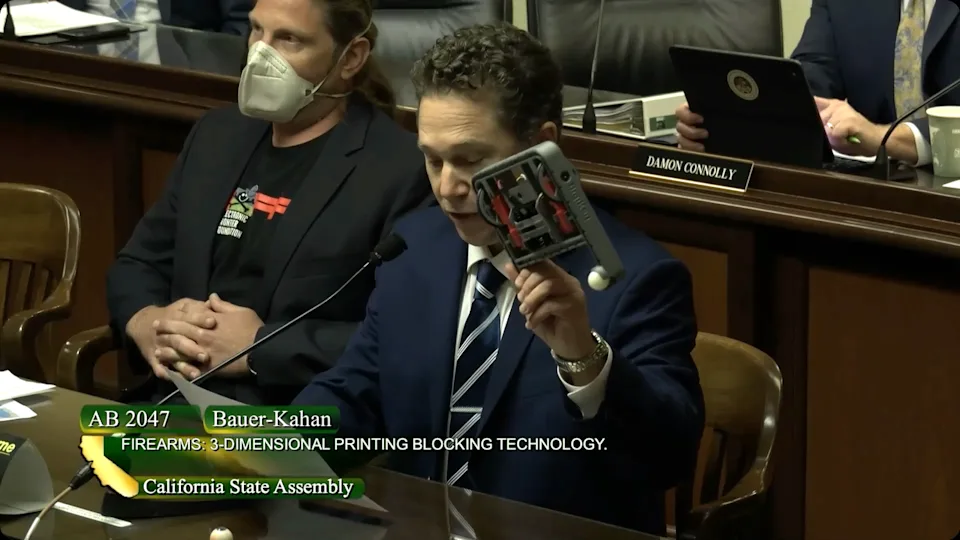
David Tobin speaks before California lawmakers during discussions surrounding AB 2047, the state’s proposed 3D printer regulation bill. Image courtesy of California State Assembly TV.
Tobin said he has been speaking with companies, academic institutions, makers, and advocacy groups to organize a response. He has also met with lawmakers’ offices and with representatives of Everytown for Gun Safety, the gun violence prevention group supporting the bill. However, he said the conversation should remain focused on the legislation itself rather than becoming a broader political debate.
That effort appears to be gaining traction. A “Letter From the Industry” has been posted on the AB 2047 resource website referenced by Tobin. The letter has already attracted support from organizations across the maker and desktop 3D printing community, including PRUSA Research, Printed Solid, MAKE Magazine, Maker Faire, West3D, Nikko Industries, VORON Design, 3D Printing Nerd, Cocoa Press, Greengate3D, and Sliceworx. Individual signatories include RepRap founder Dr. Adrian Bowyer, Prusa Research founder Josef Prusa, MAKE founder Dale Dougherty, Telling of 3D Printing Nerd, and several other prominent community members.
While the coalition does not represent the entire AM industry, it suggests that concerns about AB 2047 are extending beyond a small group of activists and attracting attention from established figures and organizations within the desktop 3D printing ecosystem.
“People need to look at what it actually says, how it would work, and what impact it could have on the broader 3D printing community. Above all, we need future-proof legislation. 3D printing is going to get better and better. We are going to have to address serious issues, but I don’t believe this is how we do it.”
That message is also intended for people in the 3D printing industry who may not see the bill as their problem. Tobin said many companies and organizations have been slow to respond, even though the legislation could affect manufacturers, schools, makerspaces, small businesses, hobbyists, and open-source developers, just to name a few.
“It has to be a community effort,” he said. “Whether you’re a kid just getting into 3D printing, or a parent, or an executive, or a teacher, or anyone who touches this industry in some capacity, we need to speak up.”
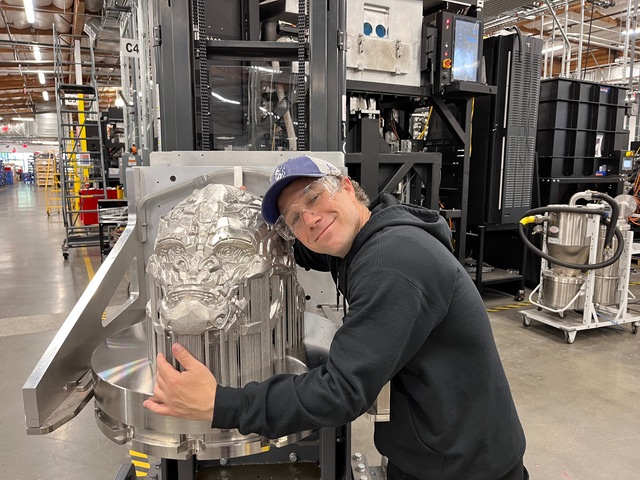
David Tobin. Image courtesy of David Tobin.
Tobin also pointed to the bill’s prop-making exemption as an example of what he sees as flaws in the legislation. He argues that the language does not reflect how 3D printers are actually used. According to Tobin, the exemption appears to apply only to printers used exclusively for prop making, even though most machines are used for many different purposes.
“That printer has to be California-approved,” he said. “And it has to be a printer that’s only for prop making. I don’t even know what that means in practice. Most prop makers use the same printers as everyone else. The same machine can make props, prototypes, replacement parts, or classroom projects. Actually, these aren’t just hobby machines anymore. They’re used in schools, small businesses, engineering labs, and product development. My concern is that regulations like this could affect a much broader part of the manufacturing ecosystem than lawmakers intend.”
In fact, the potential impact on businesses is also not fully clear.
“If the law passes, some manufacturers may decide it is easier not to sell certain printers in California rather than create a state-specific compliance system. Others may try to comply, but that could push the market toward locked-down systems and away from open development. I think the United States should expand access to manufacturing tools, not make them harder to use. If we want to compete, we need resources in America. We need a place where you have everything, like Shenzhen, in China. We need to pull the innovation and actually drive the innovation.”

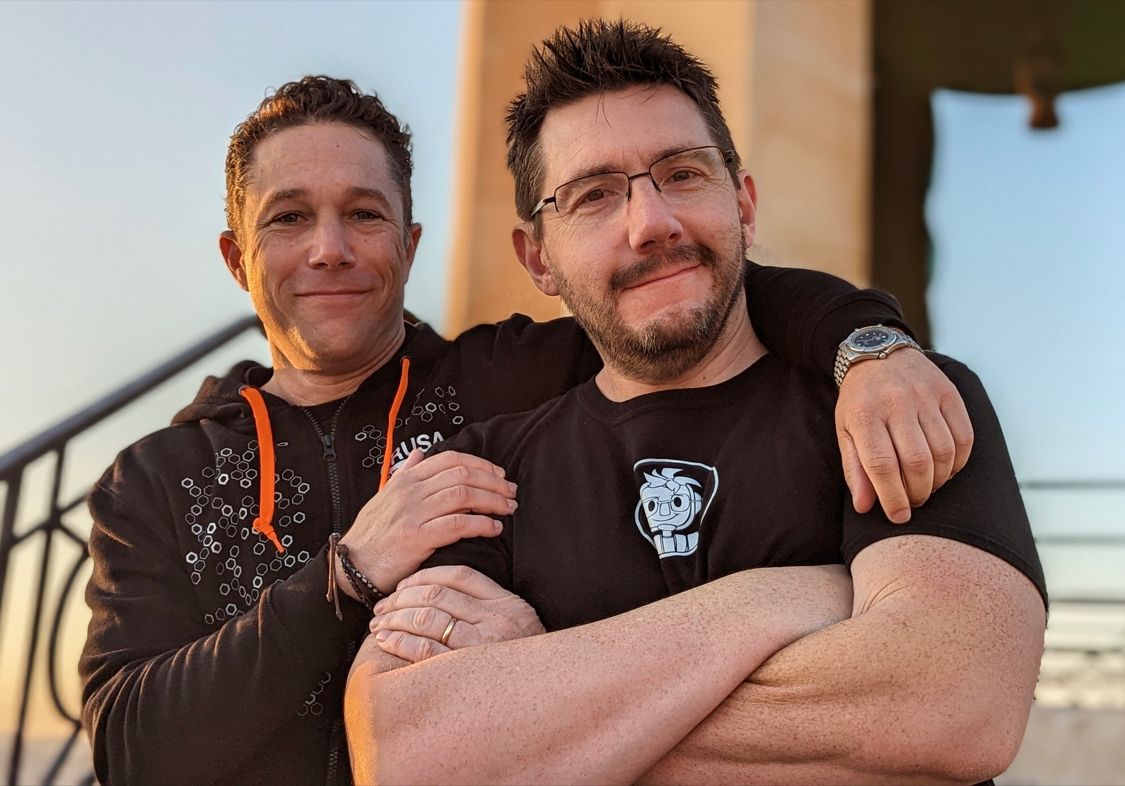
David Tobin (left) and Joel Telling, founder of 3D Printing Nerd. Image courtesy of David Tobin via LinkedIn.
For now, Tobin is focused on the Senate. He said he is encouraging people in the AM community to contact California senators, share technical feedback, and explain how the bill could affect lawful users. He is also preparing to continue testifying and organizing through the Community Manufacturing Initiative.
“This is one of the most important industries. It is the next industrial revolution, and we have to take care of it,” concluded Tobin.