
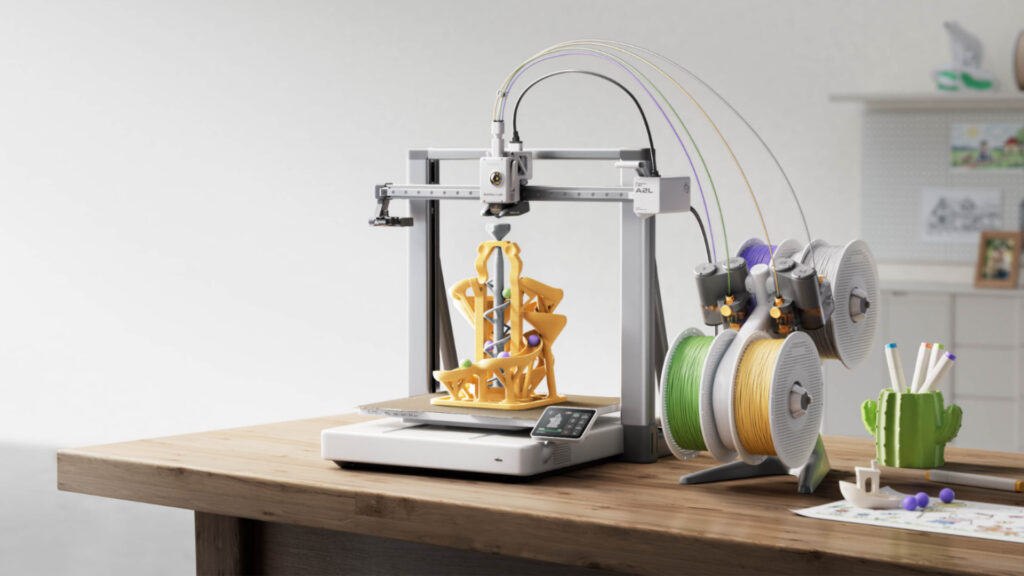
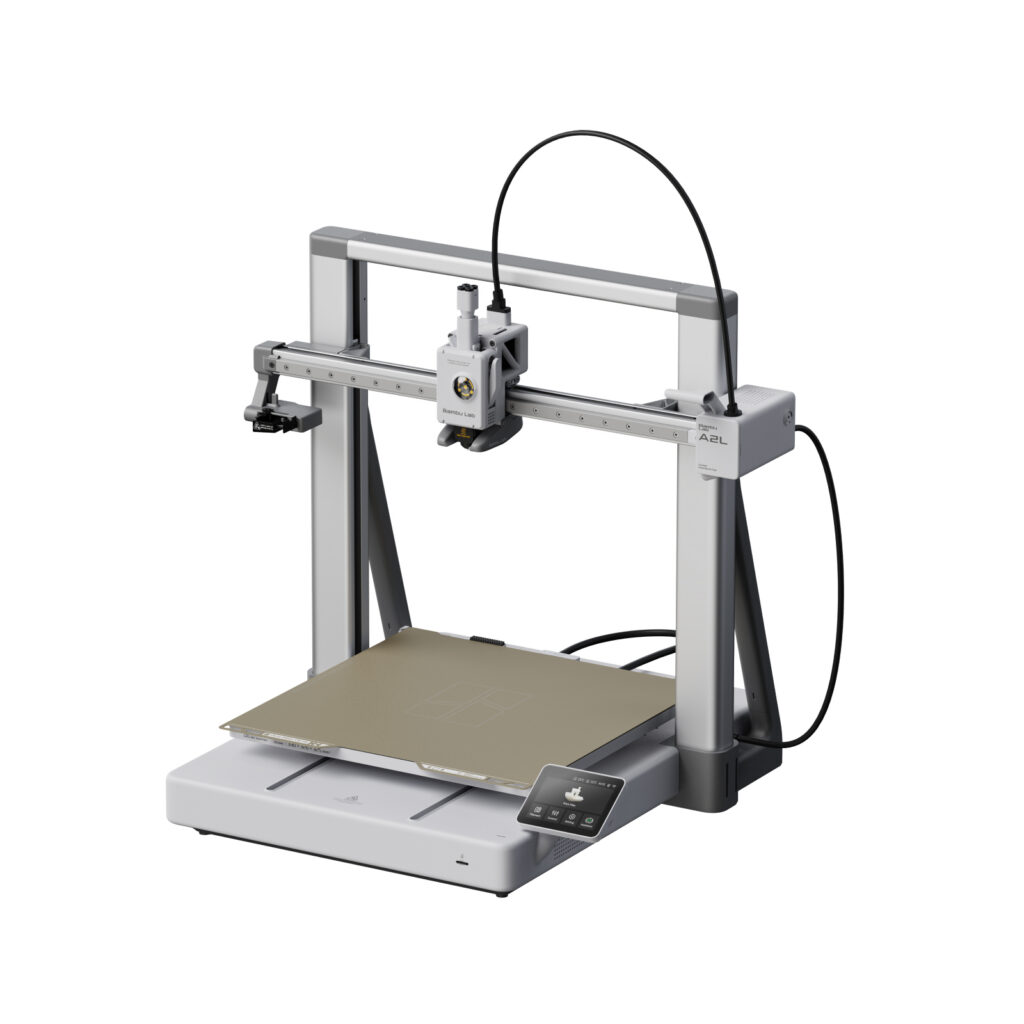
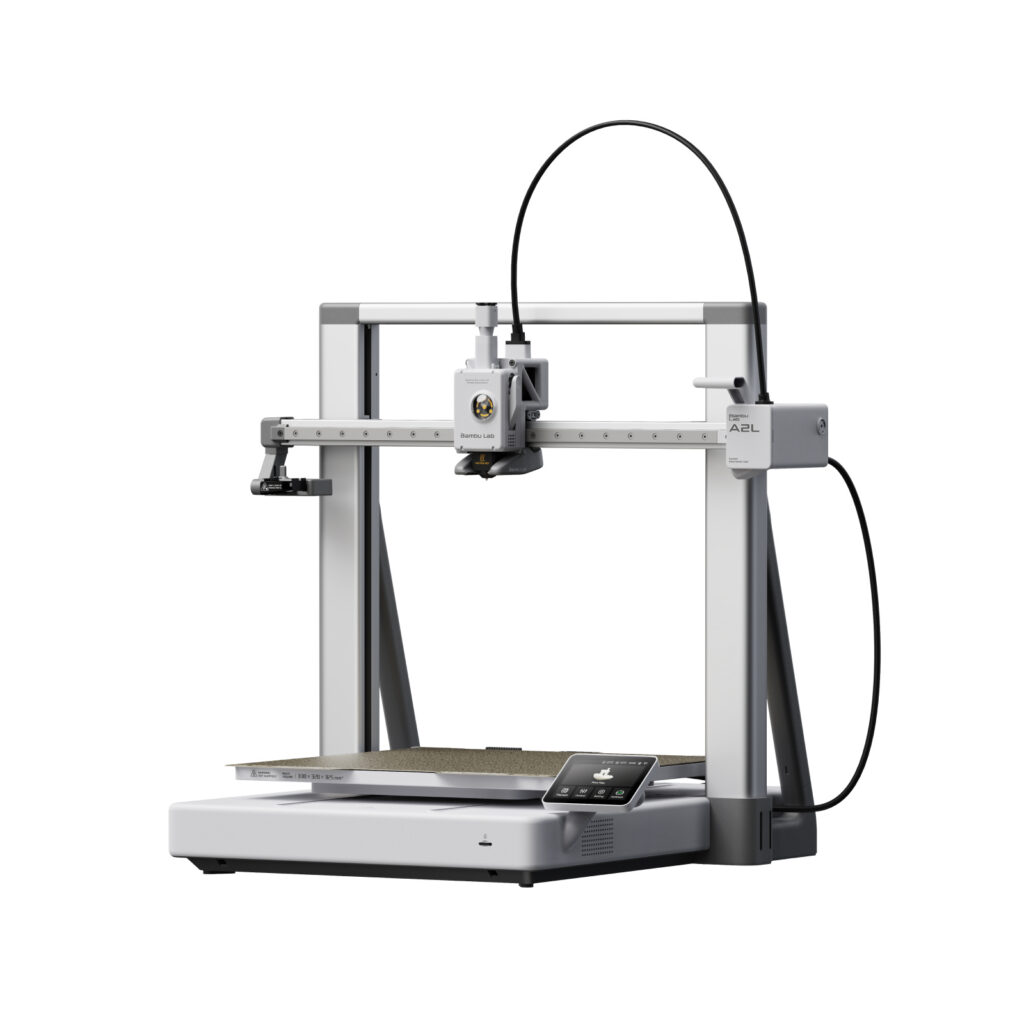
Bambu Lab continues its relentless march for 3D printing domination with the launch of the A2L. The 330 × 320 × 325 mm printer will have a nozzle temperature of 300°C and a bed temperature of 80°C. Print speed will be up to 500 mm/sec, and it’s designed for PLA, PETG, and similar materials. Users can connect up to four Bambu Automatic Material System (AMS) units and one AMS Lite unit, allowing multi-color and multi-material printing. The printer also comes with plotting and cutting modes.
It has Bambu’s PMSM (Permanent Magnet Synchronous Motor) servo extruder, along with vibration compensation, as well as two granular dampening units built into the chassis. This means the machine combines software-based compensation with mechanical dampening to reduce resonance. This should also reduce moiré patterns and other surface artifacts. The printer by itself costs $489 in the US and €379 in Europe, while a bundle with an AMS Lite costs $569 and €489, respectively.
What Bambu is doing here is significant because of the steps forward in dampening. Resonance from the motors, frames, vibration, and other effects is detrimental to smooth surfaces, and Bambu is trying to eliminate them. By staying ahead in software and sensor-driven compensation while working on better mechanical dampening, the company opens up two fronts where it can compete.
Having said that, this printer is aimed at hobbyists, so it could significantly expand the market while also finding use in print farms. To make a kid printer that could also work in the classroom, as your first cosplay printer or as your print farm standard unit, would be quite the coup for the company. The company sees this as an “H2S lite,” but it will probably be most confounding for those set on buying the P2S. What do you go for? Whereas other companies have continually feared cannibalizing existing sales or models, Bambu competes with everyone, including itself.
This is unsettling for me because it does seem inefficient. But the least efficient thing is not to sell any printers at all. The worst thing would be to fail to cover a niche. We still don’t know if the Model T Ford of this market that will sell hundreds of millions of units is the A1, the Carbon, or the H2, so why not try another hybrid to see if this fills the gap? This kind of competitive drive is what makes the company so difficult to compete with.

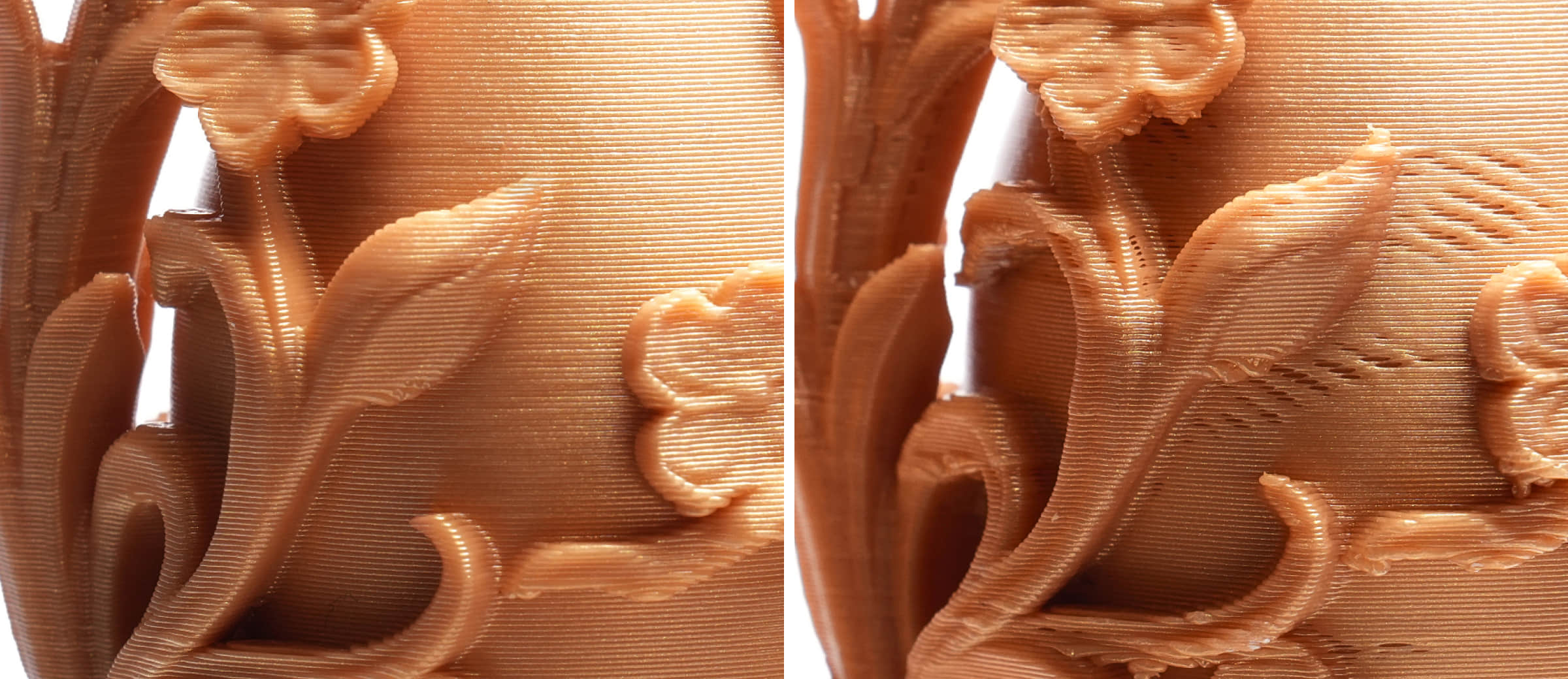
A close-up comparison showing the effect of the A2L’s vibration compensation and dampening technologies on print quality. Image courtesy of Bambu Lab.
We’re also again seeing Bambu port its latest technologies to entry-level systems. This actually decreases the costs of each feature while spreading across the Bambu lineup. The more printers that have a feature, the cheaper this feature can become. Many firms are constantly tailoring their offering. Some firms make crappy entry-level products to make other products shine. Some offer tiers of upgraded features to eke out more profit. Bambu is continuously tweaking its go-to-market strategy and will then spread its features and key components across the entire lineup. Then the firm will win in all categories across the board. Rather than trying to make a good Golf and Passat, or to iteratively improve the Accord each year, it is trying to find the right product-market fit across all lines and to continuously advance. The Bambu will cover the whole field and blot out the sky.
The new printer has new features as well, showing that their strategy is to release new features in top models; the firm is releasing cutting-edge stuff in lower-priced printers. This time, it includes improvements to the “multi-point calibration and load adaptation, eliminating ghosting and ringing artifacts when printing tall, heavy models by dynamically adapting vibration compensation parameters.” Frankly, I thought they were doing this to some extent before. The company thinks that these improvements, along with the dampeners, should see a “Bed Slinger printer to achieve Core-XY level print quality.”
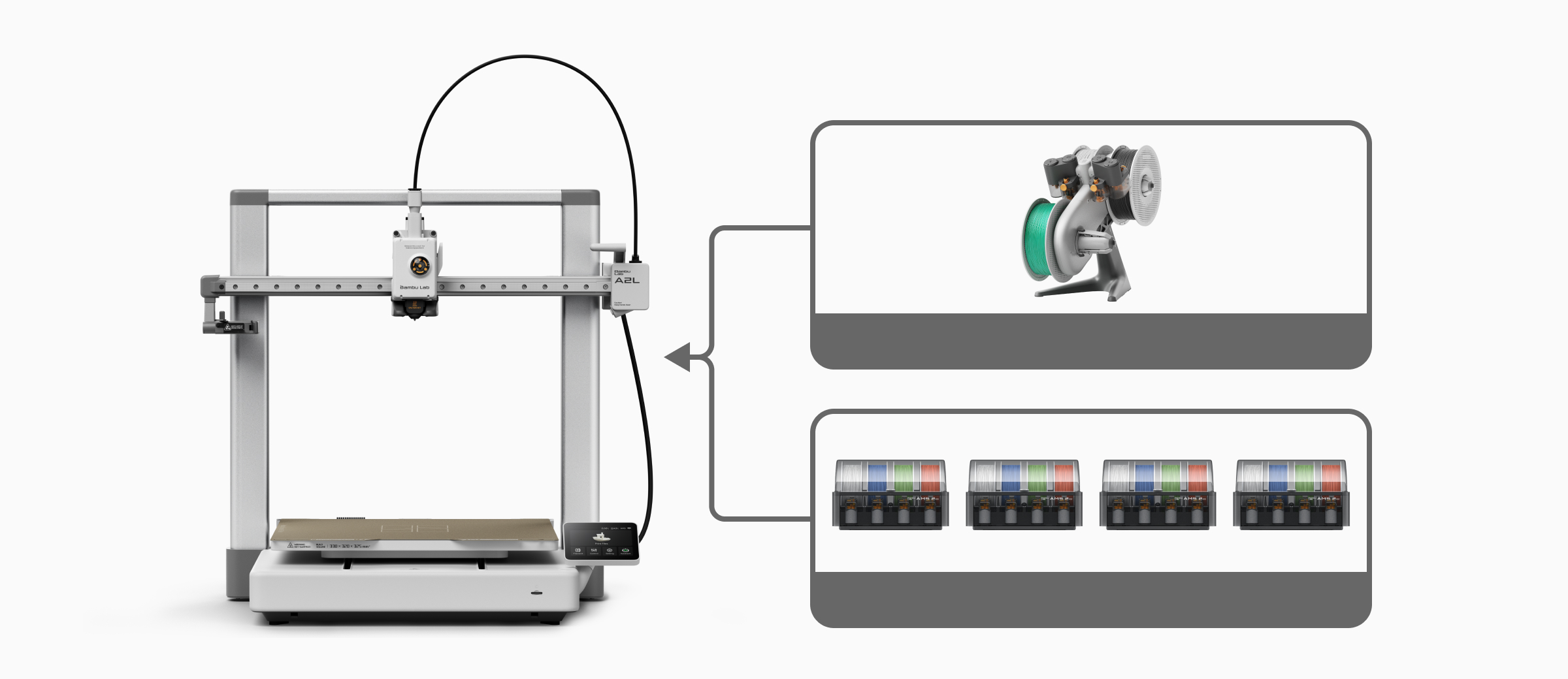
The A2L can connect to multiple AMS units, enabling multi-color and multi-material printing. Image courtesy of Bambu Lab.
The printer also has runout, clog, spool-tangle, blob, and extrusion-force detection. There’s also a silent mode. I really like this idea because it gives you a semblance of psychological control over your 3D printer’s noise levels. The work of Singer and Glass in the 70’s showed that if you ask people to perform a task and give them the option to reduce external sound levels through pressing a button, they will concentrate better. But the cool thing is that just having that button there reduces stress and increases concentration, irrespective of whether you press it. So please let’s all have silent mode buttons, they don’t even have to work. Here, Bambu says that the printer can work at 49 dB.
Another new feature is that the printer can now take expansion modules. You could buy a Blade Cutting Upgrade Kit if you wanted to cut patterns, for example. So if you’d like to print and make stickers or decals, you could pay for this, while others do not have to. I think this has a lot of potential. Bambu could make a lot of revenue from successive upgrade kits, especially if they are spread out over tens of millions of printers and are reverse-compatible.

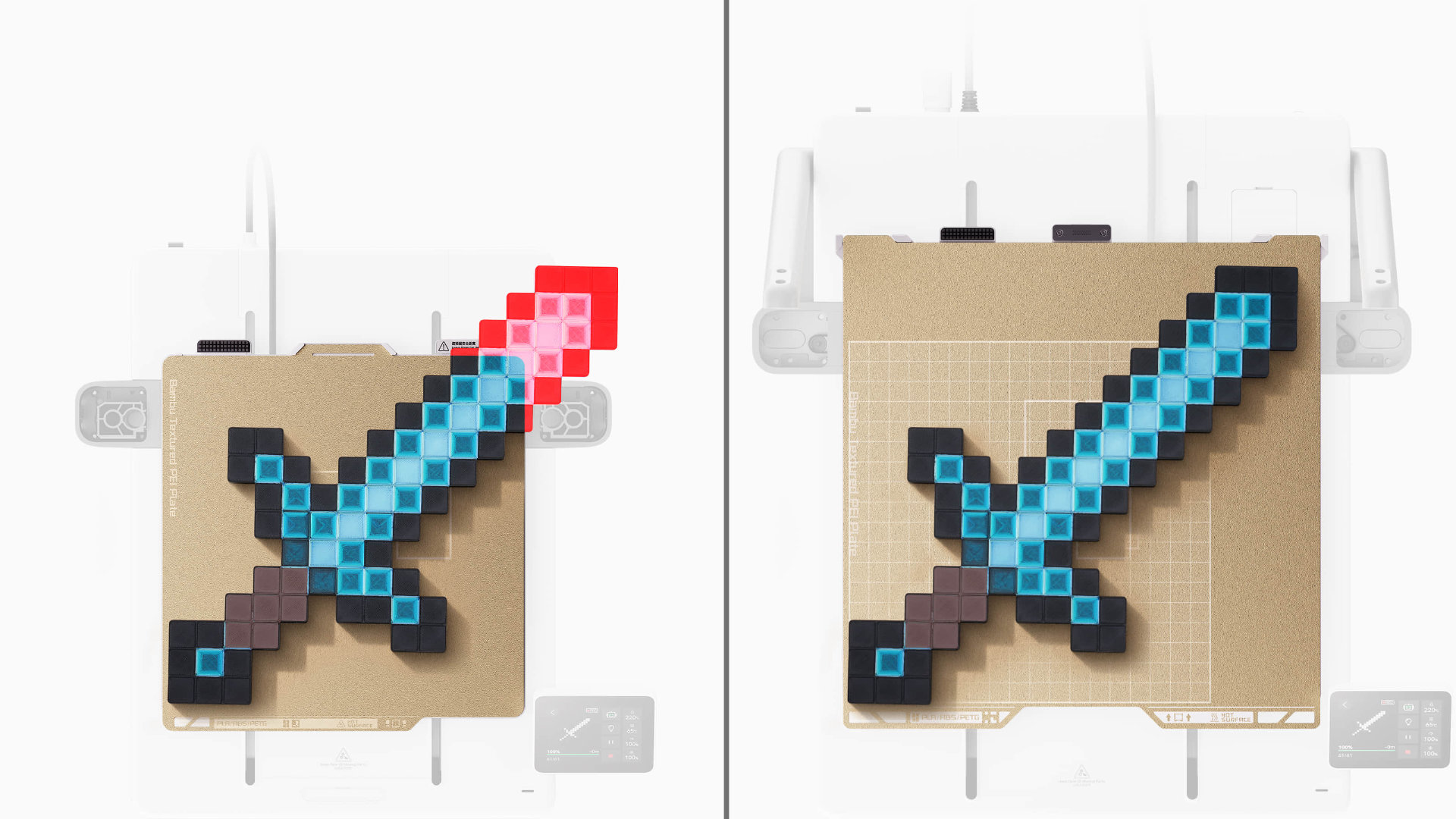
The A2L’s larger build area allows users to print bigger objects in a single job. Image courtesy of Bambu Lab.
Bambu is currently under fire from powerful YouTubers and open source advocates for playing fast and loose with OpenGL and the core slicing capability at the heart of its offering. This may very well alienate a lot of the core 3D printing community. Meanwhile, the firm continues its relentless march onward. By introducing new features on inexpensive systems, cannibalizing its own sales, and searching for new markets and models, the company is blocking out the sunlight for its competitors. Bambu grows quickly everywhere, making it hard for others to compete with it.