We’re starting off today’s 3D Printing News Briefs with two new Project Calls from America Makes. We’ll move on to some more business, with Axtra3D expanding its presence in North America through a reseller agreement with Dynamism. Then it’s on to research, first into LCD resin 3D printing, and ending with 3D printed metals in reconstructive surgery.
America Makes & NCDMM Announce Two New Project Calls Worth Over $25 Million
Recently, America Makes and the National Center for Defense Manufacturing and Machining (NCDMM) announced two new Project Calls, worth a combined total of $25.6 million. The first, Maturation Initiative for Additive Metals Interchangeability (MIAMI), is funded through the Office of the Under Secretary of War, Acquisition and Sustainment, Industrial Base Analysis and Sustainment (IBAS) Program. Worth $12.4 million, MIAMI plans to validate that it’s possible to replace traditional alloys with metallic AM materials in weapon system components for the DoW. Teams will choose candidate parts, define their performance requirements, and generate validated data that demonstrates the ability of the material to meet, or even exceed, critical properties of the legacy alloy. There will be three awards given, and participants should focus on reducing redundant material testing, speed up qualification, and enable broad, cross-platform use of metallic AM materials.
The second Project Call is the $13.2 million INtegrated System for In-situ Testing & Evaluation (INSITE), with one award anticipated. Funded through the IBAS Program and the Office of the Under Secretary of War, Manufacturing Technology Office (OSW ManTech), the objective of INSITE is to set up an integrated quality assurance system for AM that combines in-situ monitoring and post-build inspection, using a nondestructive evaluation (NDE) approach. This should advance DoW priorities for reliable AM qualification, strengthen defect detection, and deliver production-ready capabilities that can help improve competitiveness, efficiency, and readiness across the U.S. supply base. The goal of the resulting combined approach is to improve inspection of some of the more challenging 3D printed parts, like dense materials, complex geometries, and large components, and unifying in-situ monitoring and post-build inspection within a certifiable framework.
Axtra3D Announces Strategic Reseller Agreement with Dynamism

In order to strengthen its U.S. go-to-market strategy, Axtra3D announced a new strategic reseller agreement with Dynamism to expand access for its Hybrid PhotoSynthesis (HPS) technology, Axtra.Workflow software platform, and Lumia X1 3D printer. Well-known for its selective portfolio and independent testing methods, Dynamism is focused on “rigorously validated, high-performance” AM systems. These qualities make it a great partner for Axtra3D, which emphasizes repeatability and production readiness in manufacturing. By adding Axtra3D to its portfolio, Dynamism can expand its photopolymer offerings, which will help it meet increased demand from manufacturers and service bureaus with industrial-scale workflows. In turn, Axtra3D will grow its North America channel strategy, hopefully speeding up the adoption of its high-speed technology across regional industries that need repeatable end-use parts production.
“Dynamism has a long-standing reputation in North America for curating and validating advanced manufacturing technologies that meet real production requirements. This partnership strengthens our ability to reach customers who require both trusted guidance and high-performance solutions. Together, we are focused on accelerating the adoption of HPS-based production workflows across key North American tooling, aerospace, automotive, healthcare, and industrial manufacturing applications,” said Rajeev Kulkarni, CSO at Axtra3D.
Ultra-Thin Optical Film Improves Quality of Light in LCD Resin 3D Printing
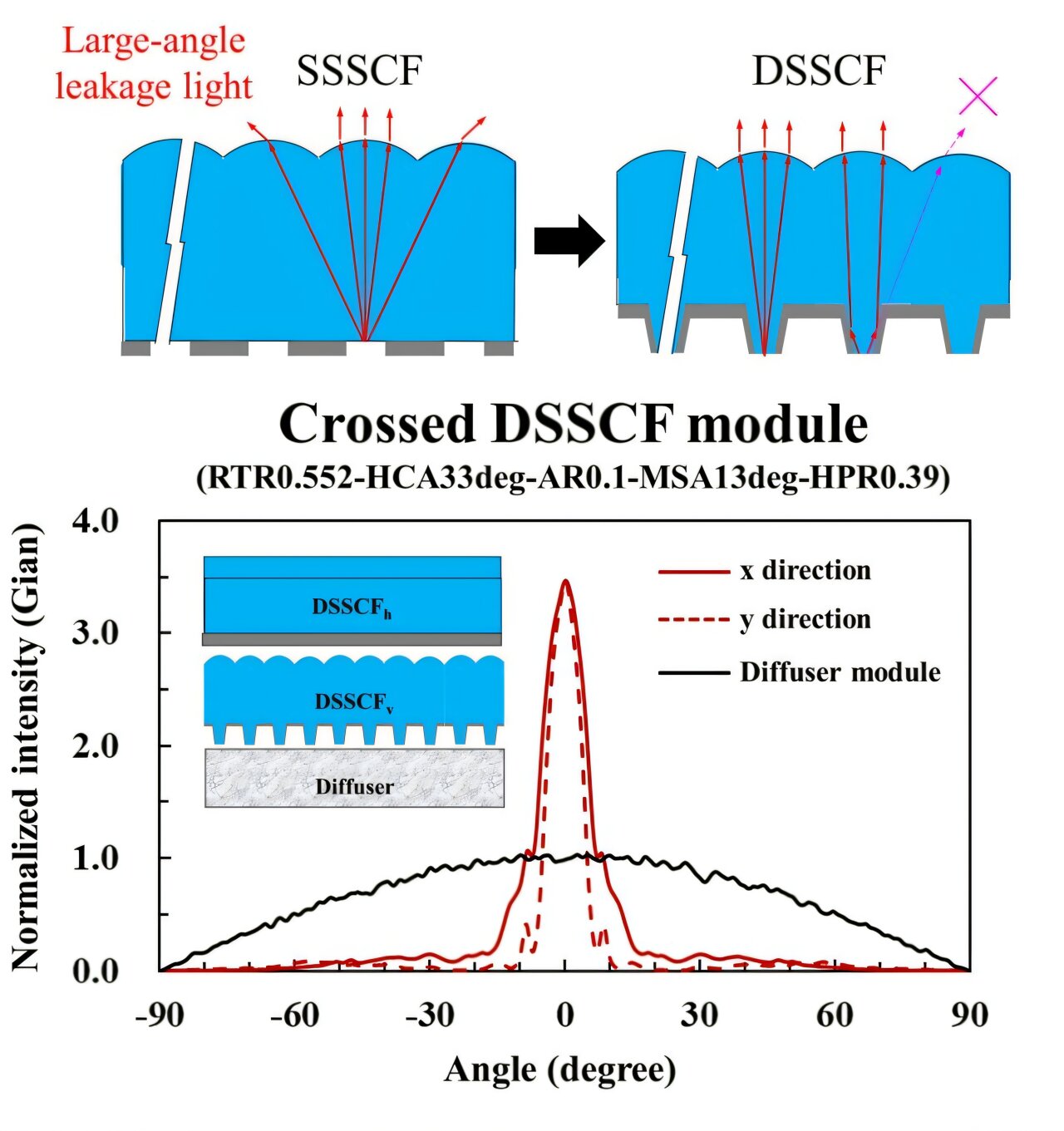
Researchers designed and fabricated a double-sided structure collimation film (DSSCF) with better collimation characteristics thanks to additional trapezoidal microstructures that prevent the large-angle leakage light seen with single-sided structure collimation film (SSSCF). The DSSCF also improves the light intensity uniformity when combined with a diffuser module. Credit: Ding-Zheng Lin, National Taiwan University of Science and Technology.
Industries like medical, jewelry, and engineering require high accuracy when it comes to printed parts, but that’s not cheap. Resin 3D printing, or vat photopolymerization, projects patterns onto liquid photosensitive resin with short-wavelength light to achieve smooth, detailed parts. Systems that use LCD backlights can be cheaper, but they aren’t always as accurate. A pair of researchers from the National Taiwan University of Science and Technology have figured out a way to improve the quality of light used in these less costly LCD resin 3D printers. They developed an ultra-thin optical film that helps make sure tiny details are precisely reproduced, which could allow users to print medical-grade products for less money. As they explain in their research paper, the team used their double-sided structure collimation film to develop a prototype LCD backlight system for resin 3D printing. This thin film makes the light that the prototype system emits collimated, which means the rays travel in parallel lines and improve light uniformity, so the intensity is spread out evenly.
“LCD-based liquid 3D printing suffers from surface roughness or dimensional inaccuracies due to improper light angular distribution from the backlight systems used. Our goal was to fix these problems without increasing equipment size, thereby elevating print performance to professional grade,” explained research team leader Ding-Zheng Lin.
“This technology could make it possible to use inexpensive 3D printing systems to create dental models, jewelry designs and engineering prototypes with precise dimensions and glossy finish.”
PhD Candidate Improving Reconstructive Surgery with 3D Printed Metals
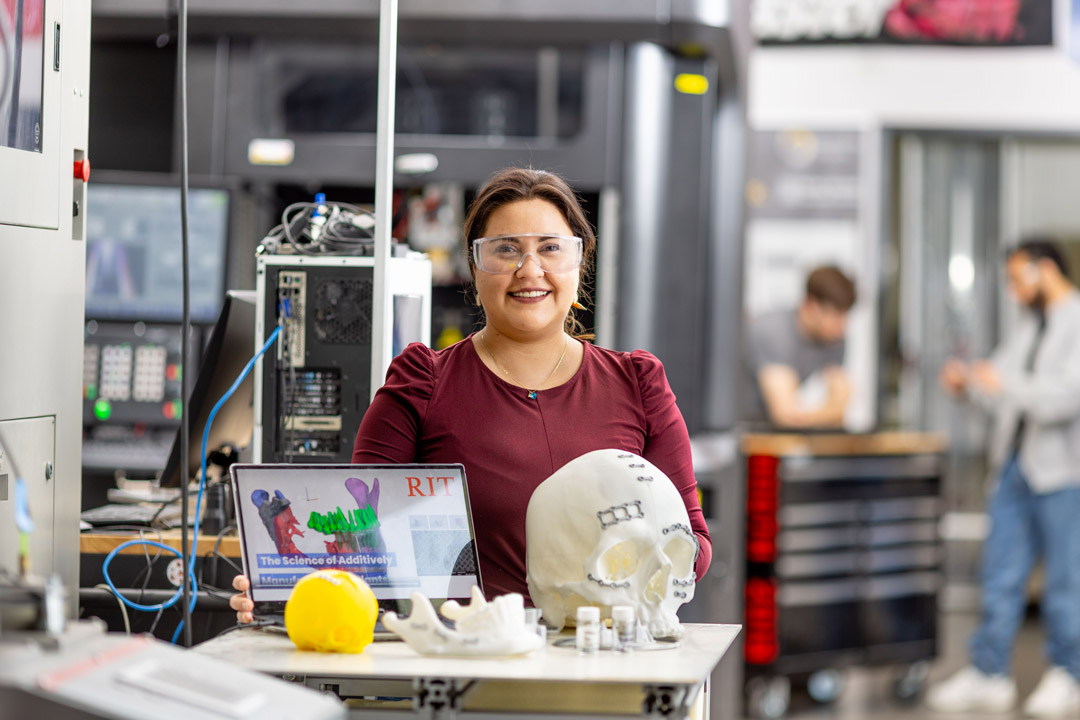
Ph.D. candidate Valeria Marin Montealegre has been working on new options in 3D printed bio-metals for facial bone implants. Image: Scott Hamilton/RIT
While simultaneously taking graduate classes in product development at the Universidad Autónoma de Occident and working at her implantable device company HumanBX, Valeria Marin Montealegre watched surgeons perform reconstructive surgeries with the 3D printed prosthetics she’d designed. She was interested in learning more about the technology, and enrolled in the Global Scholars Program at RIT in 2021. Marin Montealegre is now working to complete her PhD in mechanical and industrial engineering. Her research is focused on using 3D printed biocompatible, absorbable metals for craniofacial implants, which will benefit patients and positively impact her business as well. Her advisor Denis Cormier, director of the university’s AMPrint Center, is a pioneer in molten metal jetting (MMJ), and she’s specifically focused on using this technology to manufacture zinc, which can be used for bone healing regeneration. By 3D printing zinc-based implants, the devices can offer temporary mechanical support during the healing process, and will degrade over time as new tissue and bone grow.
“There’s a trend now for bio-metals, those that can be absorbed in your body such as magnesium, iron, and zinc,” Marin Montealegre said.
“There are few places in the world that are working with molten metal jetting, none working with bio-metals—yet. We recognized an opportunity to explore these materials using a different technology, and we are helping pioneer in this space. My lab mates are even more impressive, as they are developing the technology from its conception through manufacturing to make this possible. I think this is awesome.”