
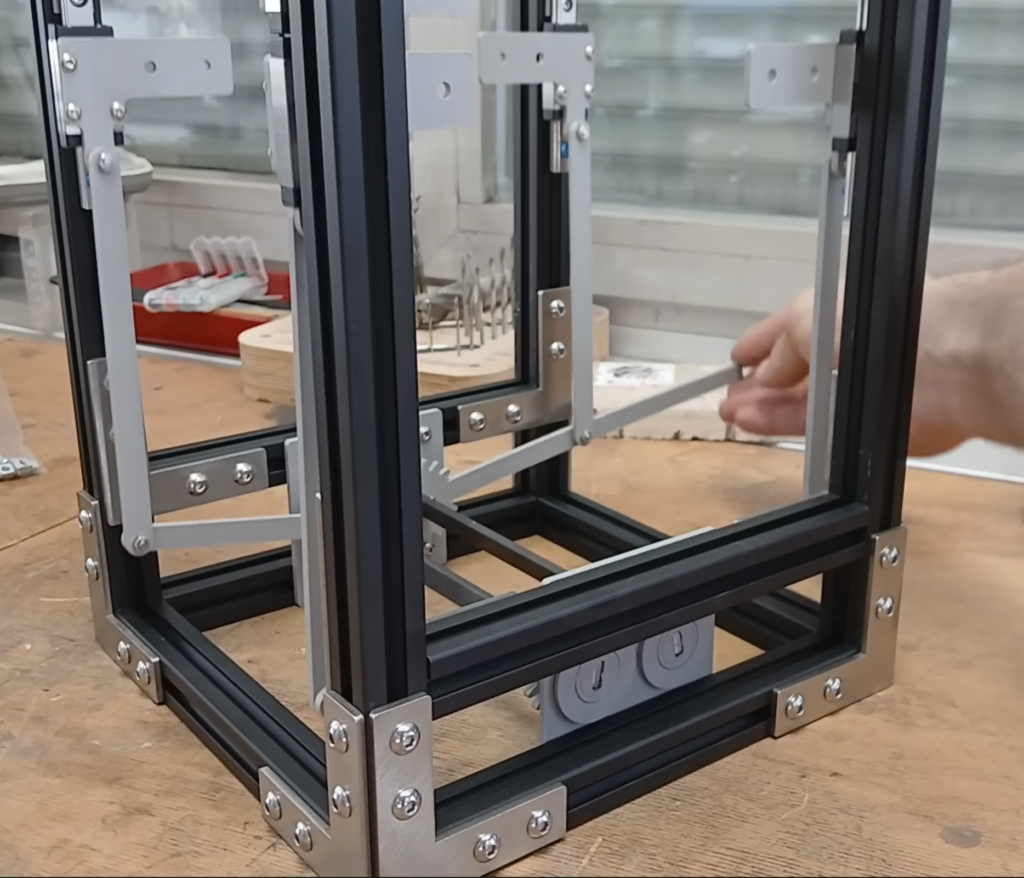

It’s Triggy is a YouTube channel showcasing engineering builds and how-tos. From testing whether wood glue is stronger than wood, to how to make polynomial curves, and how to make a rocket from office supplies, it errs on the side of nerdy. Triggy took umbrage at a commercially available multi-channel pipette system, which cost $18,000. Pipetting robots come in all sizes, prices, and quality levels, of course. Now Triggy has used 3D printing to make one for $250 in parts. The resulting CAD, explanation, and firmware are now available on GitHub.
The 96-well plate pipetting robot can be used to mix and handle pipettes for medical tests. These kinds of machines are workhorses in R&D labs and hospitals. They can be used to move around samples, dilute samples, place cell cultures, and add reagents. These kinds of robots can be simple, including affordable manual units. There is also an OT2 open source version that costs around $16,000. Automated desktop systems cost between $10,000 and $40,000. Beyond that, there are very large systems. These can be modular, and you can add robot arms to further automate storage and handling after operations. There are simple, compact, advanced, and cheap options to cover everything from high school labs to large government DNA labs. All those DNA tests used by law enforcement and by people curious about their heritage are handled, in part, on these systems.

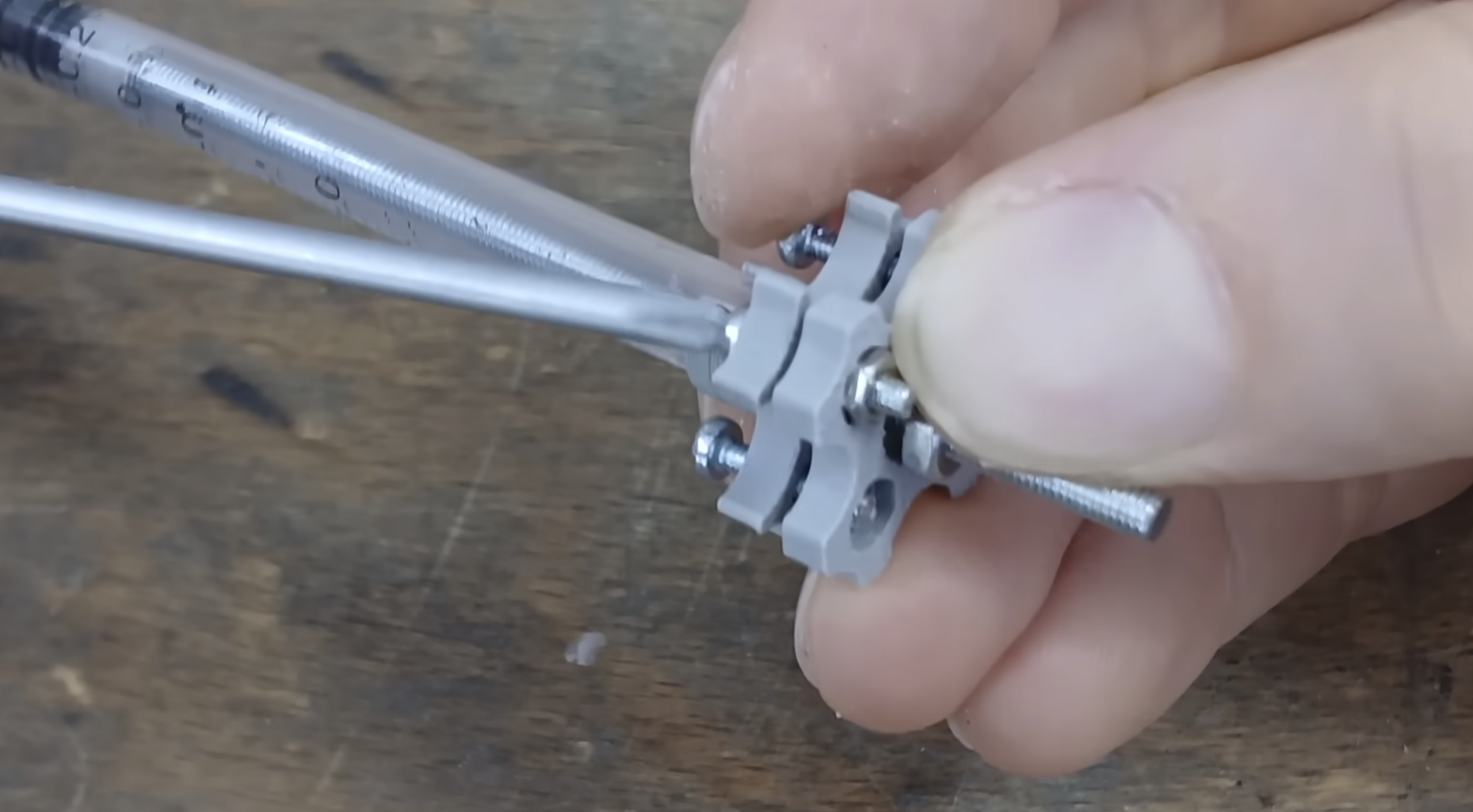
Close-up of the 3D-printed pipette holder and clamping mechanism, part of Triggy’s low-cost automation system. Image courtesy of Triggy (YouTube).
Using an ingenious geared ratchet lowering system and extruded rails, Triggy builds up the base. Housings and other key components are printed too. 3D printed guides and a platform for the pipettes are also made. Getting the amount of give and the platform’s tolerance was, of course, very important. He uses 4 stepper motors mounted to 4 lead screws to move the platform up and down. He makes the firmware and ends up with a working device. Tests then show how he can dispense and mix different liquids in pipettes. He then tests mixing different reagents and mixing programs.
Triggy says, “This isn’t going to replace high-end lab equipment, and that’s not the point; the point is to reduce barriers to entry for these tools.”
That, I think, is something that we can all applaud. We’ve seen real development in open-source lab equipment over the years. Open Labware is a collection of open-source lab equipment that often uses 3D printing, meant for developing countries and austere environments. We wrote about projects like LabEmbryoCam, developed by the University of Plymouth‘s EmbryoPhenomics lab. In 2018, we looked at the Custom Lab Institute’s 3D printed lab gear and a paper on the efficacy of 3D printed laboratory equipment. We also looked at an interferometer that used 3D printing and a smartphone. There have been good papers on this development, and it is ongoing.

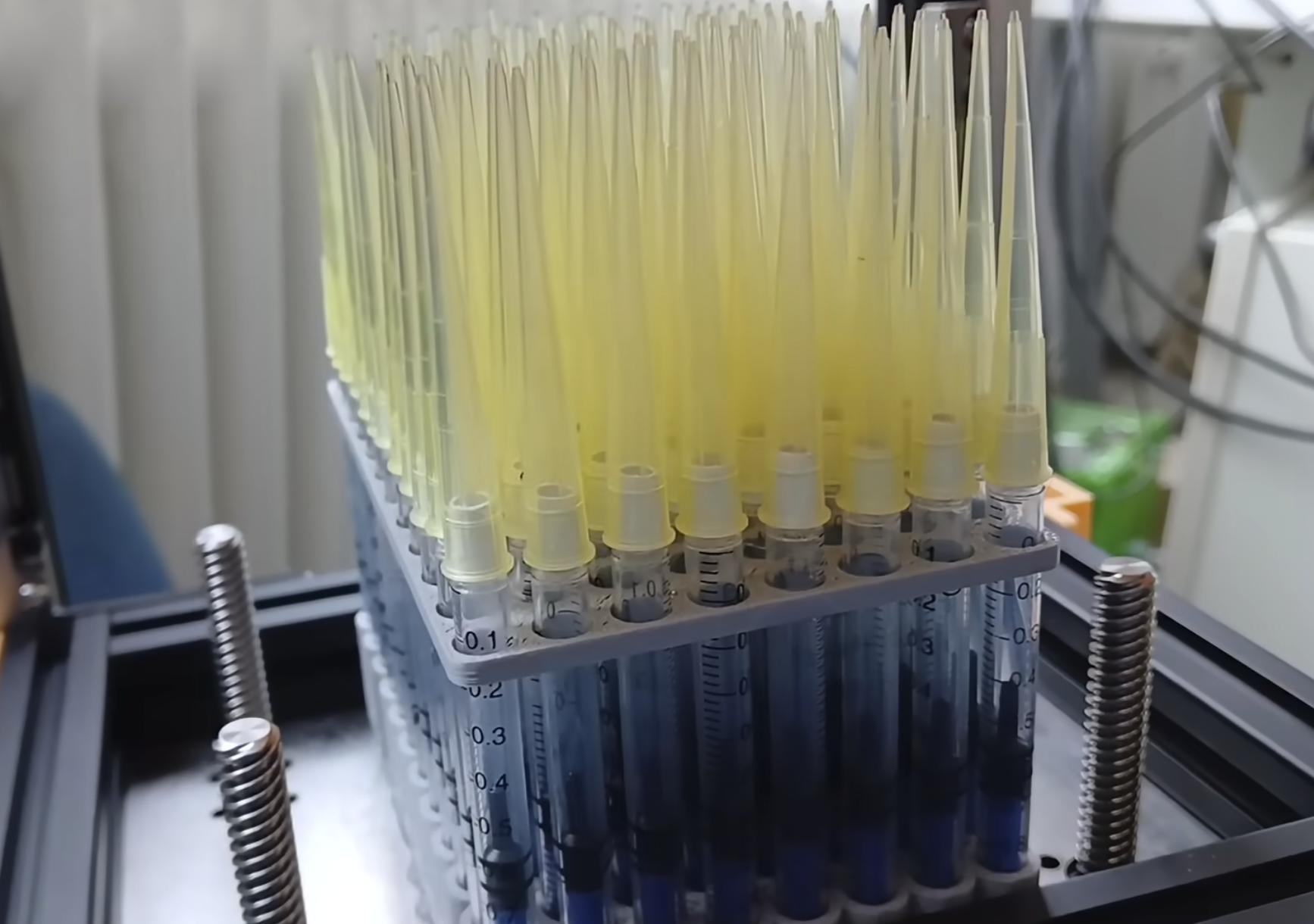
The assembled 96-channel pipetting setup is designed to handle liquid transfer and mixing for lab workflows at a fraction of the usual cost. Image courtesy of Triggy (YouTube).
The promise of this could be incredibly impactful, extending medical testing, lab work, and life-saving development closer to the people who need them most. Rugged lab gear designed for austere environments would greatly improve medical research in remote areas. If, from the design stage, power interruptions, dust, and rougher handling were taken into account, this equipment would look and work very differently from what we have now. At radically lower pricing and broader availability, this kind of stuff would let many charities, universities, NGO’s, and governments save money. Lives could be saved with this, and existing budgets could be extended.
That idealism and hope have not really brought this movement much money or visibility, however. It’s still more visual to paint a school or give some more tangible and understood things like books, computers, or water pumps. Somehow, this just doesn’t get a lot of donor love and attention. But, imagine this. Imagine if Triggy changed tack and, rather than willy-nilly exploring sciency/engineeringy topics at random, stuck to just making open labware. Triggy has 60,000 subscribers, and the medical device video has 870,493 views. A YouTube calculation tool estimates that the yearly earnings would be around $50,0000. But imagine the channel quadrupled to $200K a year, and Triggy could have a salary and budget that allowed continuous creation of open-source 3D printed medical devices. A channel ten times bigger than that could let a whole team of great engineers tackle substantive global problems full-time. Now I’m not saying we should stop filling swimming pools with Jello or having people on motorcycles jump over ever bigger things, because somehow that, too, is humanity excelling. But imagine if a new generation of YouTubers used the platform to solve some of the world’s problems.