

Earlier this year, the Department of Defense (DOD) broke ground on its biggest additive construction (AC) project to date, aiming to complete ten new barracks at Texas’s Fort Bliss US Army Post well before the end of 2026. DOD teamed up with Texas-based AC firm ICON, its longtime partner in AC scale-up, a track record that includes completion of the US military’s first-ever 3D printed barracks, also in Fort Bliss.
ICON’s work on the ten barracks, which are expected to house 500 soldiers once finished, is part of a nearly $63 million Other Transaction Authority (OTA) agreement awarded to the company in January, bringing the total value of all ICON’s government contracts over the years to over $360 million. That number is all the more impressive considering that ICON has only just this month announced a dedicated division for defense and general government work, ICON Prime, which is headed by Will Hurd, a former member of the CIA clandestine services, a three-term US Congressman, and a US Presidential candidate in 2024.
In between his retirement from Congress in 2020 and the launch of his presidential campaign in 2023, Hurd served on the board of OpenAI. During his time in Congress, he served as chair of the Information Technology Subcommittee in his first term, chairing the first US House hearing on AI in 2015. ICON has been distinctly ambitious on the role of AI in its workflow, announcing an AI program for home design back in 2024.

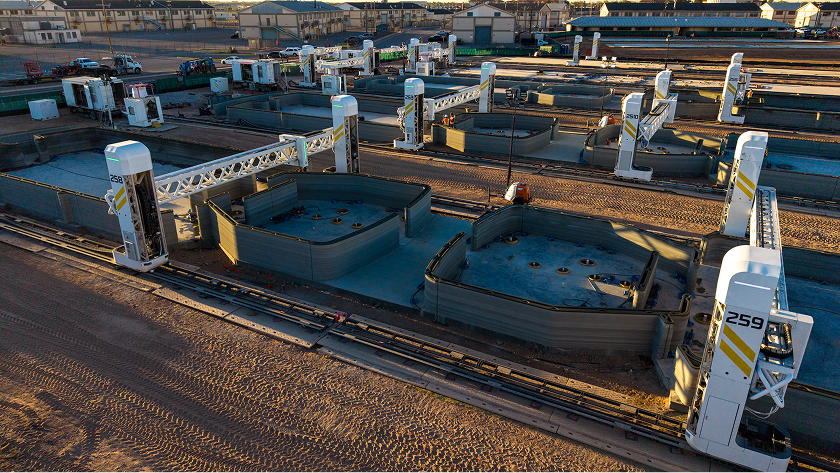
ICON’s large-scale 3D printers in operation, building multiple military structures simultaneously on-site.
Hurd has been making the rounds with media outlets following the announcement of his new role, telling Axios that he and ICON Prime are aiming to build 900 barracks over the next five years. In addition to its work building barracks for various US military branches, ICON has also been a major recipient of funding from NASA related to lunar construction R&D.
In a press release about ICON’s launch of its Prime division, and the choice of Will Hurd as president of the division, the co-founder and CEO of ICON, Jason Ballard, said, “ICON was founded to radically rethink how the world builds. With ICON Prime, we are bringing together our robotics, software, and materials innovations into a defense and space tech unit to help government partners build faster, more resilient infrastructure at a lower cost. We want to bring robotic construction to bear on the nation’s most pressing readiness and national security challenges. Will Hurd brings extraordinary experience at the intersection of technology, national security, and public policy, and his leadership will help scale this work at a critical moment.”
Hurd noted, “Advanced construction technologies are no longer peripheral to national security, they are foundational to military readiness, force projection, and interplanetary exploration. ICON is the pioneer in robotics and advanced materials that have fundamentally changed how we build more resilient structures from military installations to disaster response. The need to swiftly build at lower cost is real, and the opportunity to scale where we need it most has never been greater.”

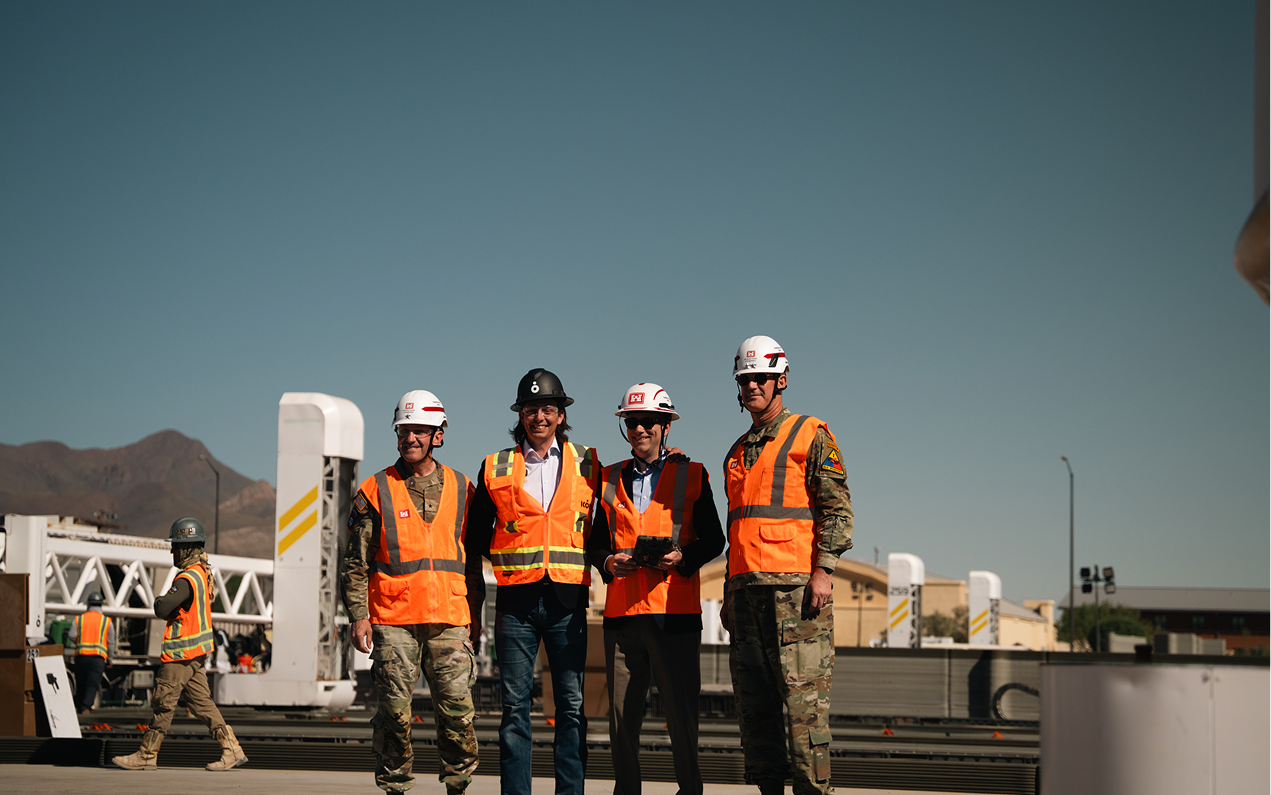
ICON’s CEO, team members and military personnel at a 3D printed construction site. Image courtesy of ICON.
Even in an industry in which hiring heavy-hitters with government experience, or appointing them to the board, has become fairly commonplace, this hire stands out. Will Hurd has wide bipartisan respect and well-earned legitimacy in precisely those areas that will be at the center of his work at ICON, which should result in policymakers taking AC more seriously as a tool for addressing the mounting difficulties in US construction.
I think what might be most striking about the hire is that Hurd isn’t your typical anti-regulation conservative, especially when it comes to AI. He’s, in fact, played a major role in laying the foundation for existing US law on AI, and has argued that solidifying rules on IP ownership and implementing workforce development initiatives to reskill workers for an age of machine learning should be among the pillars of an effective national AI strategy.
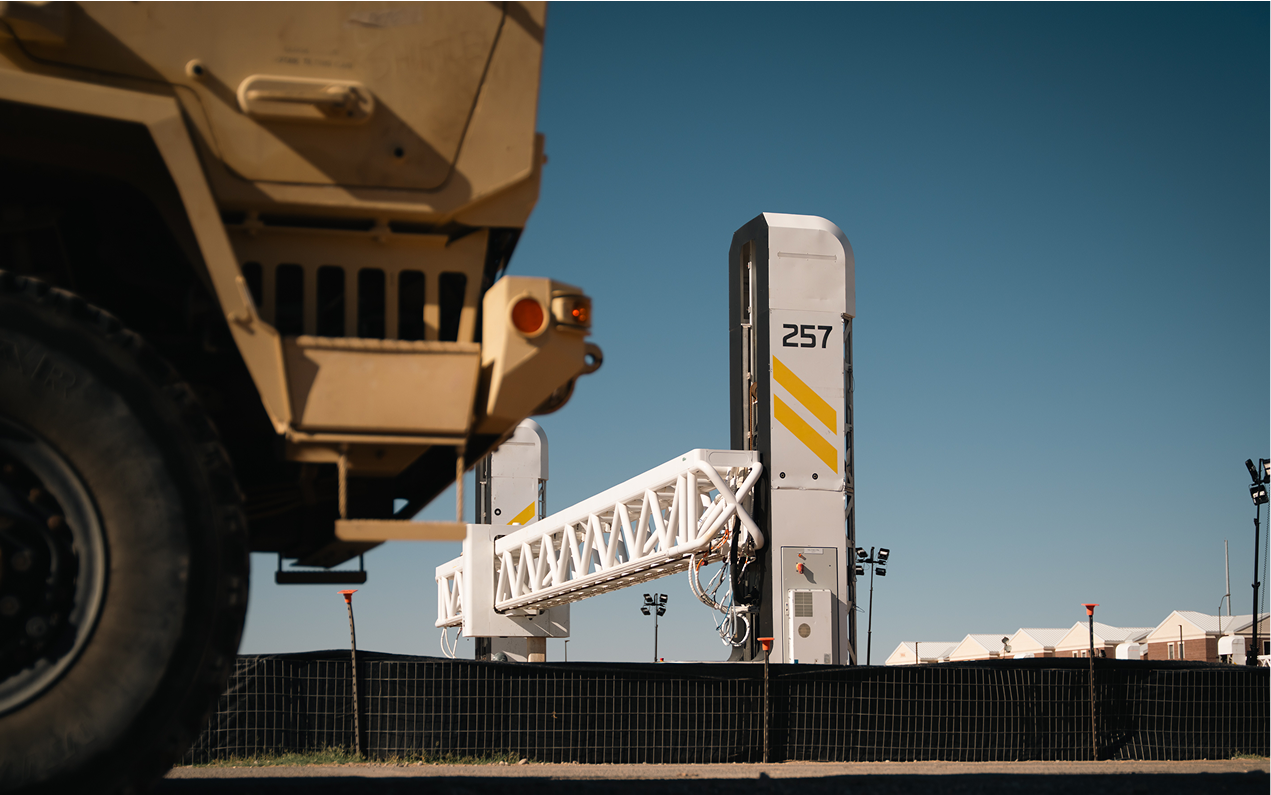
Close-up of one of ICON’s robotic gantry systems at a defense site.
This is exactly the sort of thinking required to transform deep-tech potential into commercial reality, especially in an industry as strictly regulated as is construction. However realistic the goal of 900 barracks within five years may or may not be, it certainly sounds far more plausible now that Will Hurd is involved.
I think the most interesting thing to pay attention to will be how ICON can leverage its success in the military and space to gain more traction in attracting federal funding for residential projects. That’s probably still a few years down the road, but, at the moment at least, ICON certainly appears to be the company that can achieve that pivot.
Images courtesy of ICON