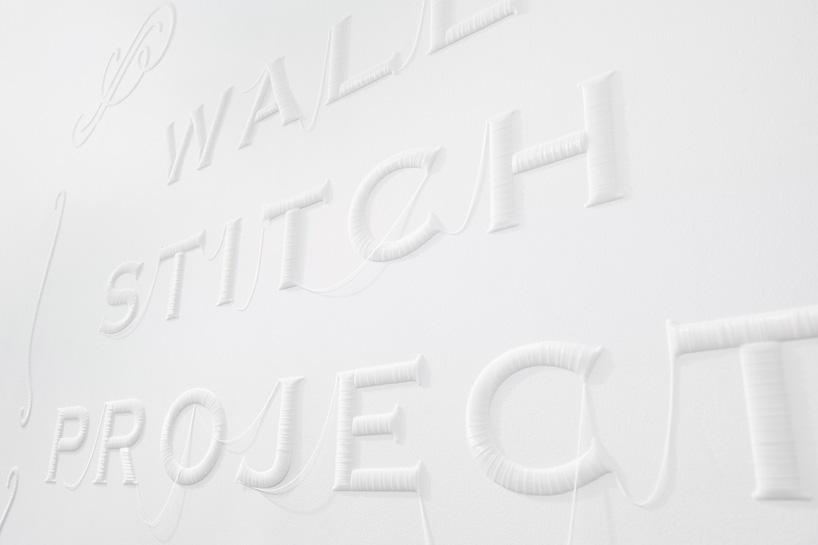
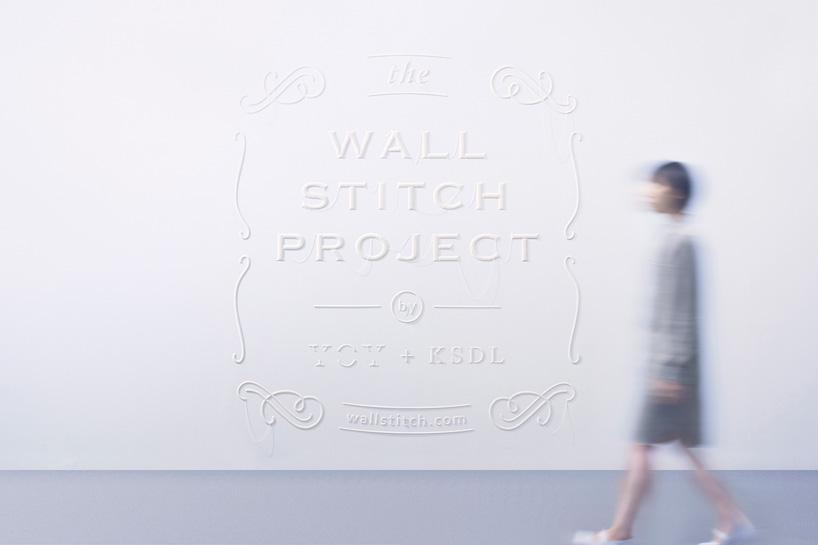
The walls appeared to be covered in embroidery at one display at Tokyo Designer’s Week 2014.
It’s a story that takes some history to understand.

Scene from the Bayeux Tapestry
Embroidery is a method of using thread to sew patterns onto textiles in decorative patterns that dates back at least two and a half millennia. It’s quite possible that its history extends much further back than that even, but the nature of textiles means that a great deal of what has been made has already been lost to time and decay. One of the most famous pieces of embroidery in the Western world is the Bayeux Tapestry, a nearly 70 meter long piece of cloth depicting the history of the Norman conquest of England and believed to have been completed in the latter half of the eleventh century.
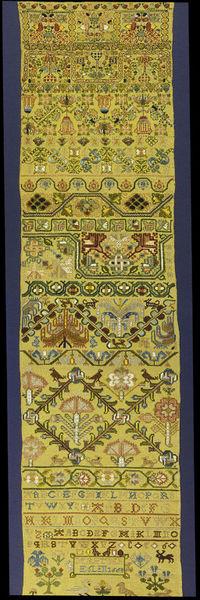
Sampler created by Martha Edlin when a school girl
By the 17th century, embroidery was something that would have been practiced as a standard part of any girl’s education and was used to create samplers that bear witness to the meticulous labor of tiny hands. For generations, girls, such as Martha Edlin (1660-1725), created panels to demonstrate mastery of a variety of patterns and letters. The basic stitches, such as the chain and the cross, require a great deal of practice in order to produce them consistently and with sufficient control to render designs from the simplest rosette to the most complicated arabesques.
More recently, the task of embroidery has been taken from the arena of feminine handicraft into the world of mechanization with the introduction of embroidery machines ranging from smaller ones meant for home use to large scale, industrial embroidering machines.
And now, even 3D printers are getting in on the action.
Or rather, 3D printers are being used to create effects that appear as embroidery. The Japanese design studio YOY, in collaboration with K’s Design Lab, has created a system for signage that utilizes the appearance of embroidery while being actually produced using 3D printing. This project’s attention to detail makes this creation more than simply letters with an interesting texture. Plastic ‘strings’ drape between the letters as dropped threads, the delicacy made possible by the very nature of 3D printing.
That same interest in juxtaposition is present in the Wall Stitch Project as the appearance of having been created with soft goods conflicts with the durability and hard plastic nature of the letters themselves that can be removed from the wall and reattached. There is also the interest created through the collision of ancient handicraft and cutting edge technological production, as well as the feminine history and associations of embroidery in contrast the masculine nature of and predominance in 3D printing.