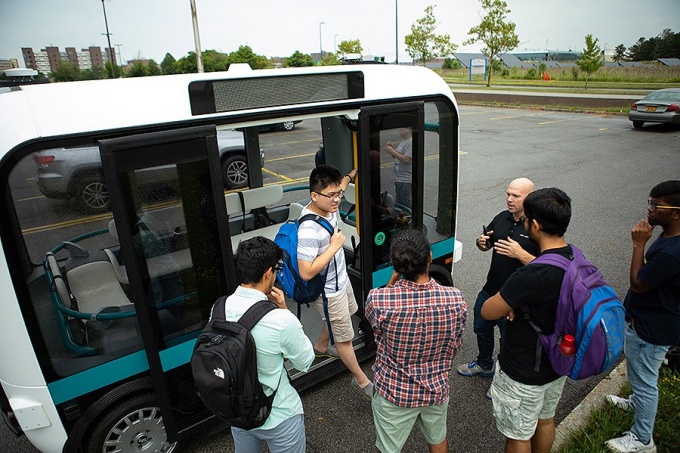
[Image: Douglas Levere]
“Our partnership with UB is about progressing development of autonomous vehicles forward through open collaboration and the sharing of data,” Matthew Rivett, Local Motors Executive Vice President, told 3DPrint.com.
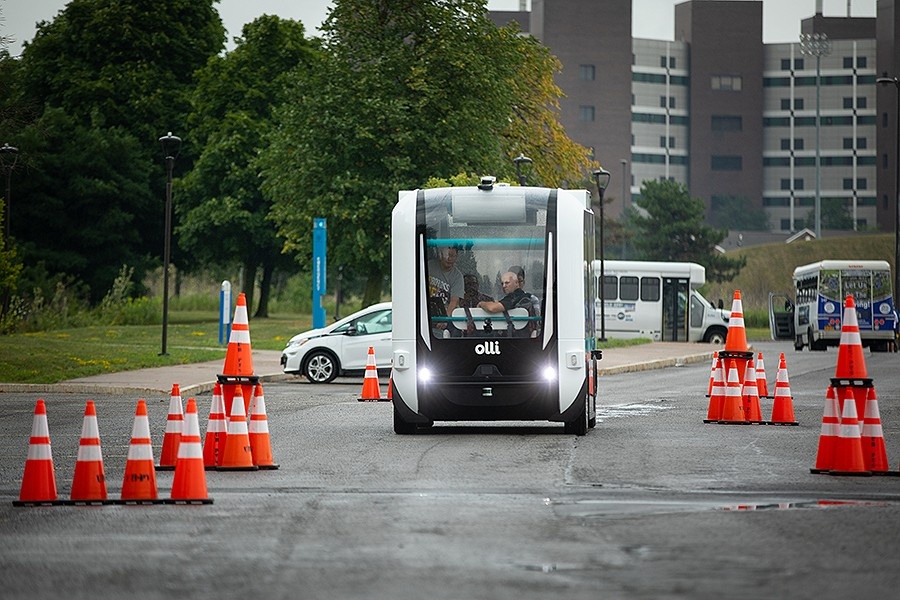
“We are pleased to partner with the University at Buffalo and the State of New York to implement and customize Olli for their mobility testing and sustainability strategies,” said Rivett. “This partnership showcases how campuses, states, and others can invest in and explore the future of transportation. Local Motors looks forward to assisting UB and future partners on practical solutions and research opportunities for mobility challenges.”
Though there are still concerns about the safety of autonomous vehicles, Olli has been shown to be a safe and reliable mode of transportation in a variety of settings. The shuttle is customizable and can be used as a singular vehicle or as part of a larger train of vehicles. Olli’s 3D printed construction easily enables its customization options, as well as being an efficient and eco-friendly means of production. The autonomous shuttle was first created in 2016, and is leading the way for other self-driving vehicles in development, many of which are also employing 3D technology.
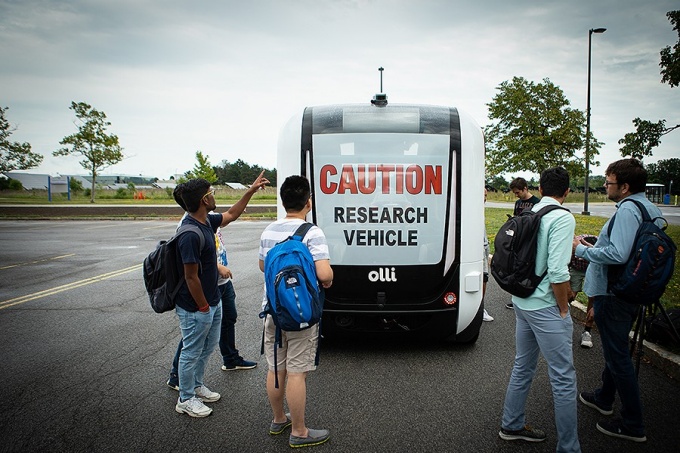
“We’re excited to have the Olli shuttle on campus, advancing the state as a leader in driverless technology while expanding our knowledge of human-automation interaction, critical to understanding artificial intelligence and machine learning,” said University at Buffalo Vice President for Research and Economic Development Venu Govindaraju. “We’ve designed UB’s ecosystem — from world-class researchers and facilities to dynamic partnerships with government and industry — to support these opportunities that foster discovery, innovation, and collaboration.”
Olli is a highly sustainable transportation option, as it encourages commuters to employ mass transit and also runs off of electricity. Before individuals begin driving autonomous cars, we are likely to see more self-driving mass transit options like Olli. Olli isn’t a super-speedy vehicle, with a maximum speed of 25 mph, but as a shuttle, it doesn’t need to be. The autonomous vehicle is especially well-suited to environments like college campuses or city streets – you won’t see Olli flying down a highway anytime soon. The next step in autonomous vehicles may be self-driving individual cars, but we’re not quite at that point yet. Until then, commuters can take advantage of the major step forward in technology that is the self-driving shuttle.
Discuss this and other 3D printing topics at 3DPrintBoard.com or share your thoughts below.
[Source: Local Motors/Images: Douglas Levere]