

“Recently, we’ve been able to develop protocols for fabrication of perfusable channels in biobased hydrogels, for example in the shape of an earlobe,” Vihar told 3DPrint.com.

They have had prior success in making 2D branched perfusable structures, as well as 3D molded meniscus models out of gelatin, but have now taken their research to the next level and fabricated a complex, geometric network made of vessels that have shaped the vasculature into that of a human earlobe.
“Vascularization is a major challenge in tissue engineering as it currently sets a very restrictive limit on the thickness of tissues that can be fabricated,” IRNAS wrote in a blog post. “New approaches will be necessary to achieve major improvements and the co-development of material and technology will play a vital role in this sense. We’re currently devising new protocols to fabricate vessel systems from other hydrogels to make it more versatile and useful for tissue engineering research. Currently structures are possible using gelatin and alginate.”
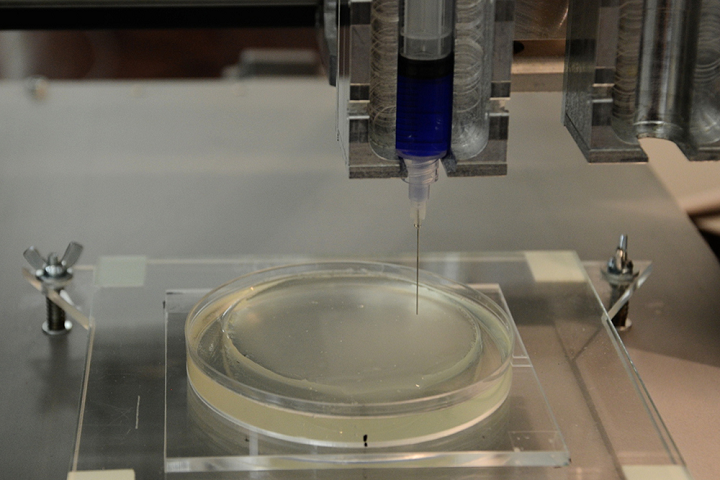

While we’ve seen 3D printed ears before, the work IRNAS is doing with this bioprinted ear vasculature could actually be used as a basis for fabricating 3D blood vessels.
That’s not all that Vitaprint is capable of, however. The compact platform, with a print volume of 200 x 300 x 500 mm, is used to help researchers apply the convenience of biofabrication to their specific applications, in order to, as IRNAS puts its, “facilitate the transition of ideas into operational devices and procedures.”
The Vitaprint workflow is simple:
- Assess case-specific requirements
- When required, undergo hardware engineering and/or customization
- Develop 3D biofabrication methods
- Test and validate developed solutions
- Manufacture the hardware
- Consult and support users and share knowledge

3D printed gluten
The researchers have used their Vitaprint bioprinting system to 3D print woodpile structures out of gluten, and say that other shapes are possible as well. Thanks to its integrated thermal control, Vitaprint allows for FDM printing that matches the melting point of hydrogels and polymers, and as well as controlled extrusion of highly viscous materials, such as pastes. The 3D bioprinter can also fabricate complex anatomical structures, like noses, using gelatin-alginate copolymers.
Vitaprint has optional WiFi and a motorized piston drive, which means an external high-pressure system is not necessary. Multiple slicing software, like Slic3r and Cura, can work with the modular platform, and because it’s open source, users can easily integrate and exchange different tools, like lasers and microscopes, with electrospinning and multi-photon lithography tools in the works.
Let us know your thoughts on this and other 3D printing topics at 3DPrintBoard.com or share in the Facebook comments below.
[Images: IRNAS]