


Lipson said, “We’ve been making great strides toward making robots minds, but robot bodies are still primitive. This is a big piece of the puzzle and, like biology, the new actuator can be shaped and reshaped a thousand ways. We’ve overcome one of the final barriers to making lifelike robots.”
His research team developed a one-of-a-kind artificial active tissue that has an intrinsic expansion ability – without needing high voltage equipment or an external compressor like other artificial muscles. This new material is able to lift 1,000 times its own weight, and has a strain density, or expansion per gram, 15 times bigger than natural muscle. The researchers published their work in a study, titled “Soft material for soft actuators,” in the Nature Communications journal; in addition to Lipson, co-authors include Aslan Miriyev, a postdoctoral researcher in the Creative Machines Lab, and Kenneth Stack.

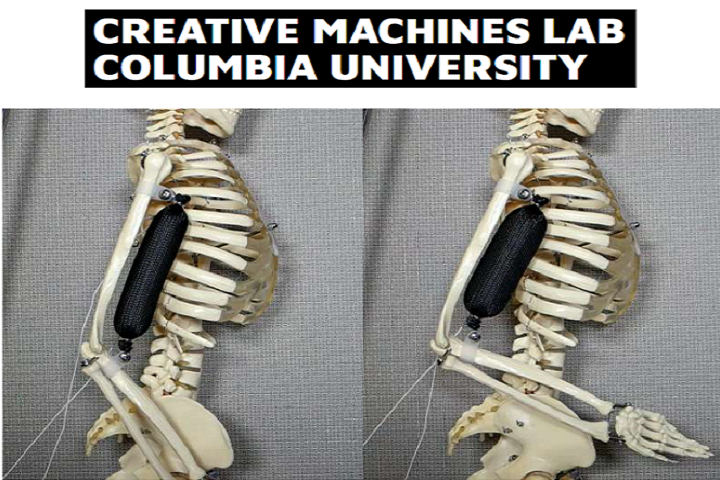
The artificial muscle in use as a bicep lifts a skeleton’s arm to a 90 degree position. [Image: Aslan Miriyev, Columbia Engineering]
According to the abstract, “Inspired by natural muscle, a key challenge in soft robotics is to develop self-contained electrically driven soft actuators with high strain density. Various characteristics of existing technologies, such as the high voltages required to trigger electroactive polymers ( > 1KV), low strain ( < 10%) of shape memory alloys and the need for external compressors and pressure-regulating components for hydraulic or pneumatic fluidicelastomer actuators, limit their practicality for untethered applications. Here we show a single self-contained soft robust composite material that combines the elastic properties of a polymeric matrix and the extreme volume change accompanying liquid–vapor transition. The material combines a high strain (up to 900%) and correspondingly high stress (up to 1.3 MPa) with low density (0.84 g cm−3). Along with its extremely low cost (about 3 cent per gram), simplicity of fabrication and environment-friendliness, these properties could enable new kinds of electrically driven entirely soft robots.”
Soft robotics are inspired by living organisms, and can replicate natural motion, like grasping, to pick up soft objects and perform other delicate tasks that rigid robots can’t handle. They have the potential to work well in fields where robots would often have to interact with humans, like healthcare and manufacturing.

L-R: The electrically actuated muscle with thin resistive wire in a rest position; the muscle is expanded using low power characteristics (8V). [Image: Aslan Miriyev, Columbia Engineering]

(f) The sleigh robot and its locomotion powered at 8 W (8 V, 1 A). (g) Tetrahedral robot evolved and 3D printed in 200034 with embedded electrical motor. (h) The same robot with the soft composite material as an actuator embedded instead of the electrical motor.
The actuator was 3D printed on a lab-made desktop 3D printer, which uses a 14 gauge syringe tip for the best results and is able to print with two materials at once, while the robotic demonstrators were printed on commercially available FDM machines: the Ultimaker 2+ used PLA to print the sleigh robot, while the Stratasys uPrint fabricated the tetragonal evolved robot using ABS. Once the artificial muscle had been 3D printed into the correct shape, eight volts of power and a thin, resistive wire were used to electrically actuate the artificial McKibben muscle. Multiple robotic applications were used to test the 3D printed actuator and muscle, and it displayed a “significant expansion-contraction ability.”
When electrically heated to 80°C, it was able to expand up to 900%, and computer controls helped the autonomous unit perform many motion tasks. The team will keep working to improve upon their work, and the first order of business is to replace the embedded wire with conductive materials, to give the muscle a longer shelf life while also increasing its response time. A long-term goal will be to “involve artificial intelligence to learn to control the muscle, which may be a last milestone towards replicating natural motion.”
Miriyev said, “Our soft functional material may serve as robust soft muscle, possibly revolutionizing the way that soft robotic solutions are engineered today. It can push, pull, bend, twist, and lift weight. It’s the closest artificial material equivalent we have to a natural muscle.”
The study was funded through a grant awarded by the Israeli Ministry of Defense, and also through the university itself.
Discuss this story and other 3D printing topics at 3DPB.com, or share your comments below.
[Source: Columbia Engineering]