Continuous Oscillatory Baffled Reactors: Complex Lab Equipment Made Easy Through 3D Printing
Clare Scott
Continuous oscillatory baffled reactors (COBRs) may be baffling to many, but for Victor Sans and his team at the University of Nottingham, the equipment is vital to their work. The complex structure of the reactors, which are used to crystallize solids from continuous flow reactions, makes them superior to simpler tubular flow reactors in that it reduces solid deposition and improves reagent mixing. Unfortunately, that complex structure also means that they’re very difficult and time-consuming to fabricate – they’re made from blown glass and require high-powered pumps that typical research labs don’t have.
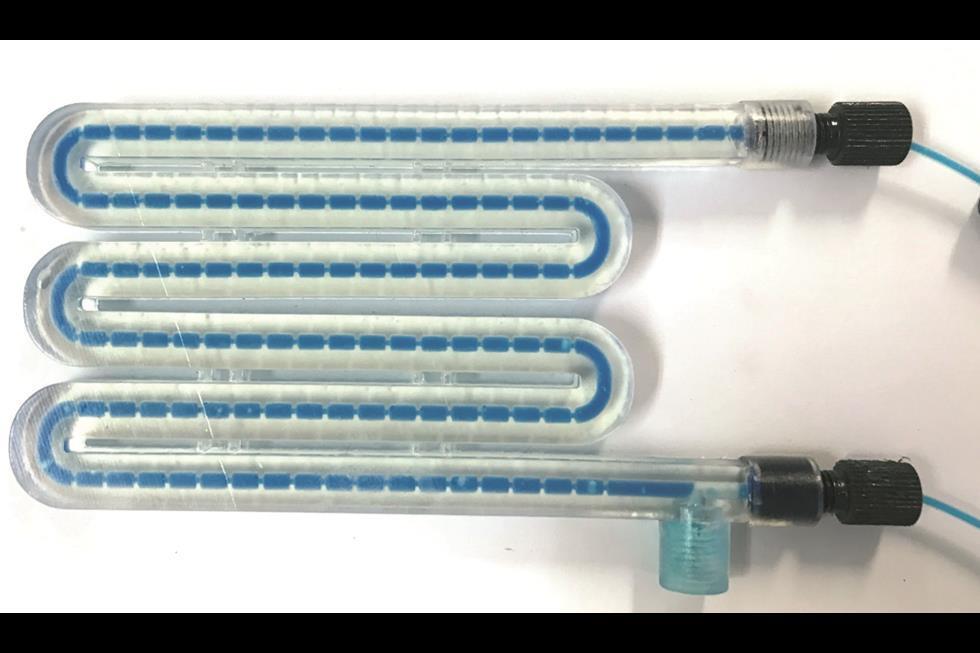
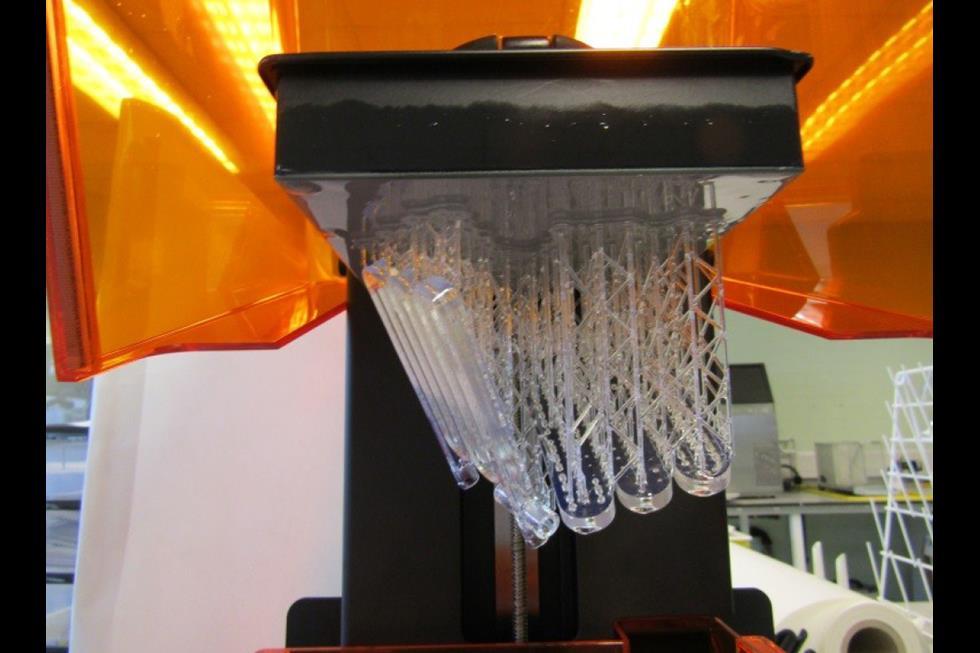
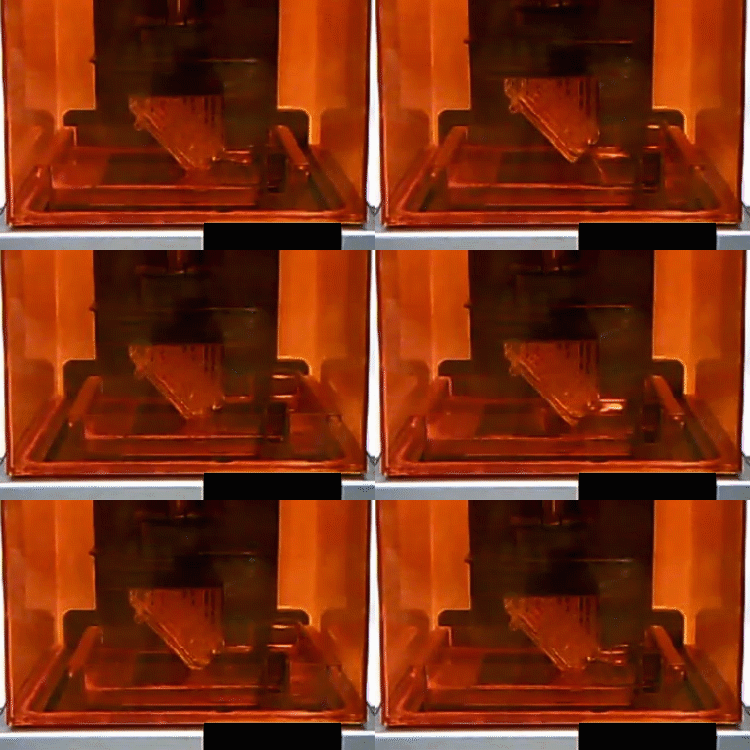
Sans and his team decided to see if there was a simpler way to manufacture COBRs – and of course there was, in the form of 3D printing. In a study entitled “Advanced reactor engineering with 3D printing for the continuous-flow synthesis of silver nanoparticles,” Sans’ group documents how they created a COBR for silver nanoparticle synthesis. Customizing the design for their specific study, they 3D printed a COBR using an SLA printer for no more than the cost of resin – about £8 worth. Not only did 3D printing the reactors reduce cost and time – each one took about five hours to print – it allowed the lab to create COBRs at a much smaller scale for more precise work.
[Image: Royal Society of Chemistry]
“This scale is unprecedented,” says Sans. “It bridges the gap between what would be a microfluidic device and a mesoscale reactor…[There is] nothing stopping us from using our imaginations to come up with completely new geometries [for reactors].”
[Image: Royal Society of Chemistry]
3D printing the COBRs also means that the lab can create as many as they want, accelerating their work by running multiple reactors at the same time. According to Sans, the flow dynamics of the miniaturized COBRs, or mCOBRs, allow for suspensions of nanoparticles that are much smaller and more regular than those produced by a tubular reactor of similar channel width, which is quickly fouled up by silver deposits. Later, tubular reactors.
“Residence time distribution experiments have been employed to demonstrate that these small scale reactors offer improved mixing conditions at a millimetre scale, when compared to tubular reactors,” the research paper states. “Nearly monodisperse silver nanoparticles have been synthesised employing mCOBR, showing higher temporal stability and superior control over particle size distribution than tubular flow reactors.”
Victor Sans (front row, second from left) with members of his research group. [Photo: Sans Research Group]
Scientists at the University of Nottingham have been busy lately, reporting the use of 3D technology for everything from fuel-efficient cars to the discovery of hidden chambers in 16th century estates. The university was granted funds for a fancy new 3D printing research lab in 2015, and they’ve clearly been using it well. Sans himself is interested in using the technology for the development and fabrication of devices with applications in a variety of areas, including, according to his lab group’s website, catalysis, biocatalysis, energy harvesting, and, of course, reactor engineering.
[Image: Victor Sans]
Sans’ research is focused on the application of chemistry to solve what he calls “some of the contemporary grand challenges,” such as climate change, sustainable energy, and antimicrobial resistance, in addition to developing better manufacturing processes. So while you may still be baffled by continuous oscillatory baffled reactors, rest assured that they’re being used for great things in Sans’ lab – with even more efficiency and efficacy than before, thanks to 3D printing.
Additional authors of the mCOBR study include Obinna Okafor, Andreas Weilhard, Jesum A. Fernandes, Erno Karjalainen, and Ruth Goodridge. You can access the full study here. Discuss in the Lab Equipment forum at 3DPB.com.