
After announcing plans to start construction on a multimillion-dollar 3D printing manufacturing facility earlier this year, Stryker went on to develop their 3D printed Tritanium Posterior Lumbar (PL) Cage Spinal Implant, which was debuted at the American Association of Neurological Surgeons (AANS) Annual Scientific Meeting back in May. Last week, the Spine division of the medical technology company announced the completion of a pre-clinical study for this Tritanium PL Interbody Cage.
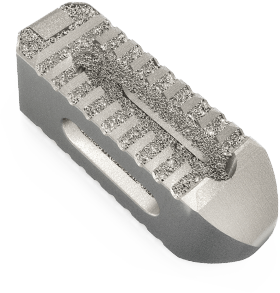
Stryker’s 3D printed Tritanium PL Interbody Cage
The results of the study compare their highly porous titanium alloy with the biomechanical, radiographic, and histological performance of commonly used implants with different surface technologies in an ovine lumbar interbody fusion model. The materials involved in the comparative study include traditional PEEK cages and plasma-sprayed titanium-coated PEEK cages. Using their proprietary Tritanium Technology, Stryker was able to produce a material with porous structures that resembles spongy bone tissue.
“Stryker’s proprietary Tritanium Technology, a novel, highly porous titanium alloy material designed for bone in-growth and biological fixation, is based on new additive manufacturing techniques pioneered by Stryker over nearly 15 years,” said Bradley Paddock, president of Stryker’s Spine division. “Tritanium, and this important new study, demonstrate Stryker’s commitment to bringing the latest technologies to our customers, and a growing number of surgeons are turning to our new Tritanium PL Cage.”
The pre-clinical study demonstrated that Stryker’s Tritanium PL cages promoted reductions in segmental motion, as well as increases in construct stiffness across all three loading directions between the prepared 8- and 16-week post-implant time points. Neither of these advantages were found when utilizing PEEK and plasma-sprayed titanium-coated PEEK cage groups (p<0.02). In addition, micro–CT and histological data showcased much greater total bone volume within the Tritanium PL Cage at the same 8 and 16 week periods when compared the other treatment groups.

The study, entitled “Biomechanical and Histologic Comparison of a Novel 3D-Printed Porous Titanium Interbody Cage to PEEK”, was recently published in The Spine Journal. Stryker also made the results of this pre-clinical interbody fusion study is also available on their website. The results of this study were presented at the North American Spine Society (NASS) Meeting, which took place in Boston from October 26-29.
All in all, the results show their Tritanium PL cage implant to have superior range of motion, quality bone in-growth profile, and greater construct stiffness when compared to the other cages. Still, these findings have yet to demonstrate this correlation to human clinical outcomes, which will likely be the next step for Stryker to make this implantable material useful to the medical sector. Discuss in the 3D Printed Spinal Implant forum at 3DPB.com.