
Many companies and research labs are studying the processes associated with 3D printing and additive manufacturing, along with weighing out the pros and cons. It’s doubtful that anyone puts as much detailed effort into their studying and exploration, however, as NASA. As one would expect, Destination: Space tends to put a substantial amount of seriousness into even the smallest of projects and constructions. Now, engineering teams at NASA’s Marshall Space Flight Center in Huntsville, Alabama are truly getting into minute detail as they begin researching exactly how neutrons will have a positive impact on 3D printed rocket engine parts.
Sometimes scientific research involves a little help from other facilities as well, evidenced here as the team from NASA used the Neutron Residual Stress Mapping Facility at Oak Ridge National Laboratory’s (ORNL) High Flux Isotope Reactor (HFIR), beam line HB-2B. With the ultimate hope of finding 3D printed materials suitable for space flight, the NASA researchers closely examined residual stress and how it affects certain parts. If they were to be qualified for use by NASA, both reduced cost and accelerated speed in production would obviously be extremely positive.
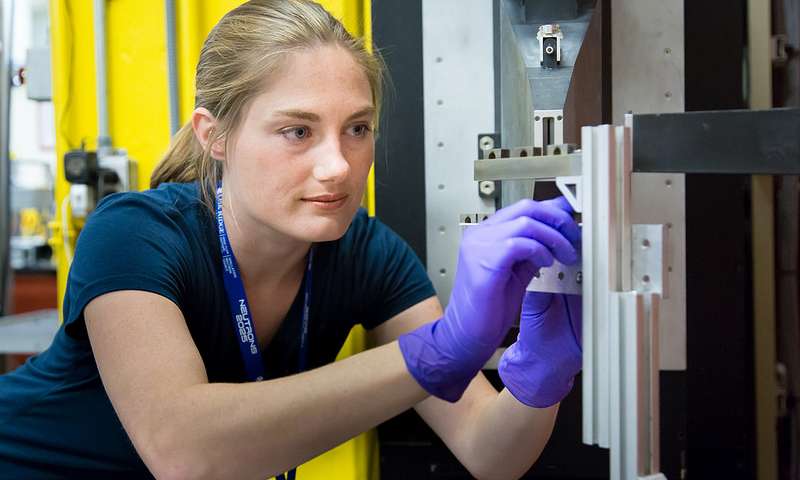
Stacey Bagg, one of the research engineers from NASA’s Marshall Space Flight Center, uses HFIR beam line HB-2B as her team studies 3D printed parts for eventual validation in space flight. [Image: Genevieve Martin/ORNL]
“Using the additive manufactured version of one engine component we are studying could reduce the amount of time needed to build a space-flight ready engine by years,” said Stacey Bagg of NASA Marshall.
And while we all like to see both money and time saved in any project, for NASA the priority is in safety. Nothing else pre-empts that factor, which speaks very highly of NASA’s fondness for employing 3D printing technology already. This means, of course, that corners cannot be cut in the research and development phase.
“Of particular concern are the residual stresses in the resulting additive manufactured components, as residual stresses may affect material properties and resultant part geometries and are difficult to measure on the resulting complex shapes,” said Bagg. “The HFIR neutron residual stress facility provides the unique capability to take detailed internal residual stress measurements on these shapes.”
[Image: Genevieve Martin/ORNL]
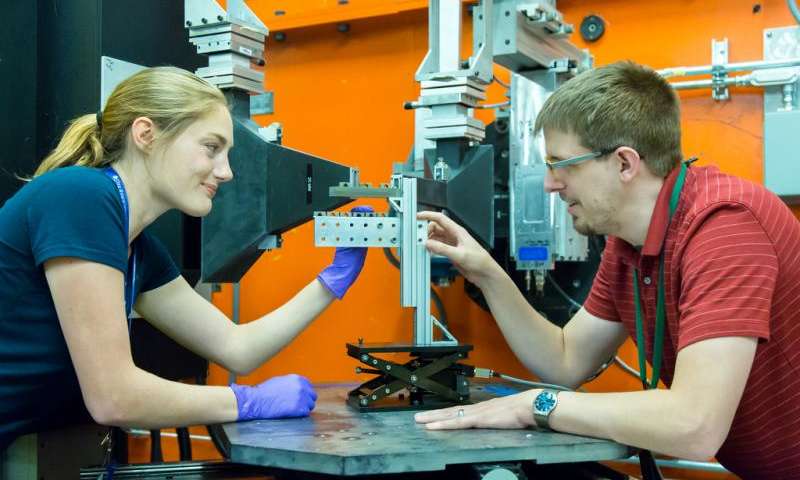
Jeff Bunn, right, ORNL postdoctoral research associate and HB-2B instrument team member, assists Bagg with preparing the experiment. [Image: Genevieve Martin/ORNL]