
This latest is not the first major project we’ve seen from CMU, as we have been following them since the opening of their MakerBot Innovation Center last year, just recently reporting on the story of a sophomore there who made a 3D printed Captain America prosthetic hand for an eight-year-old with moebius syndrome. Originally stating their mission was to center the lab around arts and human services, the faculty and students are certainly following through and building an impressive foundation.
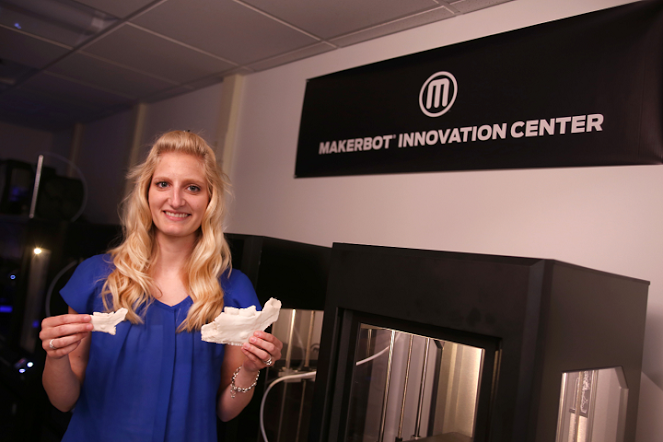
Jennifer Webb in the CMU MakerBot Innovation Center.
Now, we have a follow-up regarding work by Jennifer Webb, an anthropology student at the university who has been working on a fascinating project we reported on back in April, related to the discovery of the Homo naledi. Inspired by the excavation that was ongoing for two years in South Africa after cavers Rick Hunter and Steven Tucker found an underground room of ancient bones, Webb’s part in the story of Homo naledi began when the team not only released the formal name for this new species, but also began offering the 3D scans online at MorphoSource. A free repository meant for researchers to share information as quickly as possible, MorphoSource is quickly becoming an extensive project-based archive.
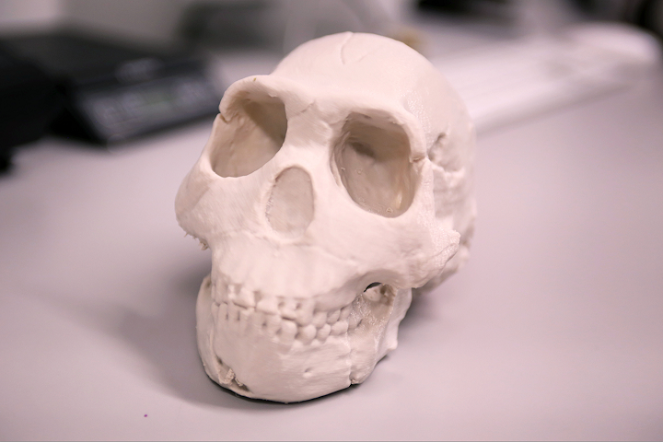
Rather than waiting years for archaeological information such as that of Homo naledi to arrive in detail, not to mention counting on budgets for access to fossils and more, scientists can use MorphoSource to download and 3D print incredible replicas of fossils such as the Rising Star cave system find. And they can do this expediently, and with no charge. Webb has been doing just that at the CMU MakerBot Innovation Center, using the prints to investigate her theory that Homo naledi may possibly be much younger than the original estimation of two million years old. The young scientist states that the original casts are still unavailable, but no worries, as she will be printing a total of ten replicas to study by the end of summer, documenting Homo naledi’s relationship to other species.
“The digital scans are available online for the species,” Webb said. “That allows a lot of people to do research. Because we had that access, we thought 3D printing would be a great alternative to casts.”
Due to their location, and in a mass burial, the bones offer clues—and here, a major one is that these Homo naledi fossils serve as indicators of a culture civilized enough to have rituals regarding death, and more. Webb believes this is telling, and as a result hypothesizes that indeed that bones could be younger.
“Bones are important because they tell stories,” Webb said. “You learn to read what they are telling you based on the characteristics that you can look at and feel. It helps you understand things that happened to them in their past.”
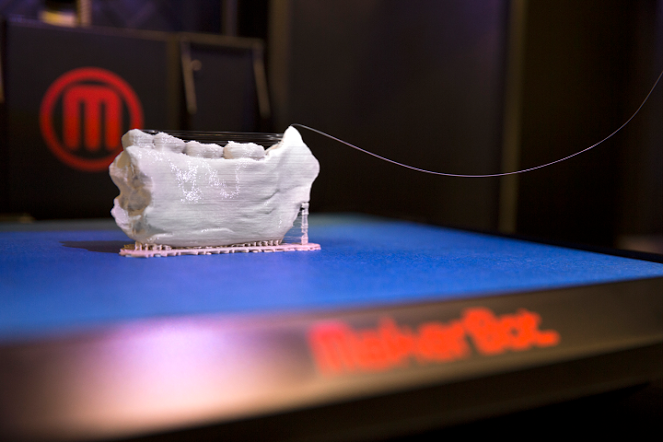
The CMU student t is also focused on the teeth of Homo naledi. She studies the following:
- Crowns
- Cusps
- Number of roots
- Wear patterns
These can be compared to more modern humans and their dental characteristics from about 100,000 years ago, with fossils that were found there in the same region. Examination and comparisons between the two cultures will help determine how old those teeth are.
“If the species turns out to be around 2 million years old, then it will be the earliest appearance of the Homo genus that demonstrates such primitive morphology and ritualized behavior at the same time,” Webb said. “If it turns out to be closer to around 1 million years old or younger, it would mean that many different types of ancient humans coexisted at similar times in South Africa than was previously thought.”
“Historically, it has taken up to 20 years for research to be published after a dig site is discovered,” CMU anthropologist Rachel Caspari said. “These are young scientists, however, and they are doing things differently. By making the scans available online, others around the world can be a part of the research. It makes it more egalitarian and can make science work much better.”
“It’s a totally new way of doing science in our field,” says the supervising anthropologist. “If every fossil was scanned, and we could print them all out, we could have the whole human fossil record in front of us relatively cheaply. It would be fantastic.”
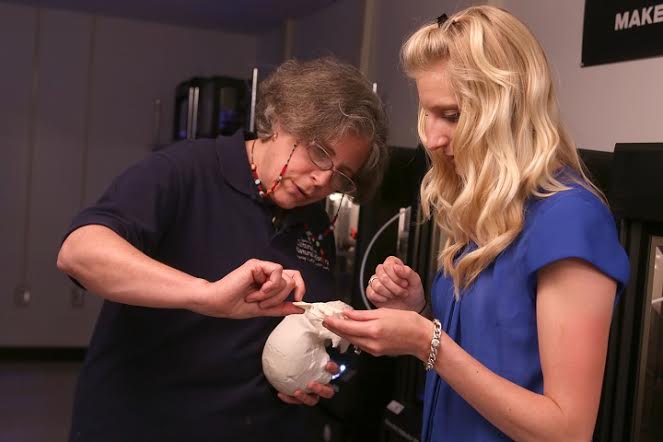
Caspari and Webb
We’ve also seen 3D technology affecting other scientific cases, and often as museums are putting together entire skeletons of prehistoric creatures like dinosaurs, from Dreadnoughtus to T. rex. With both 3D scanning and printing technology, scientists are able to recreate missing parts from enormous skeletons, adding to collections and exhibits. Not only that, they are able to educate the public on how 3D printing is positively affecting their fields, even spotlighting which parts were 3D printing within an exhibit.
While essentially there is still no better way to find old bones than to scout, find, and then set up a dig, often quite extensively, today we see that after a find of any size, 3D technology is allowing for a transformation in anthropology and related sciences through the sharing of information around the world, enriching many—rather than just one team for many years—showing some fascinating progress in a modern world driven by ever curious Homo sapiens who seem to be growing more generous with their finds—finally! Discuss further in the 3D Printed Homo Naledi Fossils forum over at 3DPB.com.
[Source: Central Michigan University / All images supplied directly to 3DPrint.com by CMU.]
