
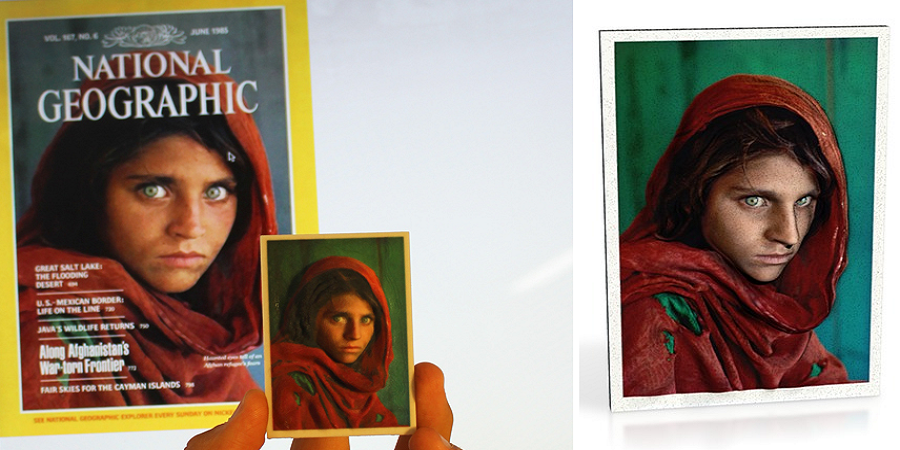
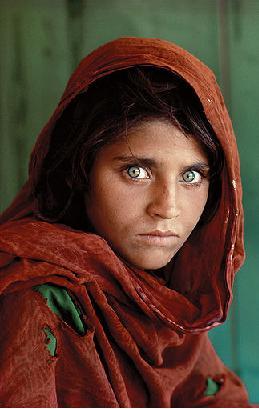
Sharbat Gula’s story resurfaced in 2002, when McCurry decided to track down the subject of his photo, although he had never learned her name. Like the rest of the world, he knew her only as “Afghan Girl.” Due to the miracles of technology and networking, however, he managed to find her, and the former refugee woman once again drew the world’s attention, although it was the first time that Gula had seen the photo of herself. She had been living in a remote, mountainous area and had no idea that people around the globe were referring to her as “the Afghan Mona Lisa.”
A Turkish designer named Erçin Gündüz decided to honor this famous photo by reproducing it in 3D. Available on Shapeways, the reproduction is full color sandstone, with a width of 4.772 cm, a height of 7 cm and depth of 1.316 cm. In such a small scale, Gündüz , a self-described “old 3D character artist” who formerly worked in the game industry and is currently a singer, songwriter and dance teacher, has still managed to reproduce the piercing gaze of the young girl with the green eyes. The design was printed by Turkish retailer 3Durak using a Projet 660 Pro. Gündüz and 3Durak hope to deliver the print to Gula herself, and would also love to see the print on the cover of National Geographic, creating a tie-in between their most famous image and the 3D printing industry.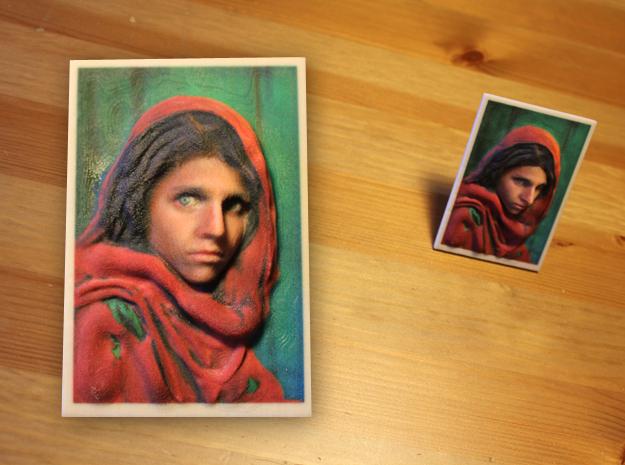
“She’s had a hard life,” said McCurry, upon reuniting with Gula in Afghanistan after 17 years. “So many here share her story.”
Her story is, tragically, shared by many outside of Afghanistan as well – the most current being the desperate refugees fleeing Syria. Their crisis has recently produced its own iconic image as well, though a much more grim one – there will be no following up with the c
“People volunteered to work in the refugee camps because of that photograph,” he told CNN. “Afghans are incredibly proud of it, as the girl is poor but shows great pride, fortitude and self-respect. It drew attention to their plight, and inspired a lot of people.”