
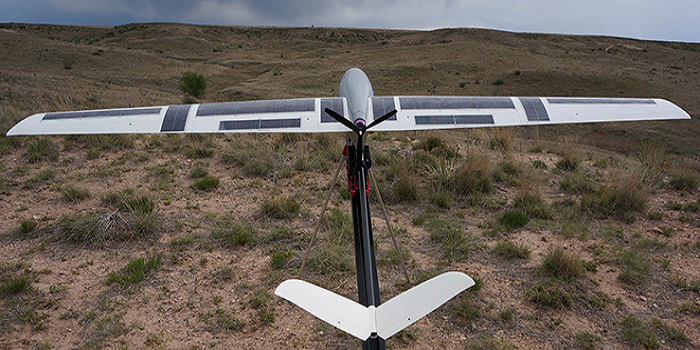

Toby Lankford (also known as tlankford1) is doing all of this, but he has several unique things going on with his single construction, fully 3D printed aerial project, Icarus 3.0. One, he plans to catch some bad guys with it. Two, it will run on both solar power and hydrogen. Lastly, the project is in the running for winning the 2015 Hackaday Prize, as Lankford participates in the yearly challenge which asks inventors to be creative while solving a serious solution at the same time.

“I work with civilian UAS and ground robotics across several fields from survey to anti-poaching. I like working in open sourced projects and contributing to overcome development and application challenges. We live completely off grid for over three years and our hackerspace and all we develop is off grid as well,” says Lankford.
His latest project, Icarus 3.0, will indeed also be released as an open-source design on Thingiverse, and should be of note to those interested in using 3D printing in combination with aerial engineering. Using dual extrusion and with the hinges built into the modular design, Lankford was able to fabricate the wings in one 3D print.
The 3D printed Icarus, capable of automated takeoff and landing, is stated to be the longest-flying plane under 5g, able to fly for up to twelve hours. It also has a number of other very notable features:
- Rapid payload and power switching
- Solar power as fuel, with alternate ability to use hydrogen
- Ability to fly long ranges of 200 km with endurance of 180 minutes
- Employment of ‘fire and forget’ autonomous mission from launch to recovery

Aside from the obvious innovative features already listed, what also makes this unique for helping to spot and catch poachers is the use of custom image recognition software and TCP/IP cloud control for observation or control from anywhere in the world. The camera equipment and sensors are obviously extremely important for this project in particular.

“We are able to use high end camera modules for thermal, multispectral, and visible light images and video,” says Lankford. “All camera modules are digitally connected and the plane of course communicates through a long range mesh network or GSM module, providing a live encrypted link.”
The full list of components is as follows:
- (2) Odroid U3 – Unbuntu Linux based embedded processors
- (1) Range Video RVJET Flying Wing for air frame
- (1) Cyclops C UAV for air frame
- (2) Piksi RTK GPS – centimeter accurate RTK GPS
- (2) Pixhawk AP – autopilot
- (2) DroneDeploy cloud communications for mobile network communications
- (2) Iridium 9252 for satellite modem communications
- (2) Machine Vision USB camera for multispectral machine vision for ID software
- (2)Thermal imaging camera for machine vision for night ops
- (2) RFID
- (1) Flexible solar panel – Alta Devices GaAS Panels
Lankford’s very specific–and noble–goal is to see to see this 3D printed drone used as a bush plane to assist in stopping the poaching of both rhinos and elephants in Africa.
“I wanted to focus this year on promoting drones as a tool for social and environmental good. Poaching is an issue that presented itself as the most urgent. We are at extreme risk of driving rhinos and elephants into extinction in this decade,” says Lankford. “We hope that we can be part of that answer with our anti-poaching cloud swarm UAV system.”
Lankford encourages you not only to vote for the design if you like it, but also to try your hand at building the open-source design for this 3D printed drone.

Brushless gimbal