

Jing Yang
Dr. Jing Yang says the work on 3D printing human tissues for regenerative medical applications uses living cells and biomaterials placed at precise locations to mimic the natural organization of cells. Yang says such “engineered tissues” mimic their naturally-occurring counterparts in the body, and that they may well be capable of superior functionality.
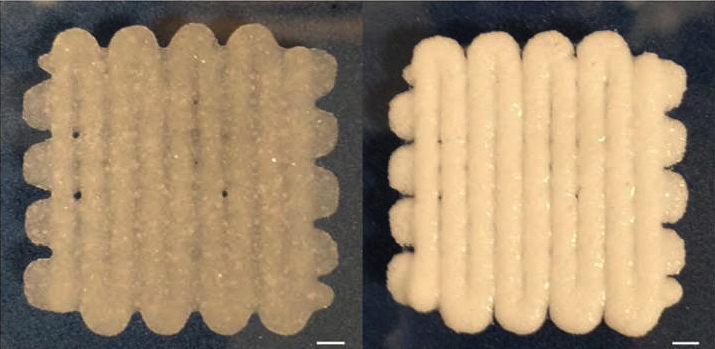
According to Yang, the paste-like bone replacement material can be mixed at room temperature. It’s made of L-lactic-co-glycolic acid and polyethylene glycol carried within a fluid.
“Bioprinting is a hot research area in tissue engineering. It usually requires a printing environment that isn’t compatible with living cells – and those materials that are compatible with living cells usually don’t have sufficient mechanical properties for certain applications,” Yang says.
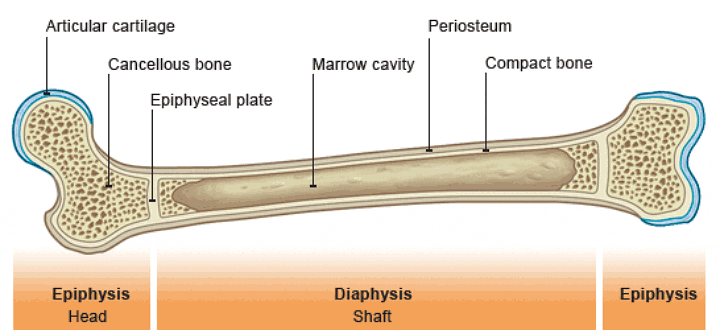
But this new technique and material allows for bioprinting at ambient temperatures and incorporates protein-carrying microspheres which can be injected with a syringe. Yang says the material should be able to withstand stresses and strains very like the cancellous bone it’s meant to replace.
The research findings were published in the journal Biofabrication, and the team says that it is the inclusion of cells and proteins to speed the healing of large fractures is key to the process.
“We’re targeting the clinical application of this material as injectable bone defect filler, but we’ve postulated that its properties would make it highly suitable for use as a scaffold to reconstruct larger shapes, which could help with more complicated reconstructions – such as nasal reconstruction,” Yang says.
Yang says work done in the past has demonstrated that proteins and cells can tolerate and survive through the mixing and extrusion processes and that the “microporosity” of the finished constructs can aid tissue ingrowth.
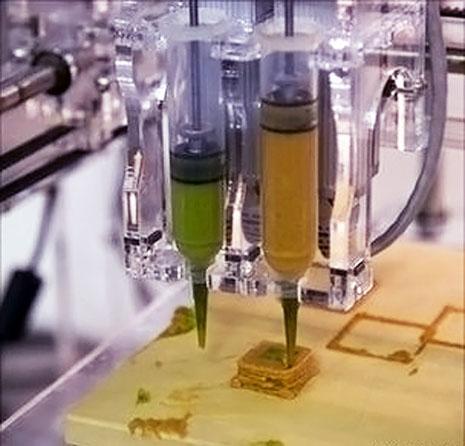
The work represents the initial assessment of the technique and used a Fab@Home bioprinter in conjunction with the PLGA-based, microparticle pastes.
