
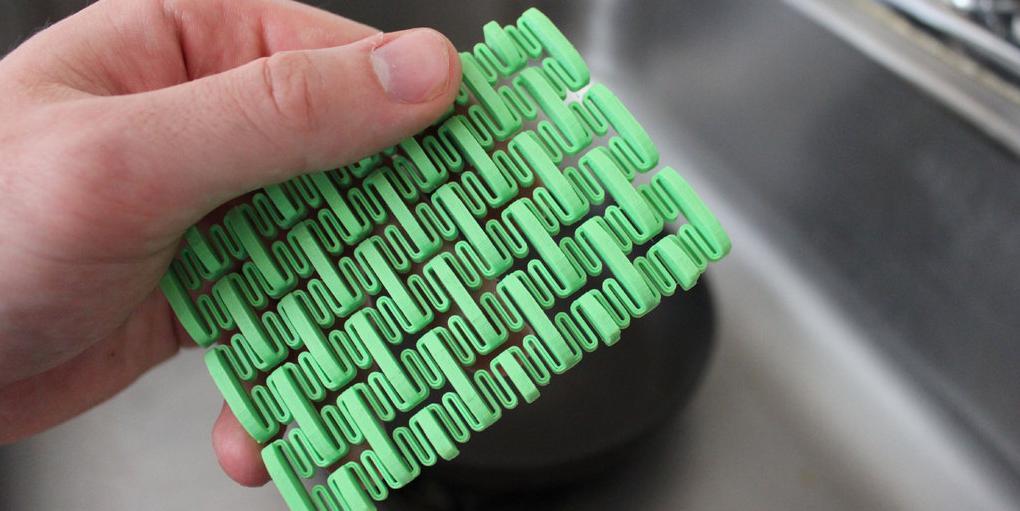
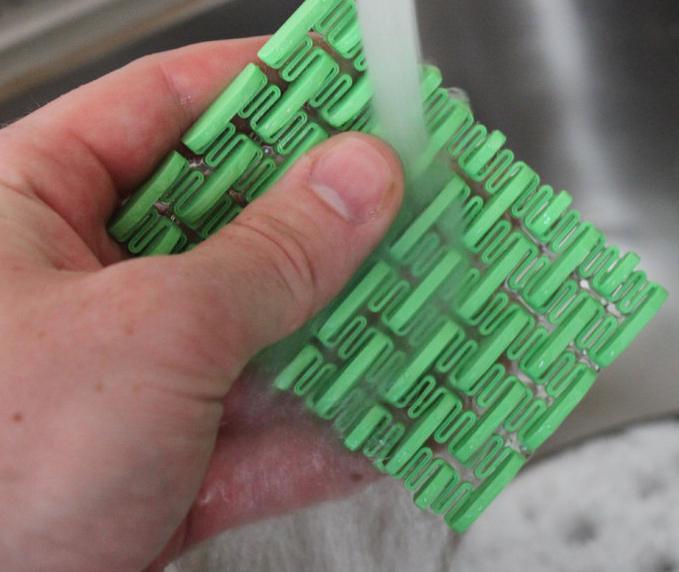
For one man, named Jacob Stanton, a product designer currently working in Chicago, 3D printing has become quite the useful tool. When MyMiniFactory recently launched their latest 3D design competition, Stanton jumped at the opportunity. The design challenged designers to create 3D printable products that can show off the benefits of a new anti-microbial filament called Purement.
“I thought that this material could have a lot of interesting applications, and the first thing that came to mind was the kitchen sponge,” Stanton tells 3DPrint.com. “Some quick research indicated that kitchen sponges are in fact one of the dirtiest things in a household, the typical sponge is about 200,000 times dirtier than a toilet seat. There are about 10 million bacteria per square inch in a kitchen sponge. I cook a lot and find those green abrasive scrubbing pads to be extremely useful, but they can get so gross, even after one use.”
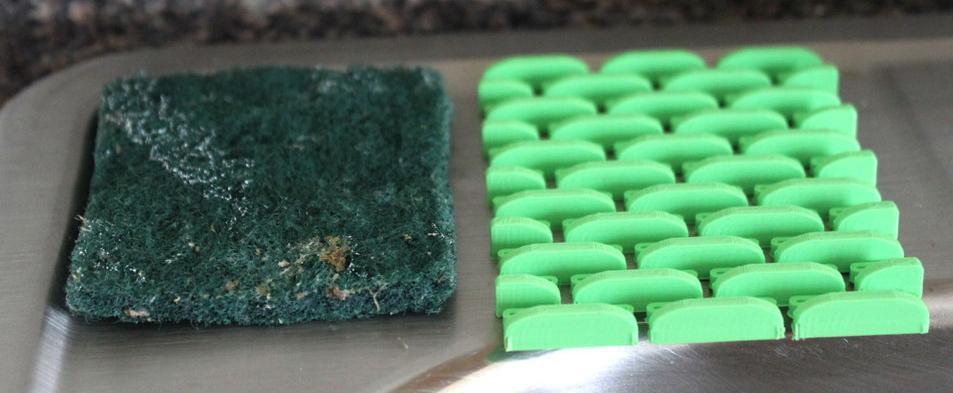
This led Stanton to come up with an idea to 3D print a kitchen scrubber in this impermeable anti-microbial filament. So he began trying out various design ideas that would provide for the ability to scrub kitchen dishes and utensils, and also bend enough so that it could contour to the shape of the object that was being scrubbed.
“Some of my favorite prints were spring-like forms, consisting of undulating lines and spirals,” Stanton tells us. “These explorations first yielded a printed fold-up dodecahedron with a spring and protrusion on each face, so it was able to bounce like a ball. It is interesting how the form of a part could make the rigid PLA plastic behave like a different material.”
Using SolidWorks, Stanton decided to make four different designs which he would then test out.

Stanton’s 4 Different Designs
After printing out all four designs, he tried them all out to determine which design would be the most efficient at cleaning various surfaces. He originally thought that one of his designs, which included “flexible nubs,” would be the best, but he soon found that another design that featured wider nubs was much better at “quickly scrubbing away grime.” Ultimately the design that worked the best was one that featured staggered protrusions. It was easily able to contour to just about any dish surface, had the most scrubbing area, was easy to clean, and held up to bending better than the other three designs.
“I have found that it works best as an abrasive scrubbing pad, for removing stuck-on debris from the dishes,” Stanton explained. “I don’t think it can replace all of the specific tasks of a kitchen sponge, but I find it very useful. I find that it works nicely on cutting boards, and I also lay it flat and use it to take gunk off of my nicer kitchen knives. The biggest surprise was how easily it cleaned up and dried after use. I can just rinse…any residue off and set the sponge on its nubs, [it] is completely dry within a few hours.”

The design files for the this unique sink scrubber are available to download on Thingiverse. It should be interesting to see if anyone else can come up with an even more efficient and effective design. The combination of the Purement filament should really go a long way in helping prevent the spread of bacteria within the kitchen.
What do you think about this unique 3D printed device? Should more people consider using scrubbers like this in their kitchens? Discuss in the 3D printed sink scrubber forum thread on 3DPB.com.