
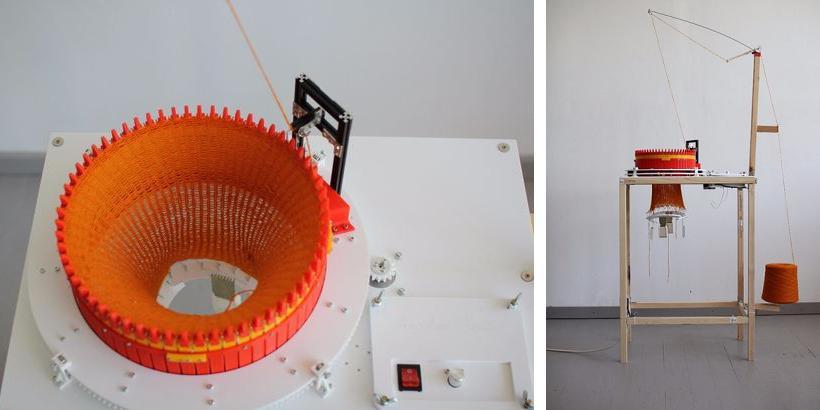
Circular knitting, or knitting in the round, is a technique used to create seamless ‘tubes’ of knit material. Circular knitting can be done either on needles, double pointed or circular, or on a knitting machine. It is a very popular method for creating hats, socks, and sweaters among other knitted necessities. Knitting with the needles certainly has its appeal; it is somewhat meditative and soothing. The sound of the clicking needles, the movement of the yarn through your fingers, and watching a project build up, stitch by stitch, are all enjoyable parts of the process. However, using a knitting machine adds a super sized boost of speed that is also quite appealing.
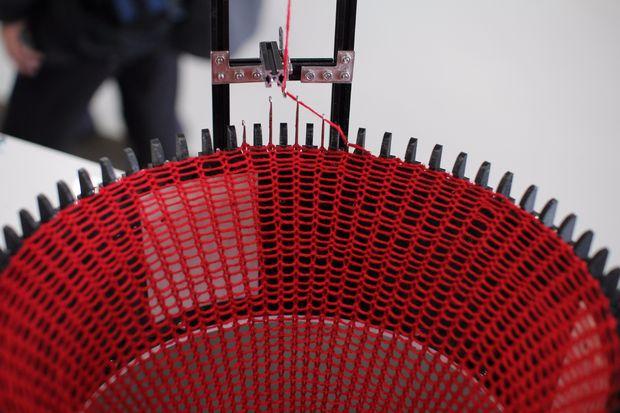
“With the boom of digital fabrication technology, a 3D printer is gradually turning into a commodity that every creative studio has on their desk. At the same time, Fab Labs and makerspaces are a lot about hard-surfact object production while the first digital fabrication tool, an electronic knitting machine back in 1976, has been forgotten and discontinued. Hence, with this project, Circular Knitic, and our earlier one called Knitic, we aim to integrate textile fabrication to the makers’ culture.”
After all, it’s no coincidence that the root of the word ‘fabricate’ is ‘fabric.’

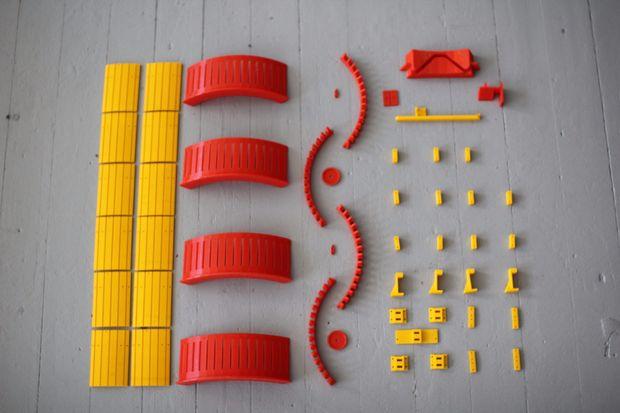
The project, which is detailed completely in an Instructables tutorial, requires laser cutting, 3D printing, basic woodworking, and comfort with electronics. There are 13 steps in total, to go from wish to completion, and a tutorial is included on how to cast on (the term used for starting the first stitch). The 3D print files are available for free download with the name of each file dictating how many copies need to be printed in order to create a complete machine. The creators add an emphatic note accentuating the need to print in high quality with a maximum 0.1 mm layer height.
There has been a hierarchy in making that has generally placed working with hard materials such as wood, plastic, glass, and metal at a higher level than working with soft goods. However, more makers are realizing the complexity and creativity required for the creation of textiles and other soft materials. As these have traditionally been conceived of in the West as feminine activities, they have all too often been ignored or denigrated as areas for creative expression. The creation of the Knitic helps to reintroduce the connection between all forms of making and makes a strong argument for the obvious relationship between 3D printing and knitting as methods of additive manufacturing.
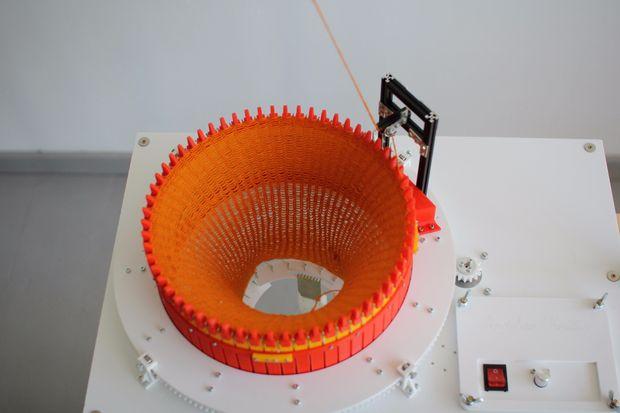
What do you think of this clever creation? Discuss in the Knitic forum thread on 3DPB.com.