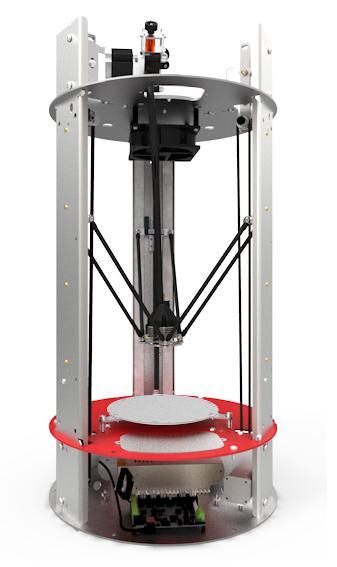
For one company, run by Myriam & Philippe Boichut, they’ve been building and selling delta style 3D printers for quite some time. This week, however, they released their latest version of their rather popular SpiderBot 3D printer.
SpiderBot v2.1, which comes in three different forms — the Standard Kit (starting at 1140,00 €) , Pro Kit and Custom version — has officially been unveiled and made available for purchase this week, with a mere lead time of just 3-5 days.
For those unfamiliar with SpiderBot, their printer features a “tilting dual head” extruder which allows for the printing of more complex parts. It also includes some other high end features such as linear guides, magnetic ball ends, stainless steel rails, a full metal chassis, an enclosure, and the special TSS (Three Sphere) System, which is explained as follows:
“The extrusion head is supported by a single plate with only 3 spheres and the Rod-End magnets. The TSS is a combination of magnets with spherical bearing surfaces at every end of the 6 carbon tubes connected to three spheres on the support plate that holds the extrusion head. The support plate has only three spheres so that each sphere is always perfectly positioned by two arms. Through this support by only 3 points, it is always perfectly parallel to the heated bed. Due to the magnetic connection that can be broken by applying the right amount of force, maintenance on the print head is easily done.”
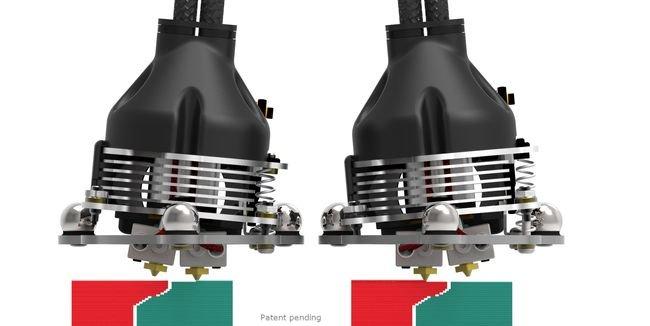
On this latest version 2.1 of the SpiderBot, the company has worked very hard to improve the print quality of this TSS system by improving the ventilation and air flow within the printers’ enclosures. Using simulations that they compiled, they were able to study the airflow that took place within the SpiderBot, and used this information in order to build a system that can use the hot air within the printer’s enclosure to keep the printed part warm enough to prevent warping or shrinkage, but at the same avoid hot spots within the enclosure and the print bed.
The printer’s main fan has been inclined, which creates two separate air flow streams (seen in red in the photos below) rather than just one. Surrounding the print bed, SpiderBot has installed special conical air deflectors (seen in orange in the photos below) which take what would have previously been “lost hot air” and redirect it onto the object which is in the process of being printed.
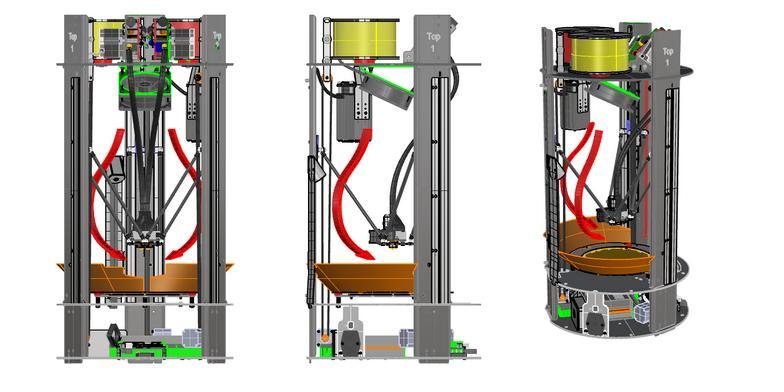
This allows parts to receive approximately three time the hot air than on other similar 3D printers, thus preventing warping on ABS printed plastic parts. This is really a revolutionary system for delta style 3D printers, one which should really enhance the print quality of printed objects, specifically objects printed in ABS.
What do you think about these new redesigns seen in the SpiderBot v2.1? Will this really enhance the quality of prints? Discuss in the SpiderBot 2.1 forum thread on 3DPB.com.