Bioprinting is defined as the three-dimensional printing of biological tissue and organs through the layering of living cells. This means that not only can animal tissue be printed, but so too can plant tissue, or perhaps even a combination of both animal and plant cells via a coculturization process.
Researchers at the Institute of Food Technology and Bioprocess Engineering, Technische Universität Dresden, in Dresden, Germany have teamed with the Centre for Translational Bone, Joint and Soft Tissue Research, at the University Hospital and Faculty of Medicine of Technische Universität Dresden to do just that — 3D print algae-laden hydrogel scaffolds for possible medical applications and uses with 3D printed human tissue.
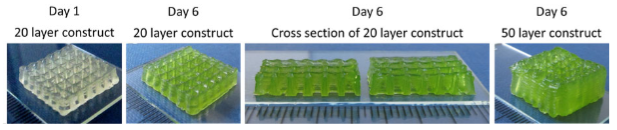
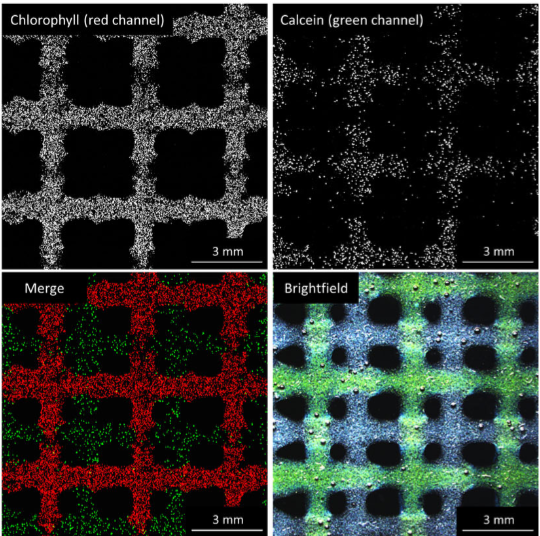
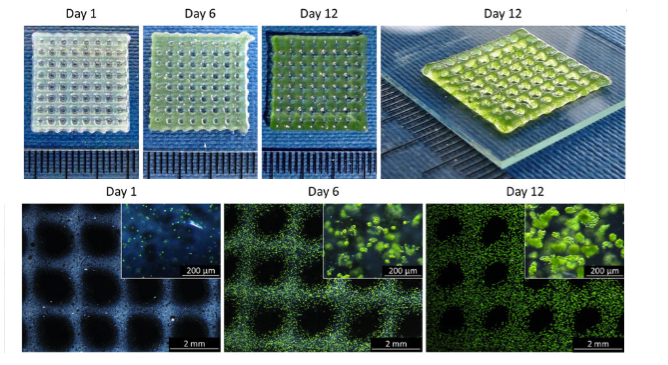
In a paper published recently in the Engineering in Life Sciences journal they describe multiple processes. First the researchers had to prove that it was possible to 3D print growing, living microalgae. To do this they mixed an alginate-based hydrogel with the unicellular green alga Chlamydomonas reinhardtii. The mixture was placed into a cartridge and used within a 3-channel dosing system. Then it was deposited layer by layer onto a platform via a pneumatic dosing control system at a rate of approximately 10mm/sec. From here the 3D printed hydrogel/algae mixture was incubated under light at room temperature for several days. As hoped, the printed material gradually became green as the algae grew, releasing oxygen into the surrounding environment.
“The application of RP [rapid prototyping] methods for encapsulation of microalgae can be expected to open new and interesting possibilities for diverse applications,” wrote the researchers.
Such applications may have staggering implications on the health and energy fields. For instance, microalgae can be used in the creation of products such as healthier foods; cosmetics; and pharmaceuticals that cater toward inflammation, bacteria, and even cancer; as well as for biofuels and filtration systems. What’s even more incredible are the possible implications that 3D printed microalgae could have on 3D printed human or mammalian tissue.
“The general possibility of combination of human and algae cells in one scaffold, in which the two cell types can be cultured in close vicinity, has been successfully demonstrated in the present study,” wrote the researchers.
One of the main obstacles researchers have had when printing human or other mammalian tissue is getting oxygen to all the cells. This is partially an issue due to the fact that vascularization has 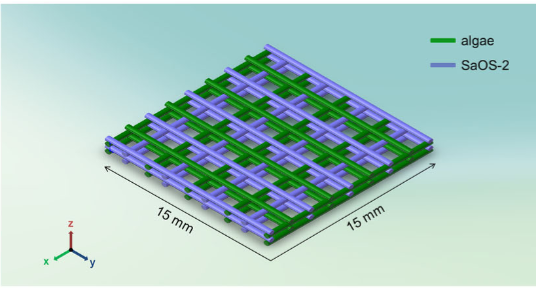
Although researchers have proven that coculturing human and plant cells in close proximity to each other is possible, there is still much work to be done before such methods are able to be used within possible medical applications. Depending on the type of human cells used within such a bioprinting process, conditions have to be perfectly optimized in order for the algae to benefit it in its growth and survival. Regardless, the research being done in this area could have major implications in the long run on the future of bioprinting in general.
Let’s hear your thoughts and feedback on these studies and area of research in the 3D Printed Algae forum thread on 3DPB.com.