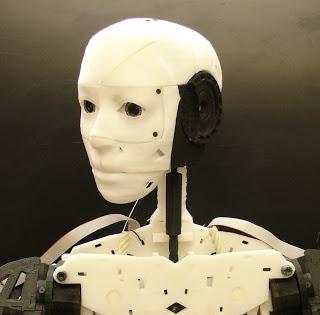

“I want to know what people want in a robot,” explains Dr. Murray, who is a researcher and teacher in the School of Computer Science at the University of Lincoln in eastern England. In addition to robotics and human-robot interaction he also specializes in aerial surveillance and unmanned aerial devices (UAVs), and 3D printing.
With his three robots, Marc, Erwin, and Tammie as mechanical guinea pigs if you will, Dr. Murray is exploring how people engage with robots. He wants to know why, despite our apparent fascination with humanoid robots, the more like a human a robot is, the more disturbing people find it. Dr. Murray asks volunteers to engage with Marc, Erwin, and Tammie by conversing with them, playing games, and interacting in other ways. “When you think of robots on TV and in films,” said Murray, “they tend to operate flawlessly–like the Terminator. He achieves his mission every time.”
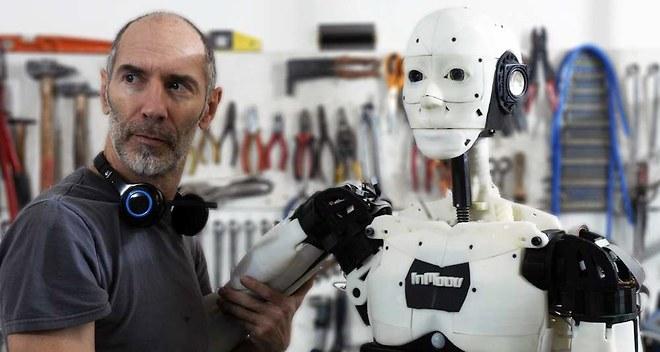
Gael Langevin with InMoov.
The University of Lincoln’s robots were produced using an open-source design from InMoov, a project of French model maker and sculptor, Gael Langevin. InMoov, explains Langevin, is “the first life size humanoid robot you can 3D print and animate.” His robot can be produced using any 3D printer with a build volume of at least 12 x 12 x 12cm. He conceived of InMoov as a development platform for makers and hobbyists but also for use by universities and labs. Langevin designed InMoov using the open source software, Blender, and the robot is powered by more open source 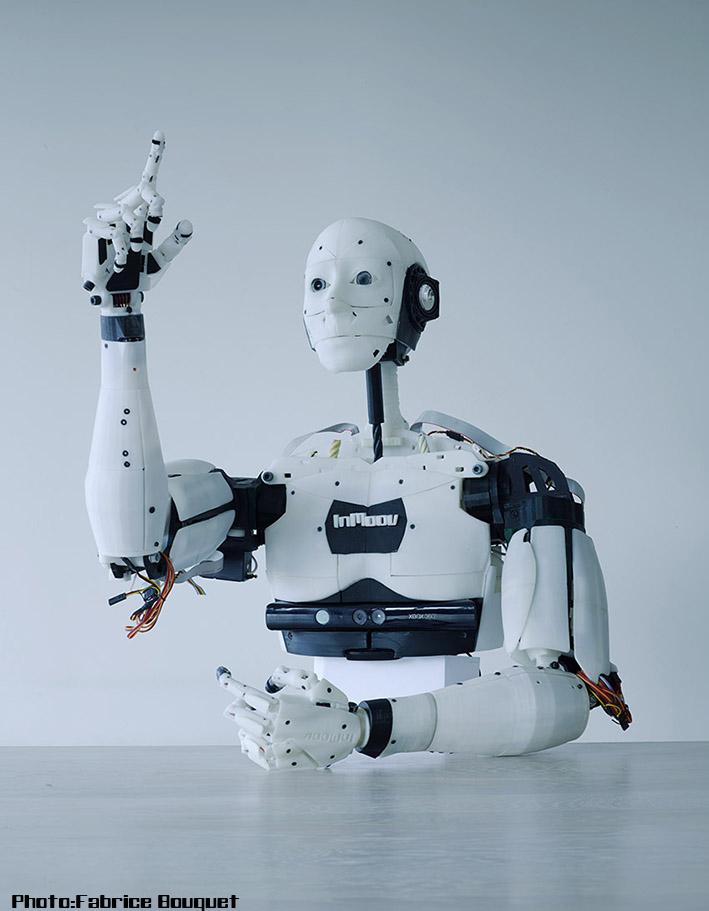

Dr. Murray’s InMoov robots have cameras in their eyes as well as microphones in their bodies. Additionally, they have contact sensors that detect their distance from people and, we assume, other objects. All three robots were individually programmed so they function differently from one another and thus in their interactions with people. Specifically, said Dr. Murray, “…We wanted to create a robot that’s forgetful and more human-like to see how people relate to it.” The idea is that humans might be more amenable to androids–anthropomorphic robots–if the machines not only had human capabilities, but also human imperfections. For instance, volunteers who interacted with the robots would introduce themselves and then, on subsequent visits, the robot would have forgotten an individual volunteer’s name.
Dr. Murray hopes to eventually deploy the robots in, for instance, hospitals and museums in Lincolnshire, where they could be useful in supplementing if not substituting for human labor. Sophisticated robots are being used in medicine, but none are humanoid–they don’t need to be. In the case of performing services for humans like aiding busy hospital staff or guiding visitors through museums, it seems like a robot with human-like idiosyncrasies might make people more comfortable in such interactions. In this early stage, Marc, Erwin, and Tammie, the InMoov robots of Lincolnshire, are sort of ambassadors for a possible android horde. We hope Dr. Murray is teaching them manners.
What are your thoughts about having 3D printed humanoid robots in places like Museums and hospitals? Let us know your thoughts in the 3D Printed Imoov Robot forum thread on 3dpb.com.