
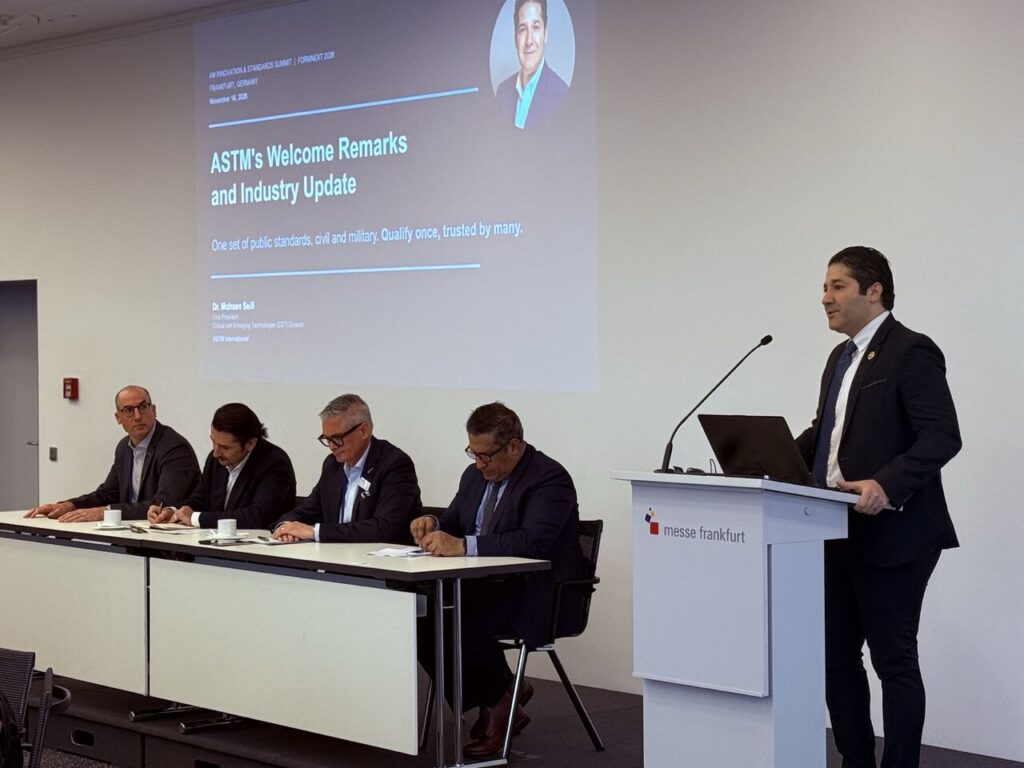
A part qualified in Frankfurt should be trusted in Houston, Seoul, or Tokyo, and the reverse. That was the proposition on one of ASTM International‘s opening slides at the AM Innovation and Standards Summit on 16 November. The day before Formnext 2026 opened, 176 participants from 17 countries gathered at Congress Center Messe Frankfurt. The room was called Illusions.
ASTM counted 103 published additive manufacturing standards across ASTM F42 and ISO/TC 261, with 74 work items open. It also cited a $9 million US programme aimed at reducing qualification barriers, including repeat testing. Holger Ziegler, NATO‘s Head of Standardization and Enablement, Defence Industry, Innovation and Armaments Division, described NATO’s approach as “Civil first – NATO only when necessary.” The breakout on civilian and military collaboration proposed a common set of documents and clearer division of work among standards organisations.
What the next supplier needs to know
Captain Lukas Hohn of the German Air Force showed how logistics handles a broken part. If a replacement is unavailable, the workflow routes a non-critical part towards an interim spare, and a structural or critical part to engineering.
His maintenance example covered about 1,920 parts across more than 160 stands. The German Air Force makes many metal components, but also printed parts in PA12 using SLS, replacing machined POM. Hohn reported lower costs, shorter lead times, and easier changes between variants.
Hohn proposed a common NATO technical data package. It would include drawings and CAD models, installation details, intended use, loads, impact, and vibration requirements, the original material, and the original safety factor: all things that can be difficult to assess. He pointed out that different machines can produce parts with different properties from the same data. He called for one provider to take responsibility for the certified process chain.
What to standardise in software
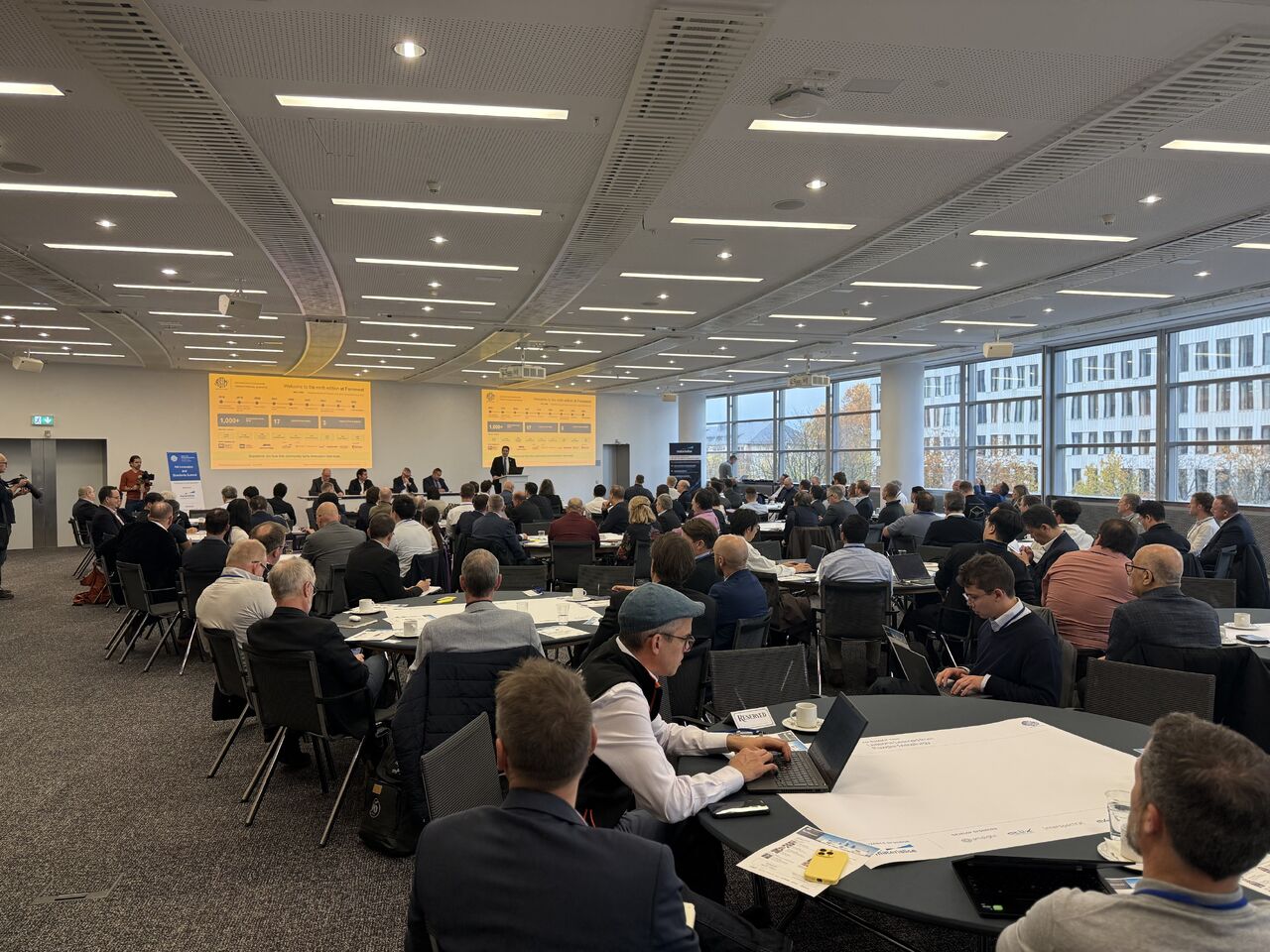
I took part in a software breakout. ASTM said it is working with AM suppliers to standardise terminology. At the table, we identified process parameters, slicing, and post-processing as places where common names would help. We also discussed consistency in the definitions and acronyms used across the standards themselves, and where AM software needs to work with CNC and metrology tools.
The table made two further proposals. One was software that helps users find and navigate existing internal and external standards. The other was common interfaces between software packages from different vendors. The discussion linked standards to customer acceptance and training as production grows. It also raised the timing question: how stable does a process need to be before it makes sense to standardise it?
The data management table proposed standard quality reports and production statistics, as well as automatic validation of AM data. It also raised how to link records across production steps when suppliers need to protect their intellectual property. A presentation by amsight showed the scale of the job. Its laser powder bed fusion (LPBF) example contained around 1,700 data points. The company estimated the automation potential at 95% for project, design, and build data, and 28% for in-situ monitoring.
What can carry over from one qualification to the next?
The European Space Agency proposed using a full set of first-article evidence to focus inspection of laser parts on critical characteristics and process deviations. The approach uses traceability, configuration control, and process monitoring. ESA quoted potential reductions of 50–70% in recurring inspection costs, and 50–80% in inline inspection time, without specifying the baseline.
The in-process monitoring table set out what would be needed to use a machine signal in a part acceptance decision. The indication has to be linked to a physical defect, its location and effect on the part have to be understood, and someone has to have the authority to accept that evidence. The table discussed CT as a way to establish that correlation, and raised the possibility of reducing CT inspection once the evidence supports it.
The process breakout put two qualified processes at the same facility side by side and asked which differences mattered to part quality. The board listed material, operating environment, process and machine parameters, post-processing, and quality tests. The qualification table called for a clearer distinction between major and minor changes, and raised the cost of overlapping specifications.
The closing panel cited a US–UK exercise in which a prime contractor in each country worked with a supplier in the other. It brought out questions about data rights, export controls, and commercial responsibility. Michael Kirka of Oak Ridge National Laboratory proposed trials across shops and countries using parts selected by the organisations that approve them. Those trials could establish which evidence a second site can use, and what it has to demonstrate again.
Final thoughts
The conversations between sessions and at the reception were worth turning up a day early for. ASTM does the industry a service by bringing the people who write the standards, make the parts, and approve them into the same room.
My own view is that we should agree early on what we call things, what we measure, and how we report it. That helps people learn the work, build a skilled workforce, and help companies scale production. Regulations set legal requirements, and standards can give us a common way to demonstrate compliance. I’d be more careful about prescribing how a process has to run while people are still improving it. If innovation finds a safer part or a better way to make it, there should be a way to prove it.
About the Author:

Ulf Lindhe. Image courtesy of The Org.
Ulf Lindhe is a veteran executive in the additive manufacturing industry with decades of experience spanning technology development, industrial strategy, and global market expansion. He has held senior leadership roles within the metal additive manufacturing sector, contributing to the commercialization and international growth of advanced AM systems. Throughout his career, Lindhe has worked closely with aerospace, medical, and high-performance engineering companies, helping bridge the gap between technological capability and practical industrial deployment.
Images: ASTM International via LinkedIn unless otherwise noted