

Third-quarter earnings results in the AM industry have been quite instructive: every area of the industry tells us a slightly different story, but when you take them all as a whole, they present a clear picture. In the most general terms, Q3 was a good quarter for companies most directly involved in producing and selling parts, and a rather mixed bag for the OEMs.
In terms of the mixed bag side of the industry, AM services also seemed to be the bright spot. 3D Systems, for instance, posted higher losses than it did in Q2, but the company noted in its earnings call that “parts manufacturing sales” were a big contributor to revenue growth.
Meanwhile, Stratasys showed a solid Q3 performance, doubling non-GAAP EPS over Q3 2025 ($.04 vs $.02) while growing revenue by about 4 percent YOY. Despite the contrasting results, services were a standout for Stratasys as well, with services revenue growing even more than the company’s growth overall (6 percent YOY).
Now, interestingly, systems growth was actually the biggest source of growth for the company (12 percent YOY), which would seem to contradict the idea that services are the winner. However, systems sales are lumpy and based on filling backlogs, and Stratasys’s slight downward adjustment to year-end guidance reflects the difficulty in depending on constant hardware sales growth as a primary revenue driver:
As Eitan Zamir, the company’s CFO, said on the earnings call, “Overall, customer engagement remains strong for the Stratasys business with a number of large and advancing pipeline opportunities. Still, with this shift towards larger orders, particularly production-focused applications, there are longer sales cycles and, as we mentioned last time, higher variability of timing. As a result of these shifts in sales cycles, we are updating our outlook for the remainder of 2026. New revenue guidance is $556 million to $561 million, from our prior range of $565 million to $575 million.”
The good news about that is that every machine that Stratasys sells sets the foundation for long-term growth from customer support, which still accounted for two-thirds of the company’s services revenue.
The dark horse, though, is Stratasys Direct Manufacturing (SDM), which accounted for around $15 million in revenue compared to $30 million from customer support and also grew about 10 percent YOY. This is especially important because, as CEO Yoav Zeif mentioned on the earnings call, it’s closely tied to Stratasys’s aerospace and defense business, which saw 35 percent YOY growth and 25 percent growth sequentially:
“The parts that are growing now relating to your question directly are mainly aerospace and defense, also SDM. So the growth drivers are first and foremost the aerospace and defense… And the second one… [SDM,] is supporting the aerospace and defense because our customers start printing in SDM and then they take the cells and print by themselves.”
I think we’ll also see that dynamic more and more in the reverse direction: that is, machine users who are hitting full utilization, instead of pulling the trigger on new machine orders right away, will turn to SDM for surge production capacity. That should be especially advantageous vis-a-vis aerospace and defense customers, who may want to avoid overcommitting to CapEx based on fluctuating demand coming from their own customers whose needs are tied to military procurement.

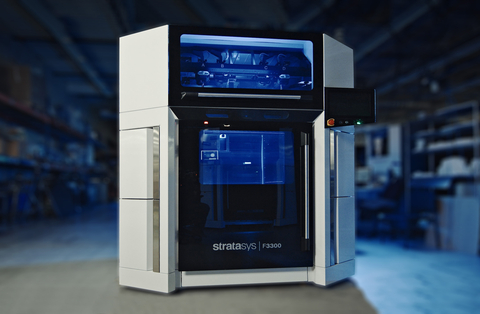
The Stratasys F3300, which helped SDM deliver strong results. Image courtesy of Stratasys.
The keyword for Stratasys, and for the AM industry’s Q3 earnings across the board, is ‘utilization’. The growth in the industry is coming from the customers whose applications drive the highest machine utilization, which is something Zeif highlighted specifically with regard to Stratasys customer GM:
“Note that GM is consistently one of our top customers in terms of printer utilization in production environments. This utilization is a reflection of the high quality of our materials, which translates into recurring revenue for us.
“GM, in turn, is gaining efficiency in production and saving $10 million in annual cost. This partnership is a true symbiotic relationship where we all win, including the end consumer that ultimately gets a better-produced vehicle. The benefits for GM are substantial beyond the annual savings. From localized additive manufacturing, production tooling response times are roughly four times faster. Worker safety and ergonomics are improved by customized production tooling, which reduces physical strain on operators.”
This has significant implications for SDM, too, because not every company has the organizational capacity to use AM as efficiently as a GM factory. And Zeif also mentioned how machine utilization efficiency is improving operations at SDM:
“Another key component of the improvement of our Stratasys Direct operations has been the increased throughput we recognized from using the new F3300 system to support A&D and automotive applications. In one case, the F3300 was able to produce parts at three times the output of previous systems, providing the customer with a significant reduction in lead time on an expedited order. Overall, the backlog for part production orders is higher than ever before across all technologies…”
Finally, the most important thing Zeif said on the call relates to how the company has been transitioning and will continue to transition from a focus on users who need rapid prototyping capabilities to production-scale users:
“…we made sure that the use cases growth exceeds the decline in rapid prototyping. And that’s why we also maintain the annual growth expectations year over year compared to 2025. … One part of the business is declining and another part is growing.”
That’s where both the opportunities and challenges lie for the 3D printing industry. It’s tough for the pioneers because they’re the ones who built the industry when it was tailored to rapid prototyping customers, and it’s going to take time to replace that business. At the same time, as Zeif noted, being a pioneer is an asset insofar as it equates to parts that have been qualified on your systems, so long as demand for those parts remains steady.