
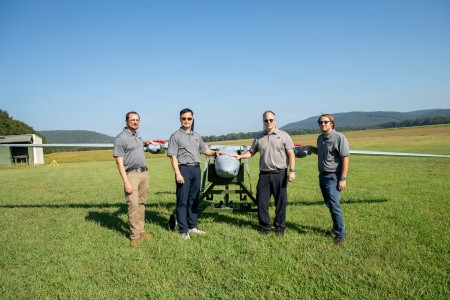
A US Army project has led to the 3D printing of a multi-fuel engine. Also called a heavy fuel engine, jet fuel engine, or kerosene engine, these engines are a mainstay for UAVs and other craft. They can run on JP-8 and other fuels. This simplifies the military’s supply chain and makes it easier for them to keep the whole Army moving. At the same time, the US critically needs to manufacture millions of drones, and so far it cannot. The US Army DEVCOM Army Research Laboratory made the VICTOR rotary engine hybrid specifically for UAVs. The engine, coupled with a 400-volt motor-generator, was developed as part of the Versatile Tactical Power and Propulsion essential research programs.
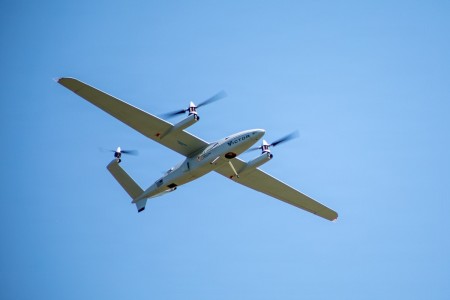
Close-up of VICTOR propulsion system in preparation for its flight near Huntsville, Alabama. Image courtesy of the US Army/Trevor Jones.
“The program addresses critical power and propulsion challenges by advancing fundamental science that could enable drones to fly longer and faster, operate at higher altitudes, carry heavier payloads and perform in extreme environments while reducing logistics burdens. For warfighters, the program has transitioned research findings to industry partners for maturation and integration into capabilities that could enable mid-sized drones to operate beyond line of sight, extending the reach of ground commanders and reducing risk to Soldiers. The use of advanced manufacturing, including 3D metal printing, allowed us to rapidly redesign engine components based on lessons learned through experimentation, It enabled us to design an air-cooled engine that reduces propulsion-system size and eliminates the need for liquid coolant.”
ARL says the advantages of Additive were to allow for “advanced computational fluid dynamics modeling and a clean-sheet design approach to address the challenges of efficiently burning heavy fuel in a rotary engine.” The work improved fuel atomization and vaporization while minimizing compressed-air and fuel-vapor leaks. So this wasn’t some hack job; this was a fundamentally interesting and difficult project to optimize this old-school quotidian engine for additive manufacturing and the modern world. The ARL hints that it was “designed to support vertical takeoff and landing operations in contested environments.”
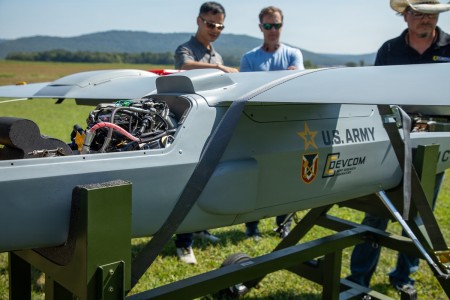
VICTOR drone in flight near Huntsville, Alabama. Image courtesy of the US Army/Trevor Jones.
The company tested it with the Griffon Aerospace Group 3 Vertical Takeoff and Landing (VTOL) Unmanned Aircraft System (UAS), the Versatile Intelligence Controlled Tactical Operational Reconnaissance and Attack, or VICTOR UAS. The VICTOR was also made as part of this program. That UAS and more are part of the Versatile Tactical Power and Propulsion (VICTOR) program. The program aims to explore new ways to build UAS platforms in contested spaces without resupply. By looking at hybrid electric propulsion systems, they hope to get an efficient solution that can run on electricity or different fuels while using electric power to stay quiet when needed. The bigger picture is to integrate and partner ground forces, ground vehicles, and drones without having to pilot any UAS vehicles. The aim is to increase UAS range, use multiple fuels, and improve efficiency.
The VICTOR program also led to “research with more than 30 universities, more than 13 federal laboratories and more than 20 industry partners that resulted in hundreds of scientific journal publications in diverse areas including combustion chemistry, sensing and controls, material design, batteries and hybrid electric technology.” Additionally, this work produced patents and Technical data packages.
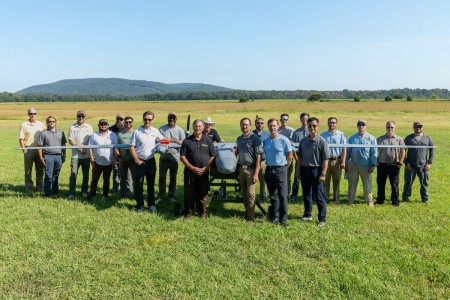
Several ARL and industry partners involved in the design and build of the VICTOR drone at its initial flight demonstration. Image courtesy of the US Army/Trevor Jones.
The Army aims to use the work to further the Persistent Unmanned Aircraft System for Logistics, Strike, Autonomy, and Reconnaissance, or PULSAR. PULSAR is essentially a swarm of Victor drones that operate in concert. PULSAR is essential to the US Army’s future logistics and supply chain efforts. With drones and sensors everywhere, moving trucks and heavy vehicles around is almost impossible. So the Army needs a more flexible logistics model. Helicopters are also no longer the apex predators they once were, as better sensors, MANPADS, and drones make these logistics and casualty-evacuation workhorses vulnerable.
PULSAR could replace trucks and helicopters at the front. But the US Army has over 3800 helicopters. The Air Force has around 200, the Marines 600, the Navy 500, and the Coast Guard 150. The US Army alone has twice as many helicopters as the next-largest helicopter-using country and nearly four times as many as China, the third-largest helicopter user. So replacing even a tiny fraction of helicopter use will be a significant undertaking.
If we look at Ukraine, mixed-in, close-in battle zones offer no real safe lines to retreat to for 20 kilometers, while casualty evacuation is usually by uncrewed ground vehicles. This reality simply does not match at all what the US mode of operations has been since Vietnam, where, for supplies, evacuation, and reinforcements, helicopters have been a mainstay.
But, even without looking at Ukraine and total drone warfare, it’s clear that something has to change. In 2011, with the downing of Extortion 17, 38 US SOF personnel died, including 17 members of SEAL Team Six. In 2005, during Operation Red Wings, 8 SEALS and 8 members of the Army’s 160th Special Operations Aviation Regiment, the Night Stalkers, were killed. This number of casualties at the tip of the spear is not only a tragedy; it’s a real risk to the country. SOAR has some of the, if not the best, pilots and helicopter pilots in the world, and they may have only 700 or so. There are perhaps around 200 SEAL Team Six members at any one time, and this DEVGRU unit, the National Mission Unit or Tier One unit, is the one tasked with the most critical missions. Losing so many people at once is a huge issue for the US. Additionally, training a SEAL from scratch may cost $2 million, and it can take over 8 years for that person to have a shot at being in DEVGRU. So even with all the money in the world, this isn’t a capacity or person you can replace quickly.
In these cases, the culprit was a humble RPG, widely available and costing under $1500. As of February, Russia has updated the RPG to the RPG-29M with better sights, day-and-night thermal imaging, and double the range. It’s clear that something has got to give. In that light, PULSAR and VICTOR could be some of the most important UAS programs going on anywhere.