In this weekend’s 3D Printing News Briefs, we’ll start with an integration between PanOptimization and AMCM, before moving on to healthcare news from KLS Martin and Lithoz, and then UltiMaker and Bioactivx. Then it’s on to a new 3D concrete printing certificate program in the U.S. We’ll finish with Bambu Lab’s 2026 School Ambassador Program.
AMCM Integrates EOSPRINT with PanX for Physics-Based Simulation
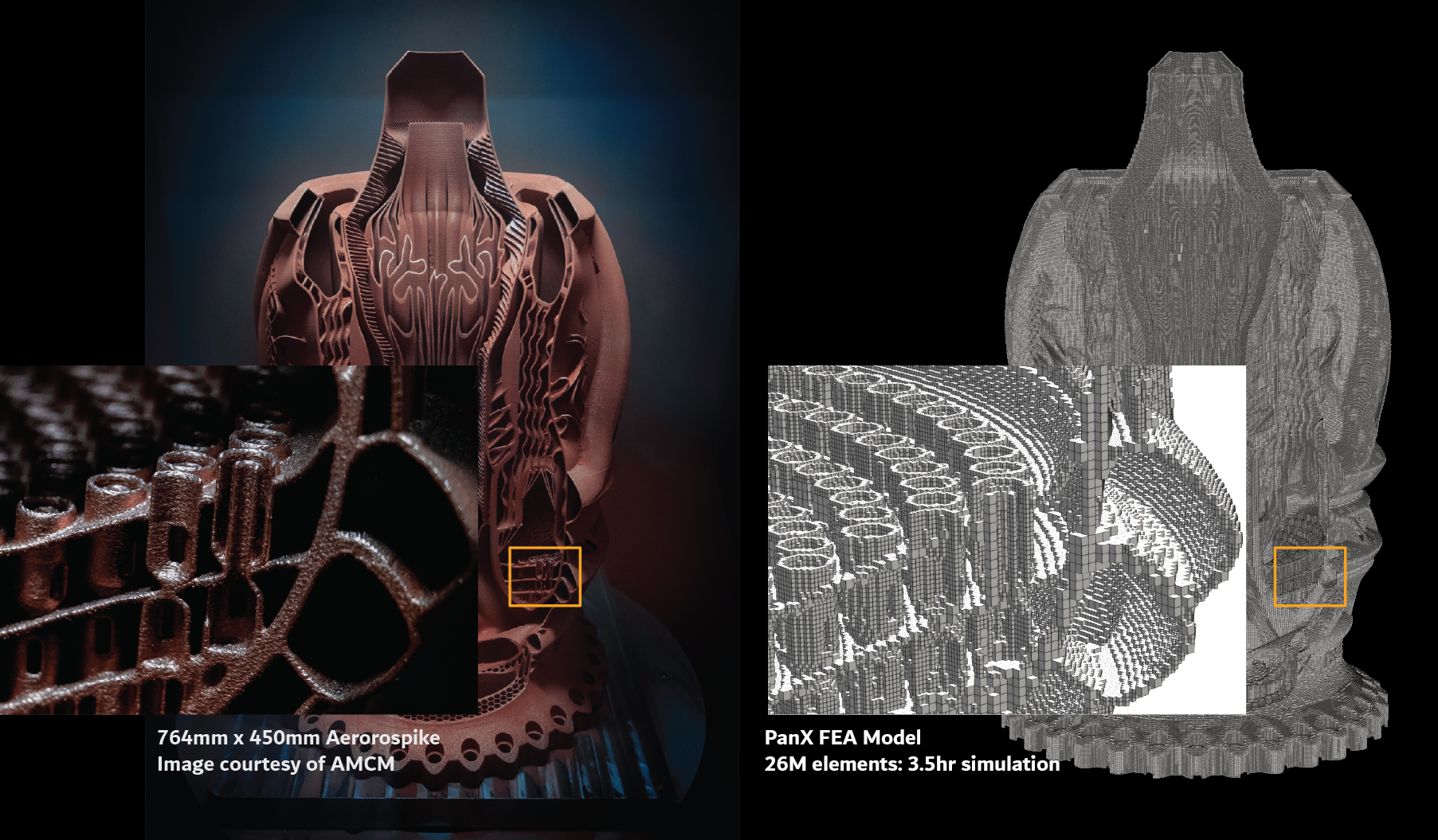
AMCM Aerospike (left). PanX Finite Element mesh (Right).
Machine and part qualification processes in the additive manufacturing (AM) industry really need to be supported by physics-based models as metal AM continues to mature; we can’t afford trial and error anymore. That’s why, in an effort to make physics-based simulation a more practical and embedded part of industrial metal AM workflows, AMCM and PanOptimization have announced a software integration between EOSPRINT and PanX. This will help bring simulation right into the build preparation workflow. First, an openjz file from EOSPRINT is read into PanX, and all the pertinent build information, like geometries and processing parameters, are extracted. The EOSPRINT API brings any other information necessary for accurate simulation, like process time per layer, into PanX. Once the simulation has been completed, a TIFF image stack and corresponding Smart Fusion Replay file are automatically written back into the openjz file, including information like compensated geometries and optimized laser powers. The information is then integrated on the printer. AMCM recently demonstrated the integration on a large M 8K build, highlighting how thermal simulation can find hotspots before the print even starts.
“Especially for the large and complex applications our customers manufacture on the AMCM M 4K and M 8K, thermomechanical simulation is a key tool to counteract overheating and thermally induced distortion,” said Tobias Petzinger, Application Specialist at AMCM GmbH. “By integrating PanX directly into EOSPRINT, we can seamlessly optimize thermal management and build strategies before production begins.”
KLS Martin Delivers 500th Lithoz 3D Printed Implant By End of Q3 2026
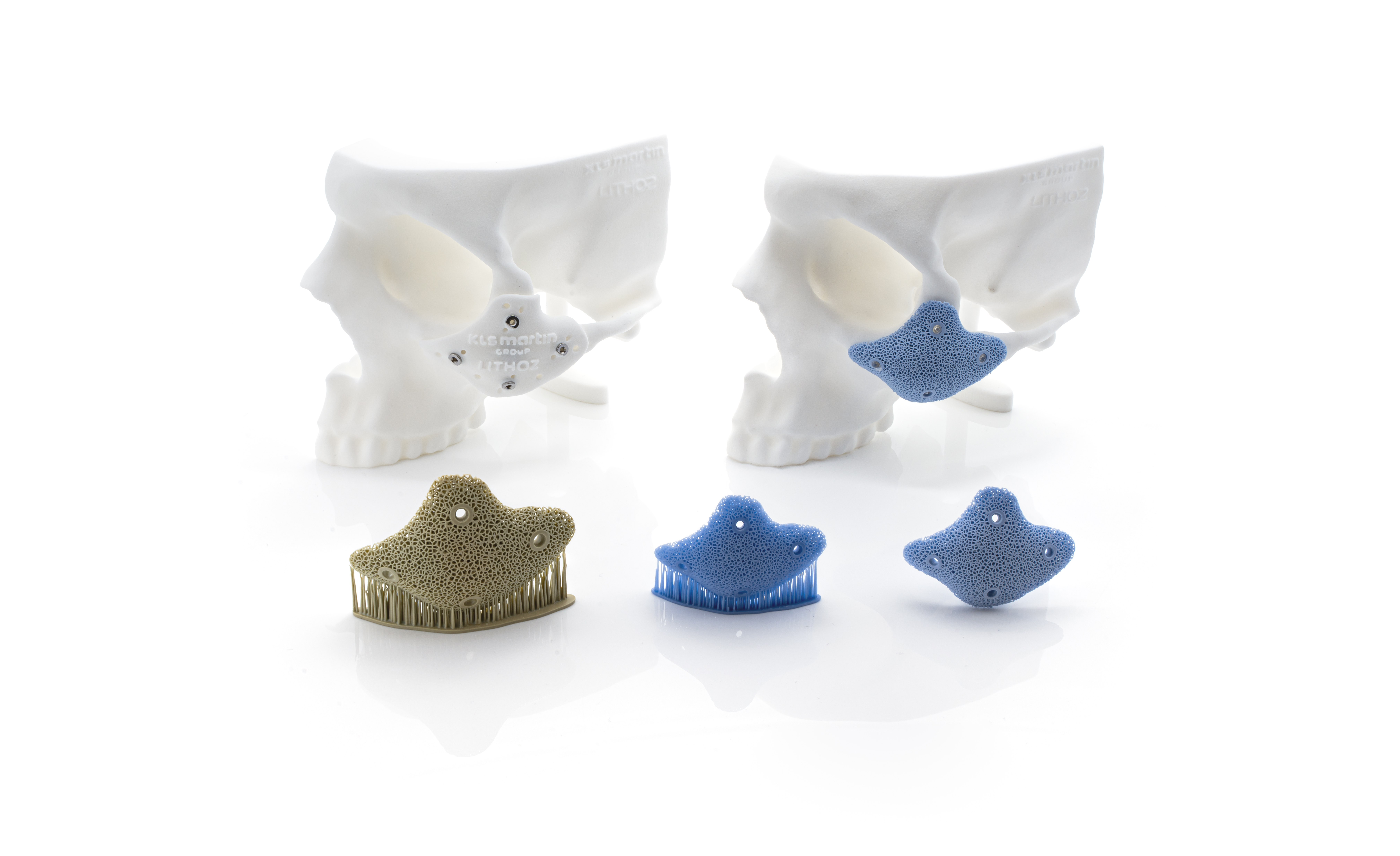
KLS Martin Zygomatic Onlay Implant made from Hydroyapatite
KLS Martin, which manufactures surgical instruments, medical devices, and implants, has announced an exciting milestone. The company’s web-based IPS Gate® for planning, ordering, and delivering its Individual Patient Solutions (IPS) now offers 3D printed implants made with the calcium phosphate LithaBone TCP (Tricalcium Phosphate) material by Lithoz. With this increased availability, KLS Martin is set to deliver its 500th 3D printed individual Lithoz bioceramic implant by the end of Q3, and expects clinical adoption to continue growing. KLS Martin uses Lithography-based Ceramic Manufacturing (LCM) printers by Lithoz to deliver custom 3D printed patient- and case-specific implant geometries, and tailored porosities that can influence degradation of scaffolds and their replacement by new bone. Additionally, while KLS Martin offers classical implant fixation with titanium screws, the company also offers fixation with its proprietary SonicWeldRx® system with resorbable polymer pints. Paired with the LithaBone TCP implants, this kind of resorbable unit means most patients won’t need additional surgical intervention.
“Launching LithaBone TCP implants as an official product on IPS Gate® marks a true milestone for bioceramic 3D printing in surgery. What began 12 years ago as a research collaboration with KLS Martin has grown into a proven clinical pathway with scalable solutions,” said Johannes Homa, the CEO of Lithoz CEO. “Seeing the success KLS Martin is having with our technology, as well as the general global adaptation of LCM in MedTech, shows that resorbable, additively manufactured bone-regenerating solutions are gaining broader clinical acceptance worldwide and demonstrate the growing role of additively manufactured bioceramic solutions in regenerative medicine.”
UltiMaker & Bioactivx Partnering for On-Demand 3D Printed Wound Care
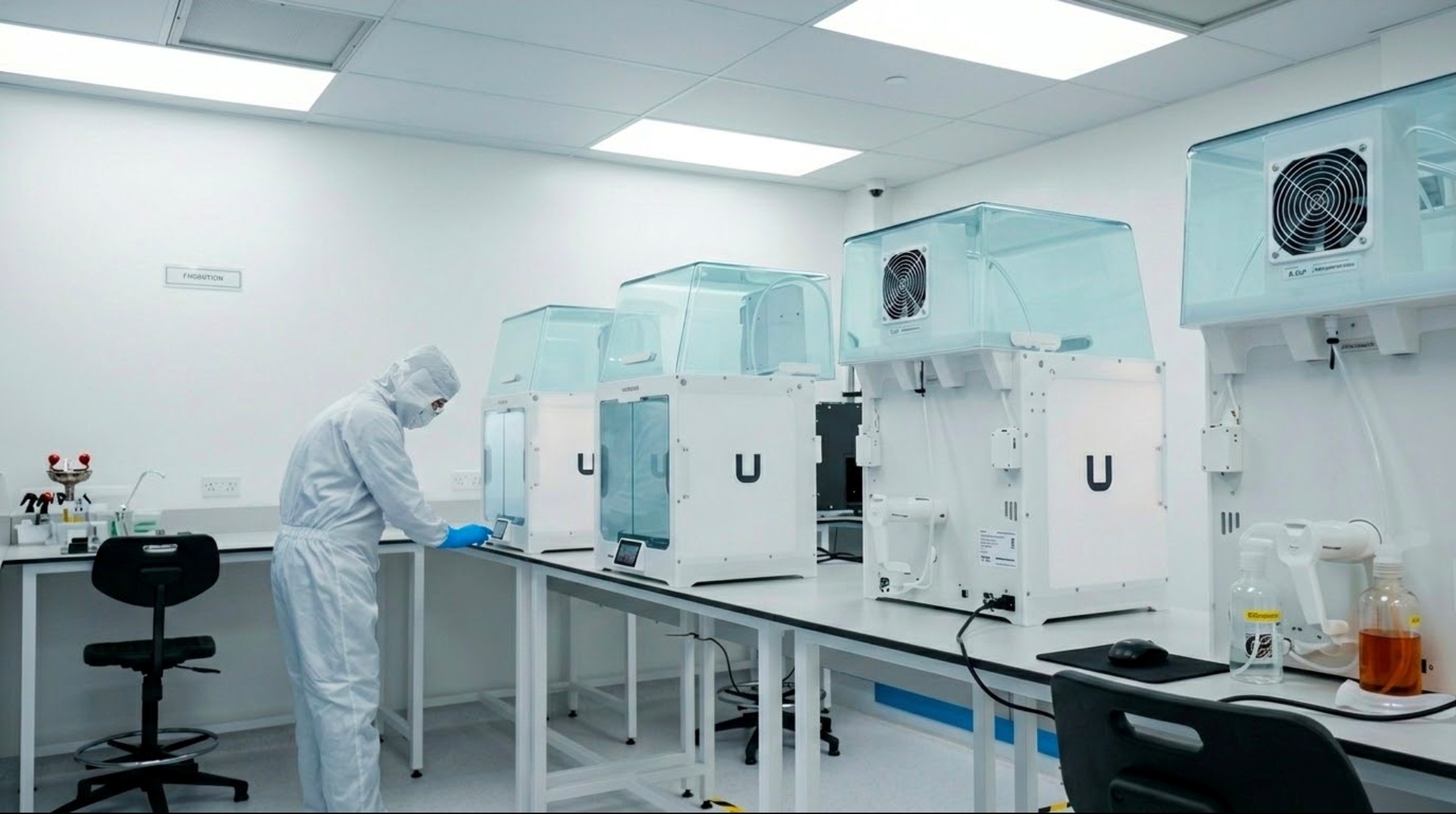
Bioactivx’s cleanroom print farm facility in Singapore, built on UltiMaker’s 3D printing platform to support the production of its HSA-approved Bioactiv® Matrix.
Singapore-based medtech startup Bioactivx and UltiMaker recently announced a Memorandum of Understanding (MOU) to work on developing a scalable, on-demand 3D printing solution for regenerative wound care. Bioactivx’s flagship Bioactiv® Matrix is a synthetic, animal-free regenerative medical solution that’s supposed to speed up wound closure and promote healing with no scars. The startup built an end-to-end digital manufacturing process to bring the medical-grade product to market at scale via mass production on UltiMaker 3D printers. This filament production and cleanroom print farm facility has officially opened, and its digital manufacturing process, and Bioactiv® Matrix itself, earned ISO 13485 certification and Singapore’s HSA approval for end-use medical implant manufacturing. This validates that UltiMaker 3D printing systems are able to create products that can meet exacting medical-grade manufacturing standards. So under their new MOU, the companies will work to develop, refine, and scale an on-demand 3D printing solution to bring regenerative wound care closer to the point of need.
“Bioactivx’s certification and regulatory approval is a powerful proof point for the medical 3D printing industry. It demonstrates that with the right process and quality controls, 3D printing on UltiMaker platforms can meet the exacting standards required for certified, end-use medical devices – not just prototypes,” said Michiel Alting von Geusau, CEO of UltiMaker.
“This collaboration is about more than one product. It’s a blueprint for how distributed, on-demand 3D printing can transform medical manufacturing – making critical treatments faster to produce and easier to deliver, wherever they’re needed.”
UW-Stout Polytechnic’s 3D Concrete Printing Certificate Program
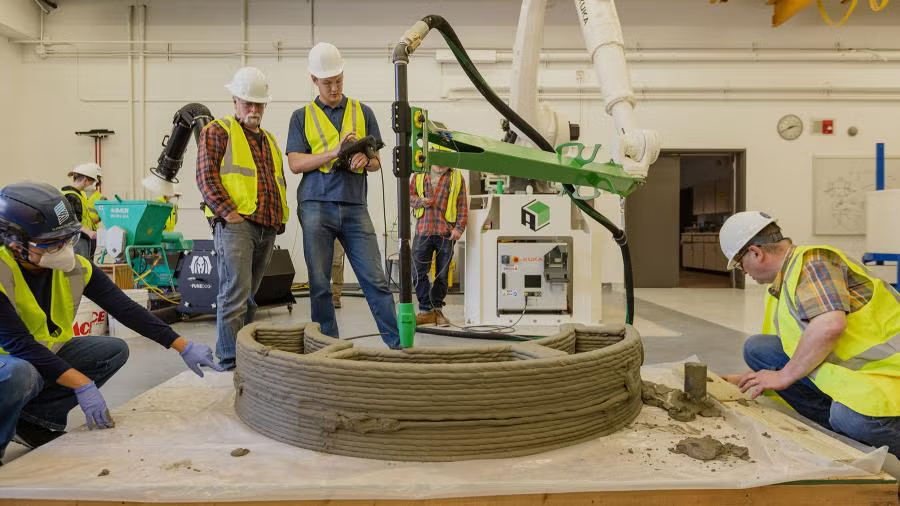
UW-Stout Polytechnic faculty and staff members operate the concrete printer.
Earlier this year, the University of Wisconsin-Stout Polytechnic became one of the first universities in the Midwest to acquire 3D concrete printing (3DCP) technology, thanks to a partnership with additive construction (AC) leader Alquist. Now, it’s becoming one of the first educational institutions in the country to create a 3D Concrete Printing Certificate program. UW-Stout Polytechnic is integrating Alquist’s equipment and curriculum into its construction management, industrial and product design, and technology education programs. The new certificate program will offer foundational workforce expertise to undergrad students, as well as to professionals wanting to learn important new skills. Jennifer Astwood, a professor of industrial and product design and Associate Dean of the College of Arts and Human Sciences, coordinated the campus 3DCP project, and worked with Engineering Professor Monika Herrman to develop the curriculum and certificate program. With the help of Alquist trainers, she also coordinated training sessions to expose students, faculty, business, and industry representatives to the technology.
“For industry and business to have a chance to provide input on how and where this technology fits into our daily business life, we need to be able to see and work with it. Having access to it firsthand at Stout is the easiest way for us to figure out how this may help us. Labor shortages mean that we have to figure out how to do more with less, and technology like this a key part of the future of construction labor,” said Senior Lecturer James Bunkelman (’00, ’20), the President and CEO of Royal Construction in Eau Claire; he has already taken part in some on-campus 3DCP training.
Bambu Lab’s 50 Student Ambassadors Become the Teachers
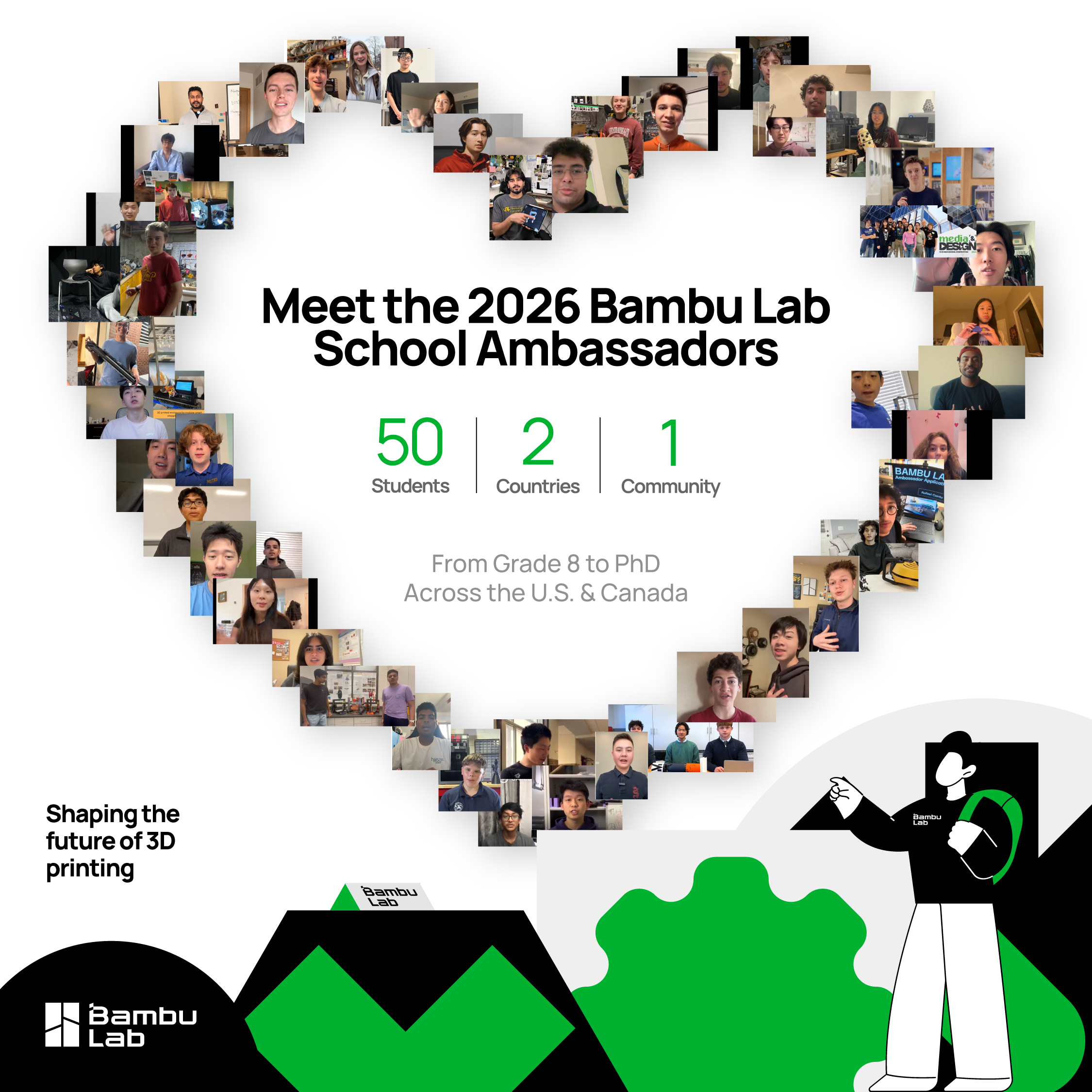
This month, as students in North America returned to the classroom, Bambu Lab introduced its year-long 2026 Ambassador Program. As part of the initiative, 50 student ambassadors at schools in 11 U.S. states and three Canadian cities are using 3D printing not just to make things, but to teach other people. There were nearly 400 applicants for the program when it launched a few months ago, ranging from 8th grade students all the way up to PhD candidates. With the support of Bambu Lab, the ambassadors are turning 3D printers into tools for teaching, organizing classes, workshops, demonstrations, and STEM activities for their fellow students, educators, and communities. Each ambassador gets a Bambu 3D printer, filament, and other program materials, and is supported by a regional partner. They advance through the program tiers as they complete events, and can even qualify for some exciting rewards, like their choice of printer or a founder-signed recommendation letter. Over the summer, this year’s ambassadors held 41 documented events that reached over 30,000 people, and most of the events were education-focused.
“I wanted to become a Bambu Lab School Ambassador because 3D printing has become a big part of my own journey with engineering. I started getting more involved with CAD, robotics, and 3D printing, and I really enjoyed being able to take an idea I had in my head, design it on a computer, and then actually hold it in my hands. That experience made me realize how powerful 3D printing can be for students,” said Bambu Lab Ambassador Rohan Amin, a 10th grader in Georgia.
“I want other kids to have that same opportunity. I believe 3D printing is going to be a huge part of the future, and I don’t think students should have to wait until college or a job to start learning about it. I want to help more students learn these skills early, become comfortable with designing and building, and eventually find the area of engineering or technology that they are passionate about. If I can help even one student discover that they want to become an engineer because of something they created with a 3D printer, that would make this worth it to me.”
The 2026 Ambassador Program runs through May of 2027. Students interested in future opportunities should follow Bambu Lab’s social media accounts for program updates.