
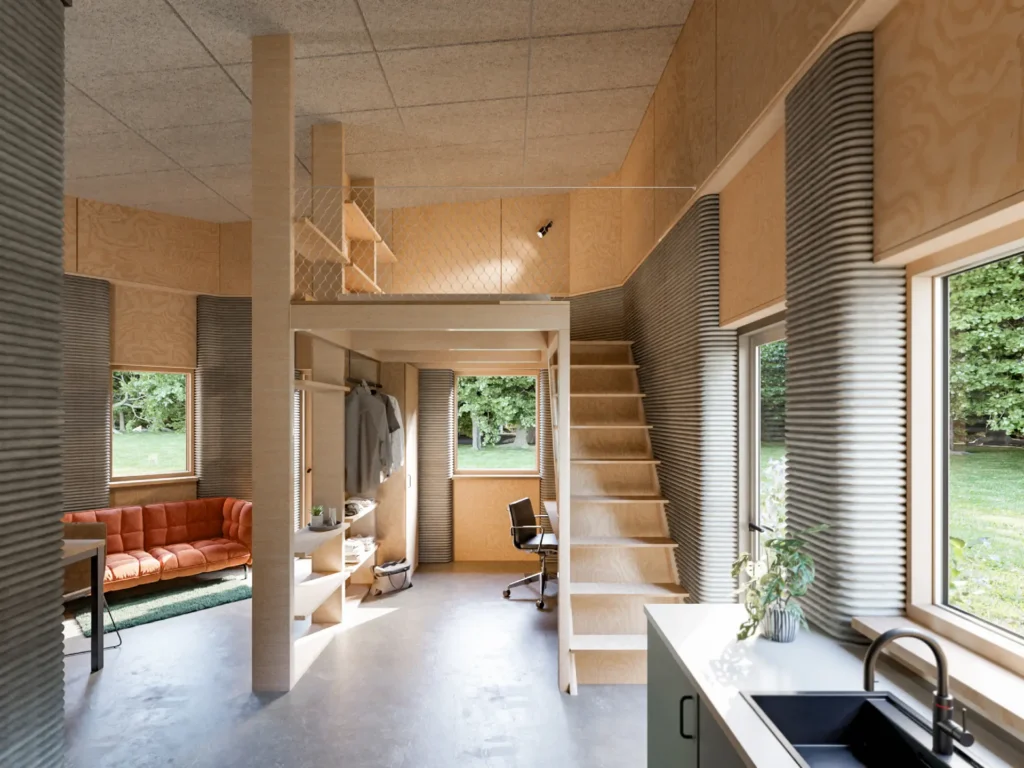
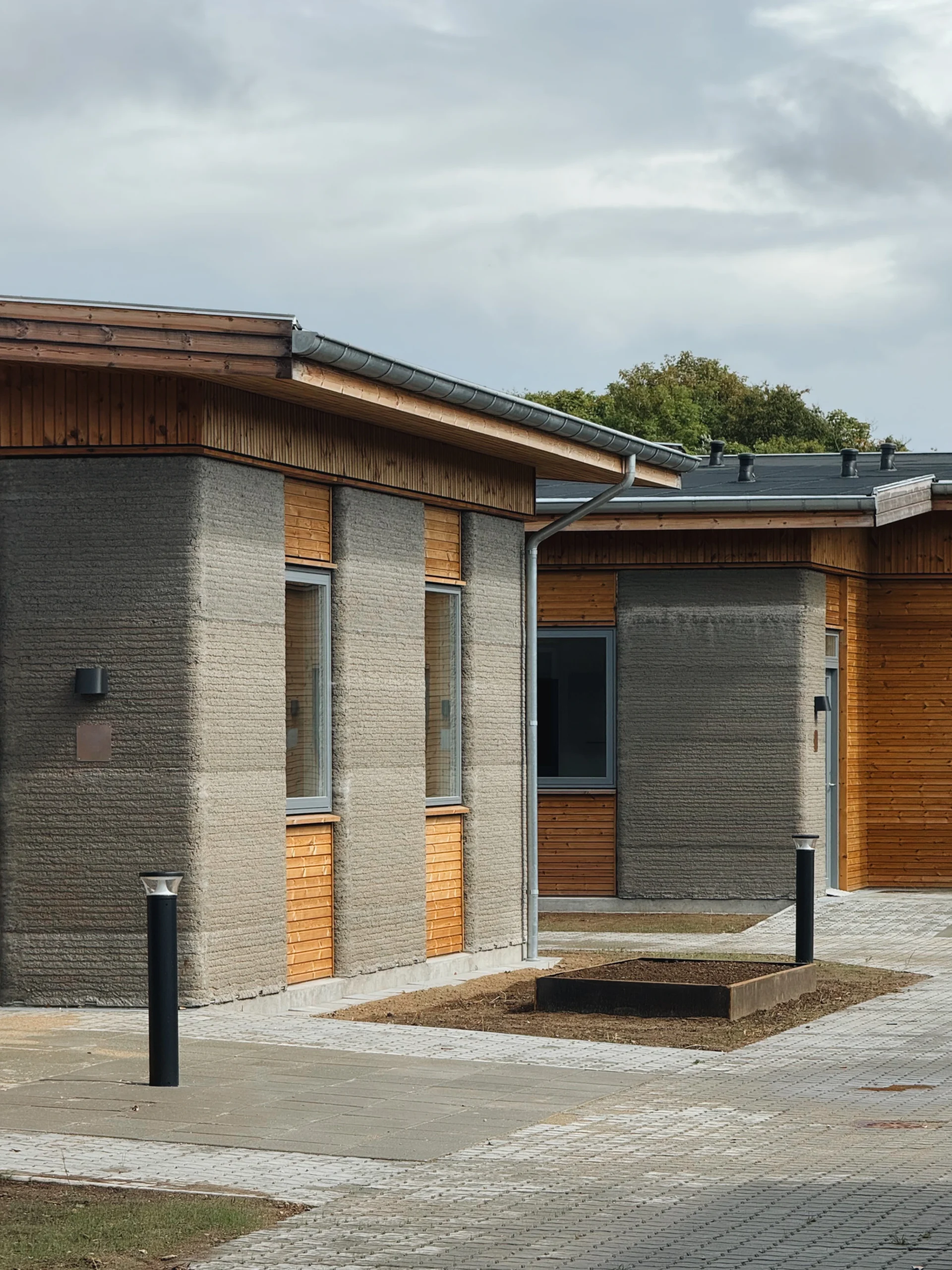
Denmark’s 3DCP Group has built 36 3D printed student apartments as part of its Skovsporet project in Holstebro. Designed by SAGA Space Architects and MS+, the project is a single-story, community-focused place near VIA University College. Printed with a COBOD BOD3, the apartments were “designed as a complete home, with a kitchen, study area, lounge, bathroom, and sleeping area. Large roof windows and slanted ceilings bring daylight into the homes, while the combination of 3D printed concrete, cork panels, glass, and traditional roof structures creates a warm and practical architectural expression.” The material used was part of FUTURECEM by Aalborg Portland and D.fab concrete.

The total area of the project is 1,650 m², with each apartment ranging from 39 to 50 square meters. The total development took one year.
Mikkel Brich, Co-Founder and CEO of 3DCP Group, said,
“The technical breakthrough was not printing one successful structure. It was repeating the process across six clusters while improving speed, maintaining accuracy, and integrating the printed elements with conventional building systems.”
Sebastian Aristotelis, Co-Founder and Lead Architect of SAGA Space, stated,
“This student housing project proves that 3D printing is no longer just an experiment. We have gone from printing small prototypes to creating 36 real homes and an entire community. That is the scale where technology starts to matter as a serious tool for architecture.”
In addition to cement, another material was used. MEVOcem a low carbon cement was used for certain parts. It has an 84% reduction in CO₂ emissions compared to regular concrete. Whilst only being used in the bicycle shed, using such a material throughout the project would make it much more sustainable. The project meets all local Danish construction guidelines and the targets set for subsidized local housing. This could mean that more such projects could be built cost-effectively in the country. Student housing is scarce in parts of Denmark, so this model, if viable, could very well have some real concrete impact.
The client in this case is NordVestBO; it is kind of a public foundation that has built and manages over 3,000 homes. Present in some form or other in many Northern European countries, these kinds of organizations were seen as a solution to rapidly building affordable homes, cheap and cheerful for everyone. Some of these organizations have billions in assets and a much more environmentally focused and “up with people” kind of focus than traditional developers. They’re non-profits and have lofty goals but govern themselves. In Germany, Housing Cooperatives and partially city-owned Kommunale Wohnungsunternehmen build many homes. One of them, SAGA, owns 134,000 houses, while Sweden’s HSB Riksförbund has 335,000 apartments. In the Netherlands, as much as 29% of the total housing stock is owned by Woningbouwcorporaties.
So it may seem to be a quaint Northern European thing to do, but such cooperatives in and of themselves could be significant customers for 3D printed construction. If their environmental and social goals aligned with 3D printing and the math works, then there could be much more demand for 3D printed houses. I think that the architects, concrete companies, 3D printer companies, and cooperatives should work together. It seems like everyone wants to be a pioneer, but no one wants to really implement the technology. If they just worked on one type of building and made it as efficient as possible, they could come up with a very efficient form and implementation for 3D printed construction that would across borders, make 3D printed housing much cheaper. They could build, buy materials and printers, and access services while ensuring that local adjustments could be made. All of these cooperatives have very similar long-term goals. They all want buildings to last, to be easy to maintain, to be easy to repair, to be comfortable, to be relatively inexpensive, to be green, and to be somehow cheerful. So if we can rally around the shared goal of 3D printing, we could really build a lot of buildings.
Images courtesy of 3DCP Group