We’re starting off today’s 3D Printing News Briefs with a little FDA news, and then a new dental material for the Axtra3D Lumia X1. We’ll end with the winners of an America Makes project call, and its newly elected Executive Committee members. Read on for all the details!
Elevation Spine Gets FDA 510(k) Clearance for Saber-C AVIA
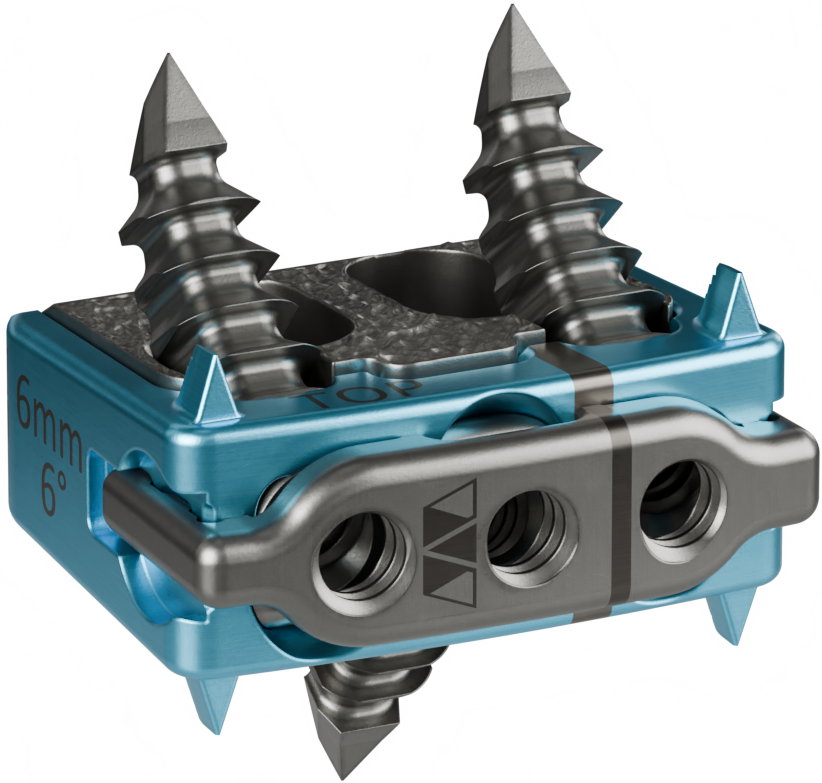
Image courtesy of Elevation Spine
California-based Elevation Spine, a leading spinal medical device developer of integrated-fixation technologies, recently announced that it has been granted FDA 510(k) clearance for the newest product line in its Saber platform, Saber-C AVIA. This is an anterior cervical fixation system, featuring a porous 3D printed titanium interbody with both spike and screw fixation options. The interbody has a 55% porosity lattice architecture, designed and manufactured to mimic real trabecular bone, which is found in the ends of long bones, vertebrae, and the pelvis. Elevation reports that in preclinical data, the Saber-C AVIA’s porous structure is associated with bone ingrowth. The Saber-C AVIA system as a whole is a zero-profile anterior cervical discectomy and fusion (ACDF) construct, featuring the kind of biomechanical stability that you typically find with traditional plating. Elevation Spine’s Saber-C AVIA, available immediately for surgical use in the U.S., ships with both spike and screw instrumentation in a single tray for more versatility in the operating room, and the implant is available in 6° lordotic and 12° hyperlordotic options with a large central graft window.
“Our dedicated Saber-C surgeon community gave us valuable feedback, and those conversations shaped what came next. We focused on purposeful instrumentation, a porous 3D titanium implant supported by preclinical research, and thoughtful refinements that build on the strengths of the original platform,” said Charlie Gilbride, CEO of Elevation Spine. “Our size is one of our greatest advantages. We stay close to our surgeon network, move quickly on their feedback, and remain focused on delivering meaningful innovation where it matters most.”
Axtra3D & KeyPrint Launch KeySplint Hard Clear for Lumia X1
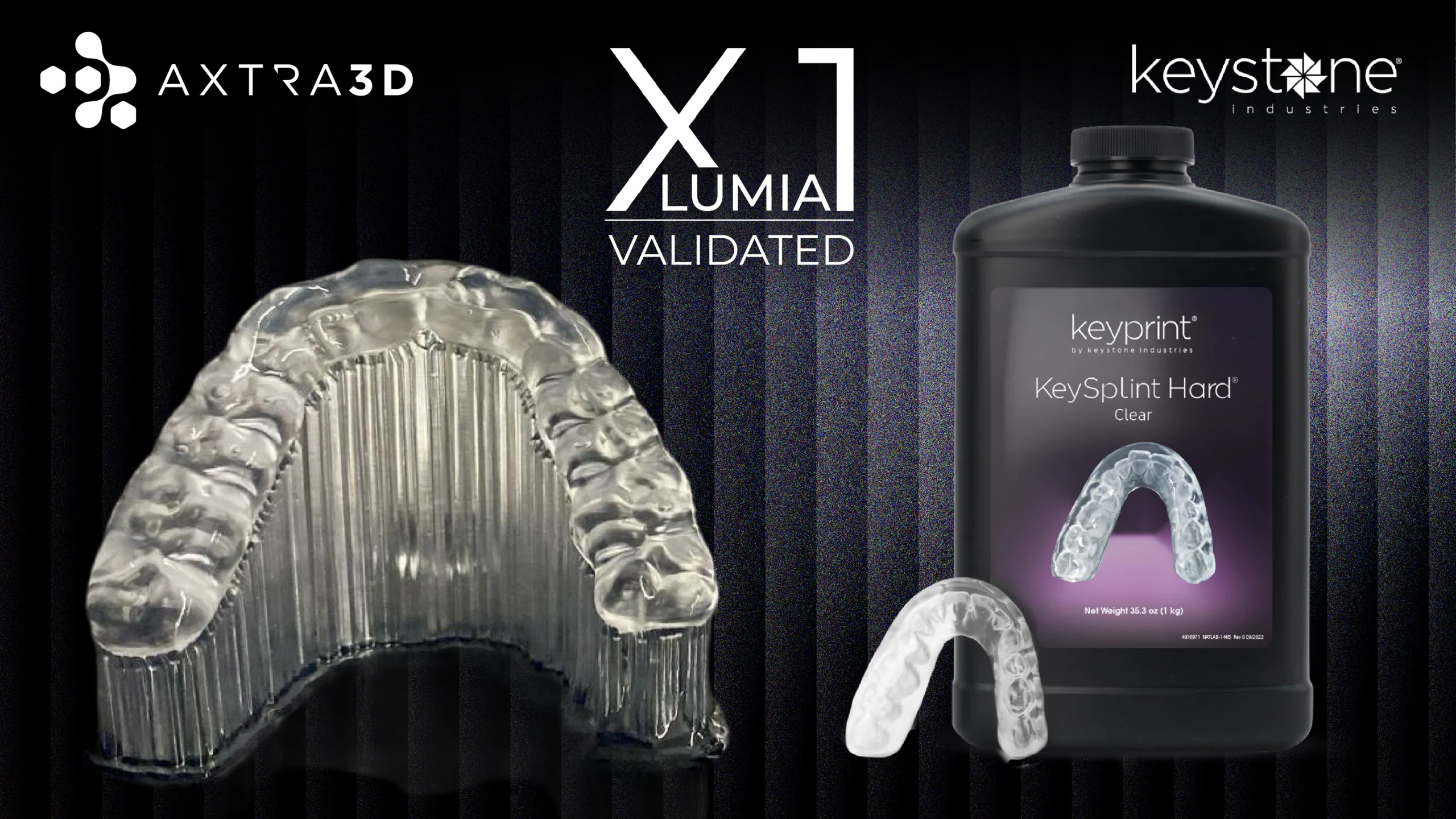
Axtra3D, Inc. is actively working to grow its offerings in the dental AM market with the launch of the biocompatible KeySplint Hard Clear material in partnership with KeyPrint of Keystone Industries. This marks the second KeyPrint resin validated for use on Axtra3D’s Lumia X1 3D printer, after KeyModel Ultra, and the two are also working on several additional material validations, such as KeyGuide, KeyOrtho Model, KeySplint Soft, and KeySplint Soft Clear. Formulated for both post-trauma tooth immobilization and retainers, KeySplint Hard Clear is strong, durable, and easy to clean, which is necessary for it to hold up under daily use. Additionally, the resin’s stain and abrasion resistance helps splints and retainers withstand wear from eating, drinking, and tooth grinding, as well as the constant contact with teeth, all without any changes to the material’s physical properties. While KeySplint Hard Clear is also available for purchase in standard Light Violet, Clear is the only color that’s been validated so far for use with the Lumia X1.
“Our partnership with Keystone is designed to improve dental lab productivity across multiple applications. Dental wearables need to have both durability and precise fit accuracy, and the combination of KeySplint Hard and the Lumia.X1 provides this,” said Rajeev Kulkarni, Axtra3D’s CSO.
“Not only does this combination create wear-ready parts with minimal post-processing, but it also provides consistent, stable outcomes that allow for dental labs to reduce variability in results, leading to a more streamlined workflow.”
America Makes Announces Winners of Delta Qual 2.0 & New Executive Committee
Just ahead of this year’s MMX event, America Makes and the National Center for Defense Manufacturing and Machining (NCDMM) announced the winners of the Delta Qual 2.0 Project Call. Funded by the Office of the Under Secretary of War, Manufacturing Technology Office (OSW ManTech), the $9 million Project Call is all about modernizing AM qualification; this is necessary to maintain defense readiness, according to John Martin, Additive Manufacturing Research Director at America Makes. By increasing processing parameter flexibility, streamlining testing requirements, and strengthening machine installation standards, Delta Qual 2.0 hopes to address some of the key AM qualification challenges across the defense industrial base (DIB). The Project Call will also, according to Martin, “lay the groundwork for a more agile, trusted, and scalable manufacturing ecosystem.”
The winners of the Delta Qual 2.0 Project Call are:
Topic 1: Quantitative Measurement-Based Installation Qualification
- Team Lead: ATI Materials
- Project Team: EOS North America, Inc., Phase3D, Laboratory Testing (LTI), Lockheed Martin, L3Harris Technologies, Fluor Marine Propulsion
- Team Lead: Trusted Metal, LLC
- Project Team: Dyndrite, RTX Technology Research Center (RTRC), University of North Carolina Charlotte, Oerlikon, Velo3D
Topic 2: Bracketed Qualification for LPBF
- Team Lead: Auburn University
- Project Team: Texas A&M University, Northrop Grumman, Eaton, Cumberland Additive, Nikon SLM, Prime Tech, 3Degrees, Ansys, Dyndrite, Oqton, National Institute of Standards and Technology (NIST), Air Force Research Laboratory (AFRL), Naval Air Systems Command (NAVAIR), RTX (Raytheon), Batelle
Topic 3: Red Team
- Team Lead: The Barnes Global Advisors
- Project Team: SAE International, American Welding Society, Battelle, University of Texas at El Paso, Colorado School of Mines, Johns Hopkins University, NIST, Elementus Additive, Nikon AM, SME, Nikon, VulcanForms, Northrop Grumman Space Systems, The Boeing Company, Lockheed Martin, Parker Hannifin, U.S. Army DEVCOM Aviation and Missile Center, U.S. Army, NASA Marshall Space Flight Center, U.S. Navy Submarine Industrial Base, Naval Nuclear Laboratory, Federal Aviation Administration
That’s not the only news from America Makes. Right after MMX ended, the newly elected members of its Executive Committee were announced. The committee meets regularly to ensure that the proper strategy, policy, and advocacy have been put into place for America Makes to successfully speed up AM adoption and the country’s global manufacturing competitiveness. Members of the Executive Committee offer counsel to America Makes on a variety of subjects, including membership value and outreach, workforce education and training, data management and IP policy, ecosystem development and partnership strategies, and more. There are three appointed government representatives on the committee, and eight representatives are elected from three sectors in the membership community. Each elected member serves a two-year term.
The government representatives are:
- Paul Gradl, Ph.D., Principal Engineer, NASA Marshall Space Flight Center
- Laura Macht, Engineer & Project Management, U.S. Army Combat Capabilities Development Command (CCDC) DEVCOM Aviation & Missile Center (AvMC)
- Paul Witherell, Ph.D., Associate Program Manager, Measurement Science for AM Program, Engineering Laboratory, National Institute of Standards and Technology (NIST)
The 2026-2028 America Makes Executive Committee is:
- Brett Connor, Ph.D., Chief Manufacturing Officer, SME
- Sandra DeVincent Wolf, Ph.D., Executive Director, Carnegie Mellon University Manufacturing Futures Institute
- Brian Fisher, Ph.D., Technical Fellow for Additive Manufacturing, RTX
- Jonaaron Jones, President and General Manager, Additive Manufacturing Division, Beehive Industries
- Mark Norfolk, Director of Government Programs, Edison Welding Institute (EWI)
- Hector Sandoval, Technical Fellow for Additive Manufacturing, Lockheed Martin Missiles and Fire Control
- Mark Shaw, Chief Engineer of Defense Industrial Base Strategy, National Institute for Aviation Research (NIAR)
- Mike Vasquez, Ph.D., Founder & CEO, 3Degrees