
For years, the conversation around additive manufacturing followed a predictable script. Engineers would acknowledge its usefulness for prototyping – faster iterations, cheaper design validation, no tooling to worry about – and then pivot back to injection moulding or CNC machining for anything that needed to be made at scale. That script is now out of date.
The shift is not sudden. It has been building steadily, driven by compounding improvements in machine reliability, materials qualification, post-processing capability, and, critically, economics. But there is a point at which gradual change becomes a new reality, and for additive manufacturing in serial production, we have reached it.
The repeatability problem has been solved
The most persistent objection to additive in production has always been consistency. Can part 1,000 be identical to part one? Historically, the honest answer was: not reliably enough. That has changed.
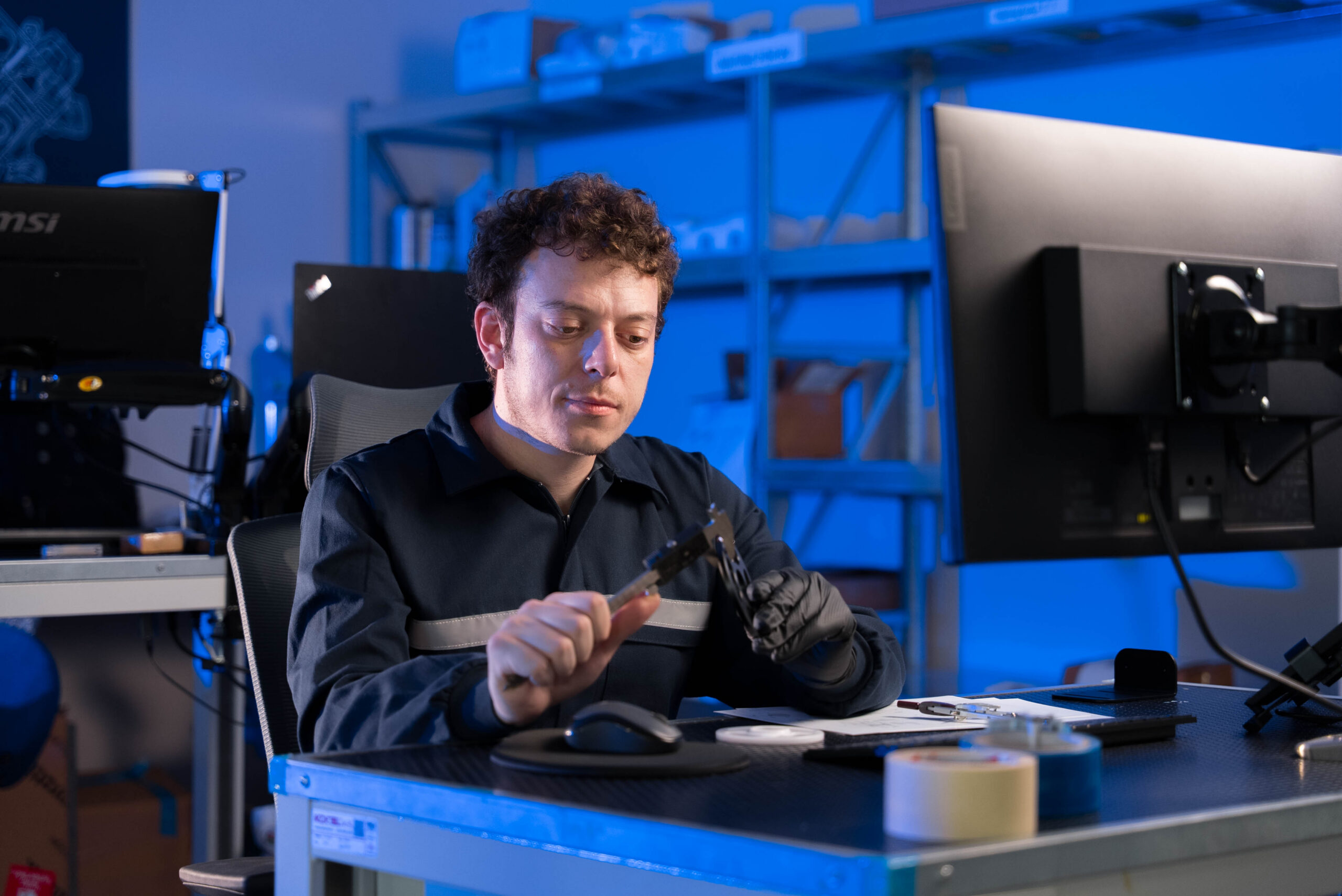
Modern powder bed fusion technologies, combined with post-processing methods such as vapour smoothing and bead blasting, now deliver standardised mechanical properties and surface finishes across entire batches. The surface quality is not quite injection moulding, but for the vast majority of end-use industrial applications, it does not need to be. Functional performance is the threshold that matters, and today’s systems clear it comfortably.
This matters enormously for procurement teams and engineers who bear risk for parts entering real production environments. Qualification used to be the sticking point. Increasingly, it is not.
Speed and capital efficiency have changed the calculation
Injection moulding is optimised for high-volume, stable production runs. When you know you need 100,000 identical parts, and the design is locked, the economics are hard to beat. But that scenario describes a shrinking share of modern manufacturing requirements.
Tooling lead times of up to 12 weeks, combined with upfront mould costs that can run to tens of thousands of pounds, create genuine commercial risk when design iteration is likely, launch windows are tight, or volumes are modest. Additive removes that exposure entirely. A design change means updating a CAD file, not commissioning a new mould. A batch of several hundred to a few thousand parts can be delivered in days, not months.
For companies navigating product launches under time pressure or managing low-to medium-volume production across varied SKUs, this is not a niche advantage. It is a structural one.
The complexity advantage remains underutilised
One area where additive consistently outperforms traditional methods, and where industry adoption is still catching up with the potential, is geometric complexity.
Features that would require expensive mould sliders or multi-part assemblies in injection moulding are simply printed. Internal channels, undercuts, lattice structures: the constraints that shape conventional design thinking largely disappear.
The issue is that most parts being sent to additive manufacturing have not been designed for it. They have been designed for conventional manufacturing and transferred across. The economics of that approach are limited. When engineers instead design with additive in mind, using part consolidation, topology optimisation, and structures informed by how the material actually behaves, the results improve substantially. The bone’s lattice structure, for example, achieves greater strength than a solid equivalent. Applied intelligently to industrial parts, that principle unlocks performance and material efficiency that conventional methods cannot replicate.
This is arguably the most underdeveloped opportunity in the sector right now, and it requires a shift in engineering culture as much as a shift in tooling strategy.
Where the market is heading
The data supports what we see in practice. Additive Manufacturing Research (AM Research) estimates that additively manufactured parts will account for about $24.5 billion in market impact in 2025. According to its “AM Applications Analysis: Parts Produced 2025–2034” report, the value of parts produced with additive manufacturing could reach $110 billion by 2034, suggesting that 3D printing is continuing to move beyond prototyping and into real manufacturing.
The verticals leading this shift are consistent with what you would expect. According to AM Research, aerospace applications make up nearly 22% of the total value of metal parts produced with additive manufacturing around the world. As governments and private space companies continue pouring money into rockets, satellites, and drones, the defense and space sectors also play a big role. The report also says that while aerospace leads in value, healthcare dominates in the number of metal parts produced. The orthopedic and biomedical industry produced more than two million metal AM parts in 2025, while the dental sector produced over 25 million during the same period.
Each of these sectors combines demanding performance requirements with exactly the kind of complexity, customisation, and volume profile where additive offers a genuine alternative to conventional methods. The energy sector, which invested heavily in additive manufacturing during a period of infrastructure constraint, is another example of an industry that made the transition and has not looked back.
What procurement and engineering teams need to consider
For organisations that have not yet integrated additive into their production strategy, the barrier is rarely technical. It is more often a combination of unfamiliarity with current capabilities, uncertainty about cost comparison, and understandable caution about introducing an unproven process into an established supply chain.
The practical answer to that caution is to start with a contained, well-defined use case. A part with time-to-market pressure, a component with complex geometry that is expensive in conventional tooling, or a low-to-medium volume run where tooling investment does not make financial sense: these are natural entry points. The risk of testing is low. No advance commitments are required, and the cost comparison with conventional methods can be evaluated directly before any decision is made.
The question for most organisations is no longer whether additive manufacturing is viable for production. It is whether their supply chain strategy is positioned to take advantage of it.

Nikolaus Mroncz, Head of Sales Engineering, Xometry
Nikolaus Mroncz has over a decade of experience in advanced manufacturing and currently leads the sales engineering department at Xometry Europe, an AI-powered on-demand manufacturing marketplace.