
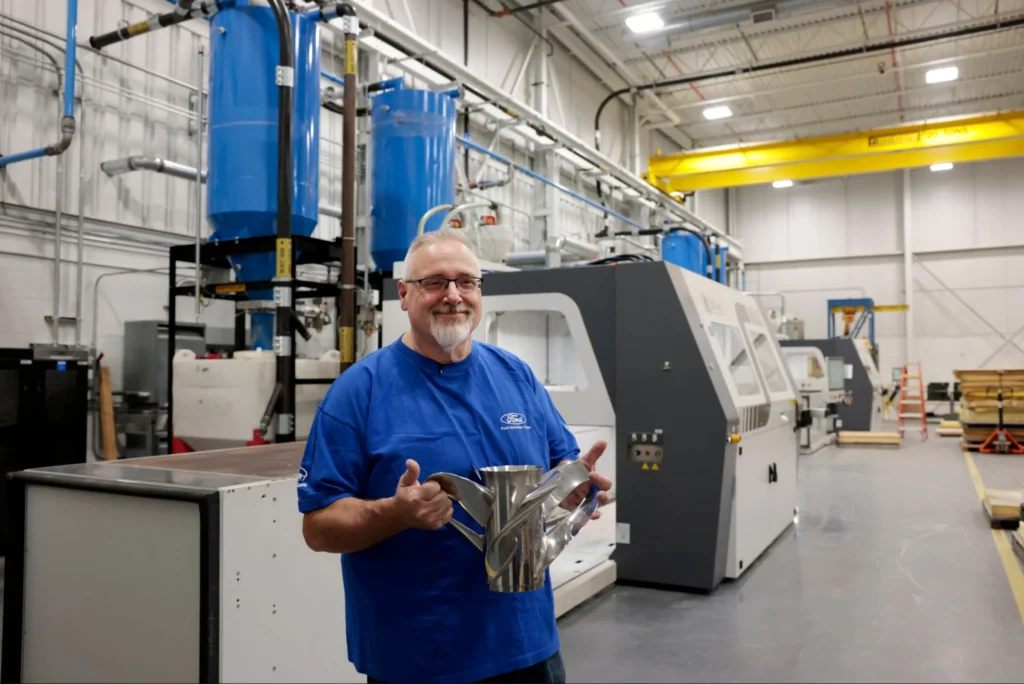
Ford’s Advanced Industrial Technology and Platforms (ATP) group has helped Sharrow Marine make a boat propeller in two weeks rather than 130 days. Thanks to the Michigan Central program, Ford and Sharrow were brought together, with prototypes produced at Newlab Detroit. The proprietary propellers are now made using binder jetting, with a sand-banding jetting sand-casting solution, replacing older methods like lost-wax casting and slip casting, which previously created lead times of up to 130 days. Working with Ford and a local foundry, Sharrow can now produce the parts in a fortnight. Debuted in 2020, the Sharrow propeller is designed to lower noise while improving efficiency.
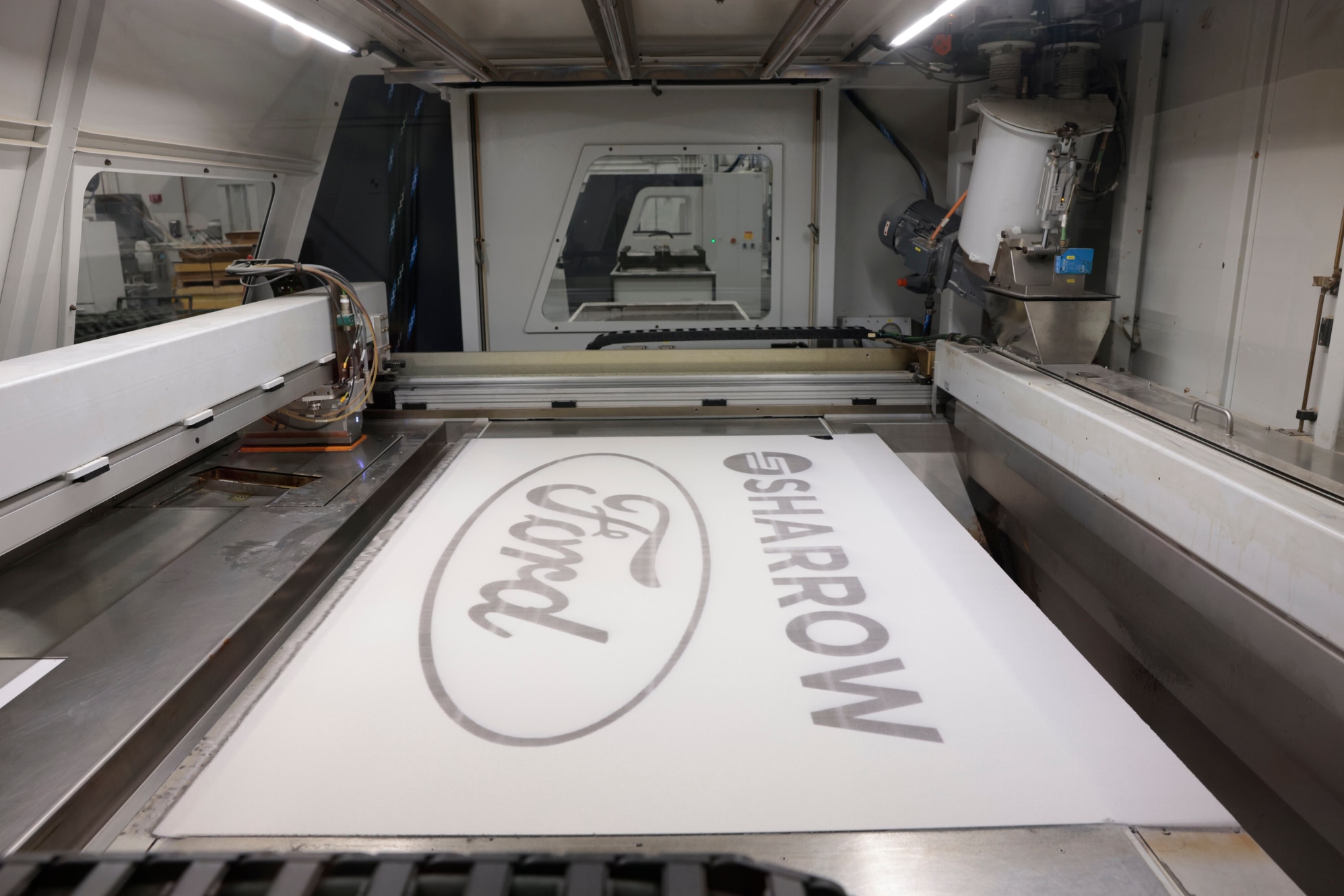
Using Ford Motor Company’s Advanced Industrial Technology & Platforms team and advanced 3D sand-casting, what once took 130 days with traditional wax and ceramic casting can now be completed in about two weeks.
Additive Manufacturing Operations Supervisor at Ford Dan Michalski said,
“Ford has been at the leading edge of 3D sand-casting for more than 20 years, and it’s rewarding to use that expertise to help another Michigan company scale so quickly.”
While Sharrow Marine CEO and Founder Greg Sharrow added,
“Scaling production has been our biggest challenge, particularly getting high-quality castings fast enough to meet demand. I could not make them fast enough. Less than seven minutes into my first conversation with Ford, they told me they had the solution. This sand-casting collaboration has solved our scale problem in a big way.”
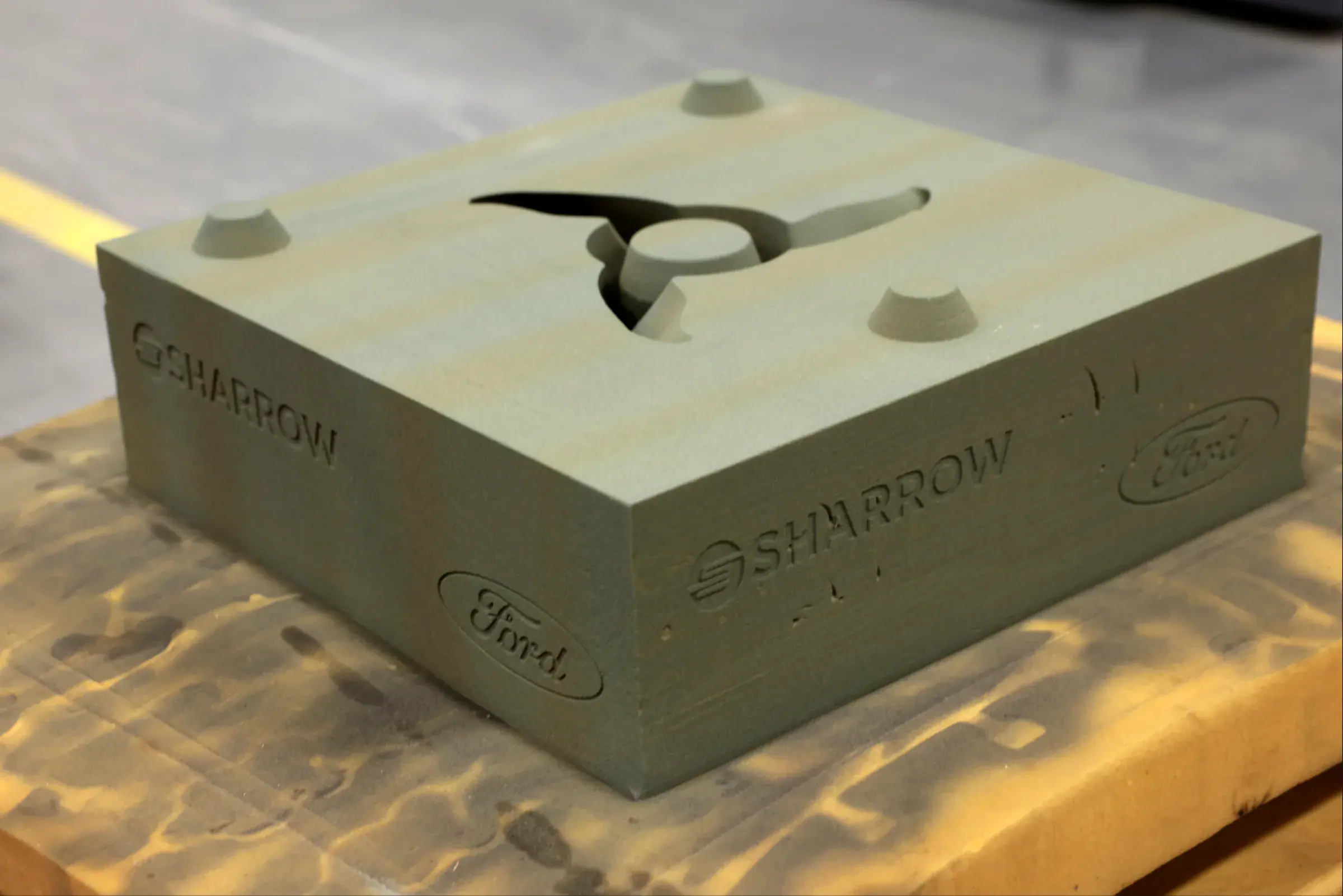
Sharrow will use the process to expand its production and sell more propellers. It also hopes to expand the use of its products into new markets. The company sees potential in drones, fans, and pumps. Ford has Desktop Metal and ExOne systems, including an S-Max Pro and an X series. The company uses binder jet for sand-casting engine blocks and other automotive components. It has ExOne systems in Europe as well and is a big user of 3D printing for jigs and fixtures across the company. The company has also put end-use 3D printed parts on some niche vehicles, notably a Raptor version for the Chinese market and a set of brackets for the Shelby Mustang GT500. In 2019, the firm spent $45 million on an Advanced Manufacturing Center that brought together 23 systems from 10 firms in Michigan.
Judging by the Furan sand and the images above, Ford used the ExOne S-Max to make Sharrow’s parts. Sand-casting is not often talked about in the 3D printing world, but for marine propulsion companies, engineering firms, energy firms, and car firms, the technology is a mainstay in some applications. One of the things it does extremely well is propellers. Faster, more flexible, and more accurate 3D printing for sand casting saves firms millions a year.
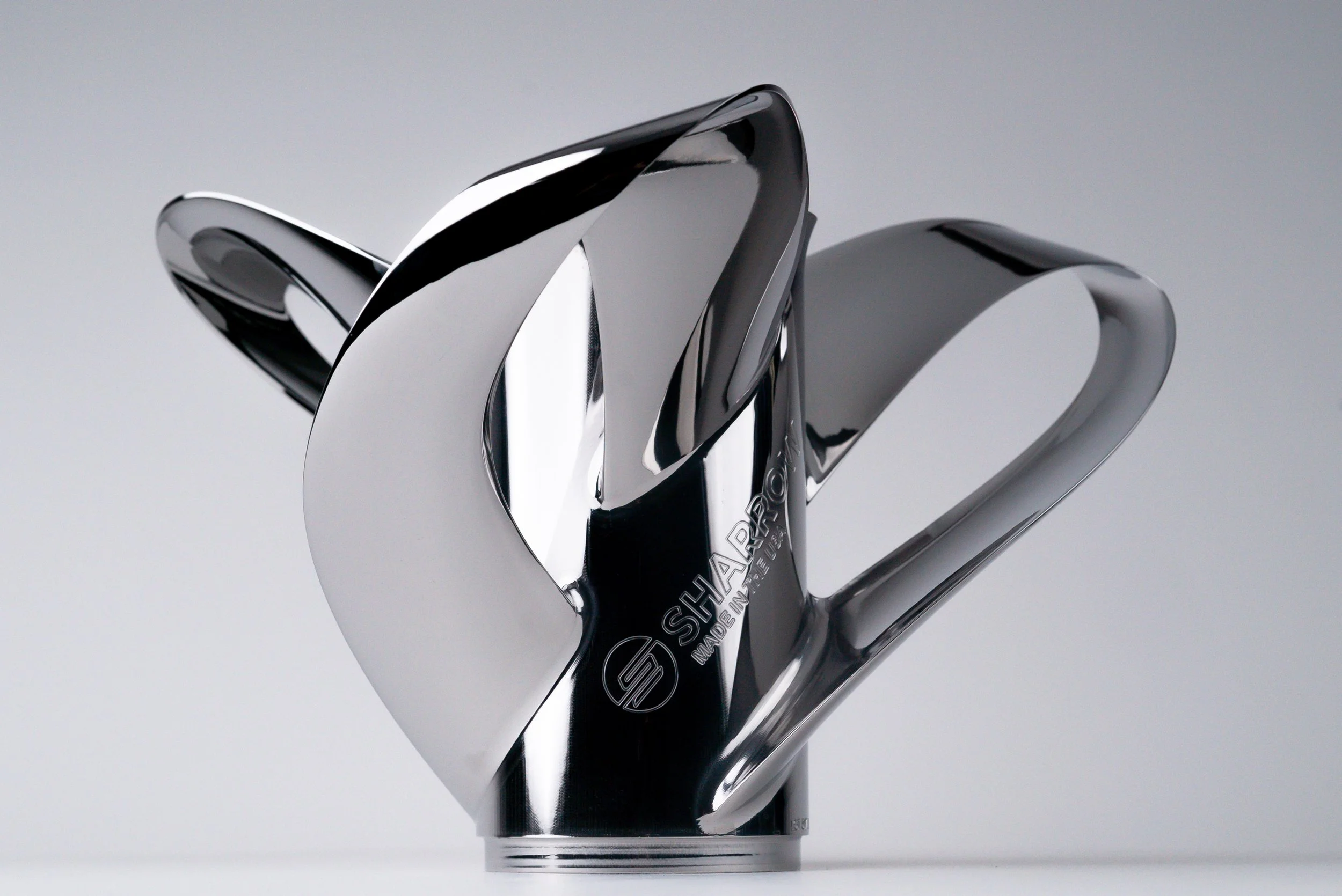
Sharrow says that its propeller changes “how your boat accelerates, holds plane, grips in turns, docks, cruises, and sounds. It is not a small performance tweak. It changes the experience.” The unit could save as much a 20% in fuel costs. At a fast clip, a small speedboat could use 3 gallons an hour while a twin-engined offshore center console boat could use 50 gallons an hour. Daily fuel costs for many boaters are higher than $50 t0 $300 per day. Especially now, this will add up quite quickly. Reducing vibration could make your boat ride much more comfortable, while reducing noise could help as well. According to the firm, your boat can cruise at lower RPM and get to planning faster. The company also says that it handles better and is more maneuverable.
The total amount of benefits, if true, is very compelling. Sharrow also offers six different versions of its propellers and would probably make more to better suit different vessels if it could. That can also strengthen the business case for 3D printing here. I don’t know if Ford is doing this for some kind of “hug Michigan” marketing thing or if there is a business logic behind it beyond PR. It could actually be interesting to build up capacity and do a kind of Amazon AWS play for manufacturing. If Ford invests and partners with companies to fill its machines more efficiently, the company could significantly improve machine utilization and lower part costs. This could be very powerful, and it could let a company outspend another in innovation while lowering overall costs. It would make even more sense, for example, if car sales were lower in the summer and boat sales higher. Ford used to make anti-submarine boats during the First World War and later on made marine engines. Currently, Ford makes marine engines with the inboard company INDMAR. So the work with Sharrow may yet be relevant to Ford in other ways. On the whole, this is a great story about how, through sand casting, 3D printing can accelerate time-to-market and make more products possible. More sand-casting business cases should be done, especially in Marine propulsion and engines, where we’re seeing more happening.
Images courtesy of Ford