
With the US turning its back on exquisite, expensive military goods in favor of volume manufacturing of less expensive items, new strategies should come to the fore. But attritable $250,000 drones will still be too expensive for long conflicts. If it is difficult to manufacture submarines and carriers are vulnerable, why not completely change what is made? For force protection of the US Navy, to protect expeditionary Marine units, for risky missions, and to protect shipping, what is the lowest-cost solution we can come up with? What if the US put a ring not on it but around its existing craft, rings of inexpensive autonomous vehicles that defended the fleet and installations? What’s better than a loyal wingman? I give you the Kamikaze Bluejacket. Sacrificial swabby? Or perhaps the disposable seamen? Drownable pawn? Interchangeable admiral? Harikiri boatswain? Scuttled skipper? Deep Six Sea Daddy? AJ Keeled Over? Suicide squid? Suicide squid it is.
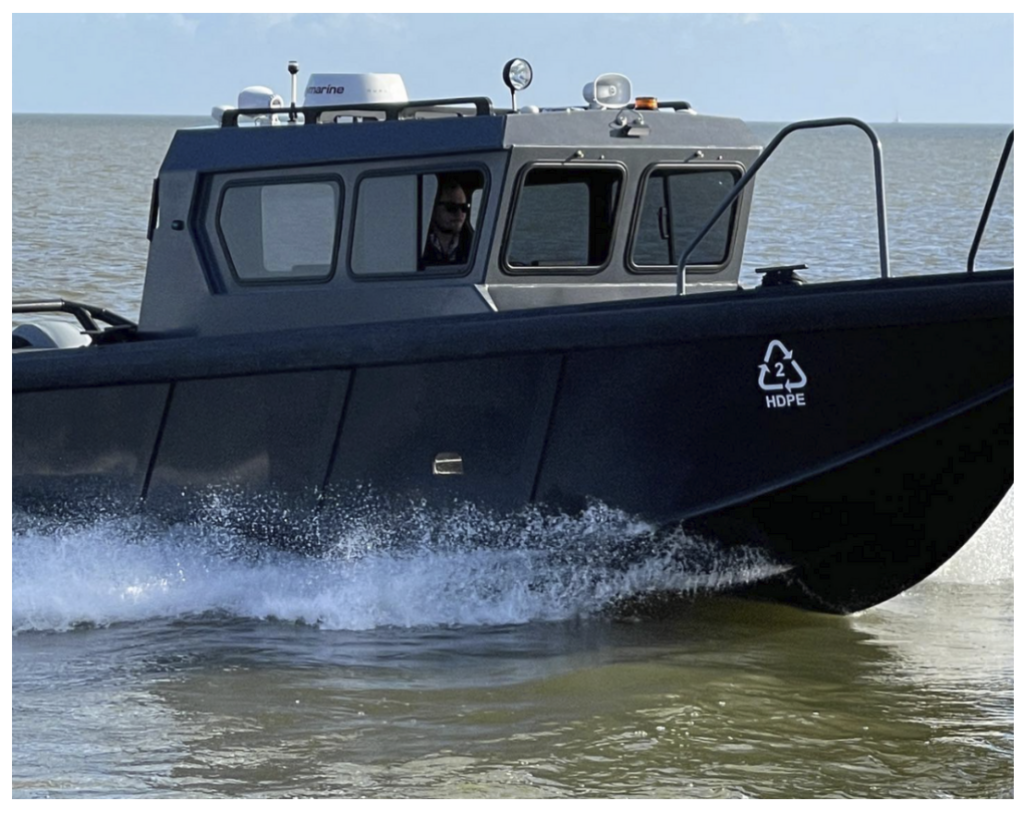
Now, let’s have an HDPE (high-density polyethylene) boat hull that’s nice and rugged, and cheap. Could you 3D print these things if you suddenly needed a lot of them? Of course. But we can order them from Tideman Boats now. Let’s pick the Valor, a triple-engined 300 HP open-sea model that can be up to 14 meters long with a payload of up to 15000 lbs. The boat is around $250,000, engines will be around $75,000, and let’s say another $150,000 for radar and coms. Let’s then make a lot of versions of this boat.
- On one version, we put an entire CIWS (close-in weapon system) unit; the seakeeping will suck, but this will give us good anti-ship and missile defenses.
- On the second type, we can put a 36-cell Uvision Hero 120 loitering munition unit with 150 munitions. Each munition can loiter for an hour and has a maximum range of 50 kilometers.
- Another version carries two Rafael Spike NLOS Missile Systems, preferably the Naval unit with 8 missiles and a 50 caliber station.
- Another version will carry an Altius loitering munition set with a 500-kilometer range.

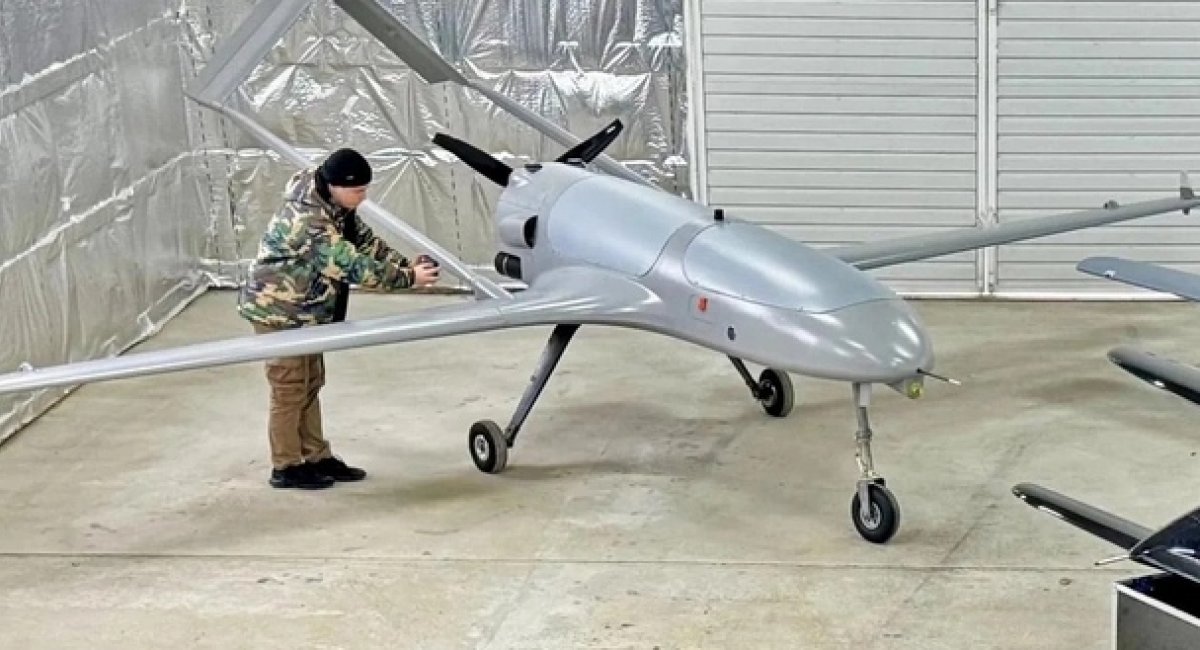
A technician inspects a fixed-wing uncrewed aerial vehicle (UAV) inside a hangar.
- Another one will carry Liutyi long-range strike drones with a range of up to 2000 kilometers for anti-ship strikes.
- Another boat will carry 10 long-range Firepoint drones for ISR and relay.
- Then one will carry a four-pack of NSM strike missiles with the launcher. This will be the most expensive boat, with one missile costing more than most of the other boats.
- Then, ten boats will carry 3000 kilos of explosive charges and 500 FPV drones each; these will be used to confuse missiles and attacks. If an attack comes, they break off and launch all the drones at once, forming a kind of controlled chaff cloud. They can be reused and do this over and over. If a missile or vessel is close, it can be used to strike. The boat itself can function as a mine or be used to ram other vessels.


Toloka 1000 Ukraine drone. Image courtesy of the Ukrainian-developed drone program.
- Another five will not have the drones and be more similar to the Toloka TLK-1000 strike boats used for bridges and the like.
- Another will be a launcher for 2 Marchica, 1,000-kilometer subsea loitering munitions that can remain on the seabed for days.
- Another boat will carry 20 Toloka TLK-150s for subsea swarm attacks.
- Then another boat will have a Mark 32 Triple Launcher or similar torpedo pack with spare torpedoes.
- Another vessel will have an NSM unit and a Mark 32.
- Yet another will have 20 “Sichen” 1,400-kilometer range autonomous drones for long-range strikes against bunkers and the like.
- Then one will have 100 TAV interceptors for high-speed interceptions of up to 300 kilometers per hour.
We could then have 5 fuel boats that can refuel and resupply the other boats. We add solar panels and electrical systems to extend life at sea a bit and assemble flotillas of these vessels. Now, you’re probably wondering, why so many boats? We don’t have to make one boat to do it all. In fact, one-size-fits-all weapons systems have not done well and have been too costly. Instead, we can assemble a flotilla of 500 ships to surround fleets and scout ahead of them. If individual weapons systems don’t work, we take the boat back and put a new one on it. With more containerized solutions, racks, self-contained systems, and the like, this will become easier. We don’t need to make the perfect boat. We can just spend one million making something that may work. Test it, field it, and replace it with the new one. It will be difficult for an enemy to engage this kind of a swarm-carrying flotilla because so many types of munitions can be deployed in so many different ways. With constant upgrades, new weapons systems would be available. So it will be impossible for you to gauge their capabilities or anticipate some attacks.
Imagine you’re seeing spotter drones of three types: one is a long-range loitering munition, and the other is an interceptor drone. Which boat are you up against? Can you counter NSM? What about a flotilla of small drones or one coming straight at your hull? What if they managed to get a lot of these different munitions to arrive at once? Wouldn’t that overwhelm your capacity to act and systems? How would you attack and sink all of these ships? And while you do it? While you’re busy engaging all of these targets and munitions, it’s that Marchica quietly waiting on the seabed that will get you, overlooked by an overstimulated sonar operator. These vessels will cost between $500,000 and $5 million to build. And one flotilla could beat most navies. You could perhaps get people at home to pilot them all remotely at a super low cost, or rely on autonomous teaming.
This is the kind of Navy that 3D printing can build. Sure, we can help with the $5 billion submarines. But 3D printing can also help if you don’t build them in time. We could 3D print the hulls. But, even if we don’t 3D print all the housings, integration, additions, reinforcements, and other gear is the advantage here. Rather than a few ships, we could make an ephemeral, ever-shape-shifting cloud of defenses. A force that could take out a swarm of speedboats would blunt a swarm of drones and would be able to attack or defend a large array of targets, all without any loss of life. All for less than the cost of one Littoral Combat Ship. 3D printing will win here because it enables inexpensive, faster integration and adaptation of systems that will collectively outperform.
If you’re interested in how drones and 3D printing are coming together in real-world applications like this, the topic will also be explored at the Additive Manufacturing Strategies UAS: The Present and Future of Drone Manufacturing event on June 30, 2026.