Online design and collaboration community Wikifactory has initiated a design challenge, being held from the June 8 to July 5. The “Let’s make it #SafeToPlay! Design Challenge” is being run together with Snapmaker and we at 3DPrint.com are a partner. The central concept is to design new inventions, products, and solutions for the New Normal.
We all know that the world has fundamentally changed only very recently. What will the New Normal mean for us all? The Wikifactory team thought about something as simple as play. Play is fundamental for one’s upbringing, but far beyond your younger years, play can still provide you with much joy. But, how exactly can we play now? How can we experience the unbridled joy of being together, interacting and having fun in a safe way?


The challenge is exactly this: What products can you think of that promote play, but do so in a virus prevalent world? What games, sports or interactive activities can you redesign for the new world? What CNC-milled, laser-etched or 3D-printed products can you conceive that are virus-resistant and fun?
The contest will be judged by:
- Daniel Charny (award-winning creative director, curator and educator at FixEd),
- Zhijie Liang (Snapmaker)
- Christina Rebel (Co-founder of Wikifactory)
- Agustin Arroyo (Professor at UVF Madrid and @flowalistik)
- Henk Werner, Co-founder of TroubleMaker (Shenzhen)
- Me
The lucky winners will receive a Snapmaker 2.0 A350, a “3-in-1 digital fabrication machine” that can etch, mill and 3D print.


Winnings:
1st prize:
- Snapmaker 2.0 A350
- Feedback on your design
- Mentoring from the jury to help bring your concept to the prototype stage
- 1-year FREE Wikifactory Private Subscription for your team for up to 10 collaborators, worth EUR 840
2nd prize:
- Snapmaker Original
- Feedback on your design
- 1-year FREE Wikifactory Private Subscription for your team for up to 10 collaborators, worth EUR 840
8 Runner up prizes:
- Feedback on your design
- 1-year FREE Wikifactory Private Subscription for your team for up to 10 collaborators, worth EUR 840
Rules
- Your design entries must employ at least one digital fabrication technology, including 3D printing, laser etching or CNC milling (but you’ll score points for building in all three).
- You must also incorporate anti-viral materials or processes, into your submission.
“You can add electronic elements or existing objects you’re already working on, as long as your entry fits with the rules of the competition. This is a great design challenge to create fun objects that bridge the gap between functionality, aesthetics, creativity, positive social impact and safety. Presentation and documentation are essential. Our expert panel will also assess aesthetics, great concepts, and how collaborative the design process was. So, don’t hesitate to combine your design submission with a step-by-step tutorial or a nice video to really impress our jury.”
Selection criteria for finalists
“We’re looking for functionality, creativity, aesthetics, printability (accessible manufacturing process), documentation quality (photos, GIFs, video, assembly process, FAQ…), collaboration (engagement on your project and in your social channels), and technical or antimicrobial materials used such as copper-based materials.
“Designs can already be available on other platforms, but the user must be the original creator of the designs in order to be eligible. Users can submit as many designs as they wish, but they will only win one prize. Winners will be announced on 8 July 2020.”
Entries must:
- Be uploaded on wikifactory.com, the world’s first social platform for collaborative product development, and your all-in-one workspace to collaborate, design and prototype with our amazing 3D visualisation and version control software. Here you’ll find all the tools you need to make a great design happen
- Include the topic hashtag #SafeToPlay when creating the project and invite @flowalistik straight away to provide mentoring and guidance.
- Be shared on your favorite social media, tagging Wikifactory and Snapmaker
- Include at least one digital fabrication technology, e.g. 3D printing, laser etching or CNC,
- Carefully incorporate anti-viral materials or processes into your design.
- Encourage at least one of the #SafeToPlay design tips (see below)
- Be able to be manufactured using a Snapmaker 2.0 A350 (1st prize) and fit the working dimensions of 320mm X 320mm X320mm
- Include complete project documentation
#SafeToPlay Tips for virus-safer designing:
“Eligible ‘design concepts’ must encourage at least one of the following: (Based on WHO‘s advice for the public)
- Encourages people to wash their hands (painting toys that will require washing their hands after playing)
- Encourages social distancing (frisbee, badminton…)
- Stay home if you’re not feeling well (board games, marble runs…)
- Don’t touch your face (cosplay helmet/mask design)
- Look after yourself and stay healthy (individual sports made more comfortable, bicycle accessories, skates, electric vehicles…)
Additional recommendations include designing devices that can be easily disassembled, allowing for in-depth cleaning, using temperature resistant and antibacterial materials and technologies, and creating original and innovative designs.
If you have any questions about your design, open an issue on your project and tag our Content Developer (@flowalistik) who will follow and support you through your project submission during the competition to increase your chances of creating a unique submission.
Best practices
- Simple design that allows in-depth cleaning: Antimicrobial or virus-resistant materials that do not deform under high temperatures (PETG, ABS…)
- Do things in different ways to improve the New Normal: Designing a regular ping pong set is not as impressive as an original ping pong set that implements design changes to avoid direct contact.
In general, one solution that you can turn to is copper. Copper filament, making copper objects by electroplating 3D prints, or making copper parts through casting wax (or in a pinch PLA) parts is a straightforward path to making parts with antimicrobial qualities. Below you can see a part by Australian cold spray 3D printing company SPEE3D, where they made an activated copper door handle with antimicrobial properties. SPEE3D is not affiliated with the contest but they do print copper and I thought that this was really an excellent example of what one could do. Of course, this object does not directly promote play or engender playful opportunities in a safe way. So, what can you do, with copper? Or with another smart innovation to make the world #SafeToPlay once again.
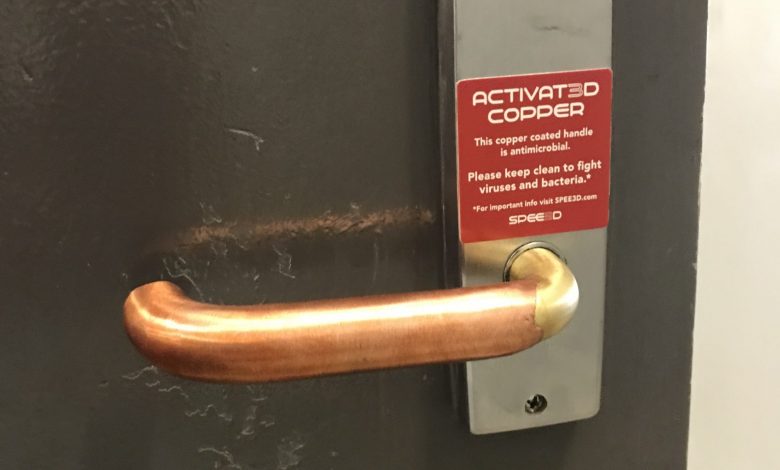

The use of a Copper Alloy surface is a supplement to and not a substitute for standard infection control practices; users must continue to follow all current infection control practices, including those practices related to cleaning and disinfection of environmental surfaces. The Copper Alloy surface material has been shown to reduce microbial contamination, but it does not necessarily prevent cross-contamination.