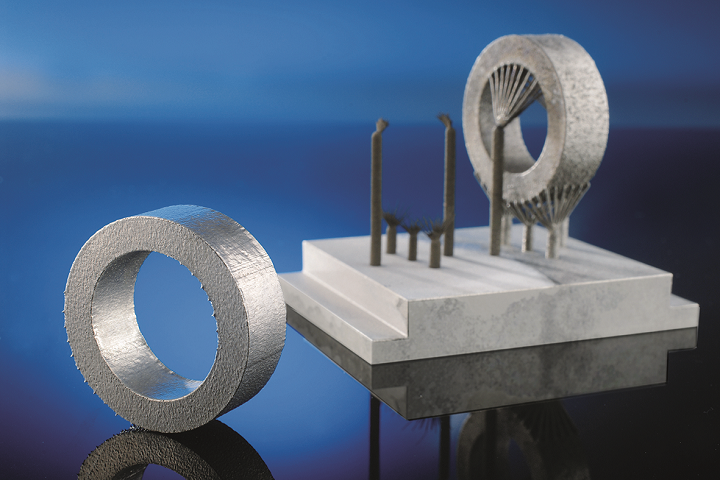
[Image: Fraunhofer ILT]
In addition to Fraunhofer ILT and Daimler, the AutoAdd project partners include:
- BMW
- GKN Sinter Metals Engineering GmbH
- Karlsruhe Institute of Technology (KIT)
- Netfabb GmbH
- TRUMPF Laser- und Systemtechnik GmbH
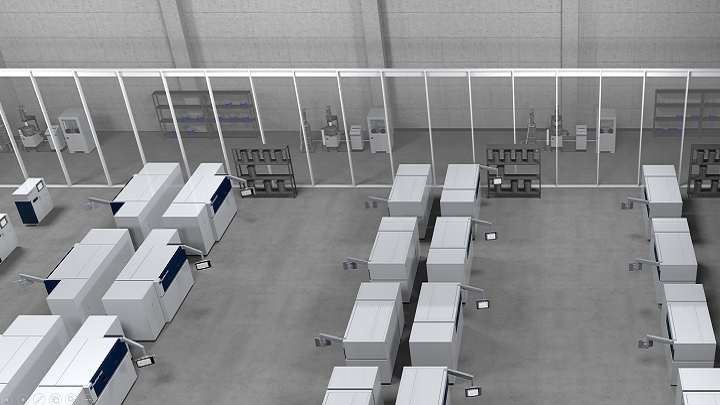
[Image: TRUMPF]
In addition to a modular system architecture that allows for the use of an “interchangeable cylinder principle” and multiple beam sources, potentially production-ready optical designs were created. The AutoAdd partners also analyzed GKN’s novel scalable materials, as well as created some promising post-processing concepts that could be automated, such as support structure removal.
KIT was the partner which ended up evaluating these new factory designs.
According to a Fraunhofer ILT press release, “Using a simulation model, the engineers of the wbk Institute for Production Science visualized an exemplary, conventional process chain, in which they were able to design various possible LPBF plant concepts. With methods such as cost or benchmark analyzes, they were able to compare the new approaches from a technical and economic point of view with previous ones.”

Long-term recording of the contour exposure during 3D printing of a grinding wheel. [Image: MTU Aero Engines AG]
The joint project results are interesting and impressive, showing that it is indeed possible to achieve additive mass manufacturing. For instance, the whole process chain can be automated, making it more efficient and cost-effective, as the team discovered that modular cylinders and wet-chemical immersion baths are effective ways to remove, batchwise, components during post-processing. In addition, common metrics for evaluating LPBF manufacturing equipment were developed by the AutoAdd project partners, which can be used to identify popular equipment manufacturers for a large-scale benchmarking exercise.
“By using standardized benchmark jobs with different test specimens, industrial users can now calculate transferable key figures with which they will be able to find the most economical system for their purposes,” the press release noted.
One of the most, if not the most, important points the AutoAdd team needed in order to make 3D printing ready for series production was the ability to reproduce mechanical properties. The partners took an important fundamental step by demonstrating and evaluating this feature in multiple facilities – showing that it is possible to integrate an economic additive process chain in automotive mass production.
Discuss this story and other 3D printing topics at 3DPrintBoard.com or share your thoughts in the Facebook comments below.