

“This is our first time presenting the machine here; not everyone understands how it works, yet when we explain, we watch the mind cinema begin to work,” Schmid told me.
The machines on display were what he referred to as his “pre-series babies,” machines just ahead of the final EXIGO 3D printers and LIFTcell production lines, which will have “some small changes, not much” following more thorough testing runs. The machines themselves are manufactured just across the border from Liechtenstein, in Switzerland; if he wanted another selling point, Schmid said with a smile, he could write ‘Swiss made’ on the machines.
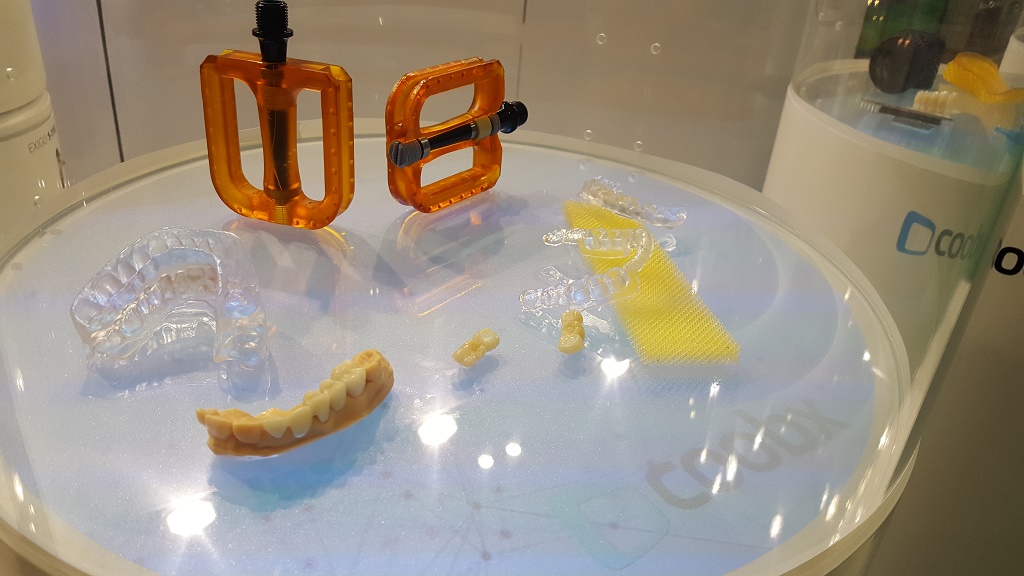
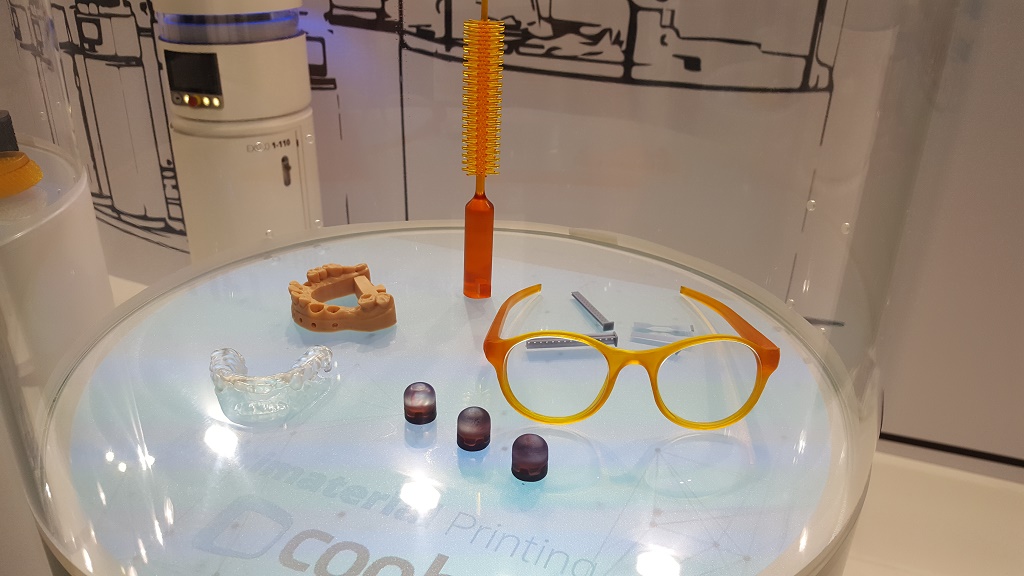
Among the applications showcased at the booth were products made for the dental industry (including both dental molds and toothbrushes), bicycle pedals, and glasses — all of which are uses we have seen benefit from a turn to 3D printing. Coobx technology allows for inset parts and shallow shell printing, among other techniques to create customized and complex parts and prototypes. Echoing a growing refrain, though, it isn’t just prototypes where Coobx sees its target market: it’s manufacturing.
Schmid has some very serious ideas about the place of 3D printing in manufacturing, falling in line with big names like HP and Deloitte, which see additive manufacturing disrupting the $12 trillion global manufacturing industry, as well as familiar industry names like Carbon, which is seeking to move into scale production starting with footwear. Coobx is tackling production, intending to take on traditional injection molding-based manufacturing, through a number of well-thought-out methods, including partnerships (such as with medical materials partner Dreve) and scalable, automated technology.
One of the biggest mistakes many companies have historically made in their ambition has been in hyping themselves up too much and running too quickly; Coobx is enthusiastic, but Schmid laid out a level-headed approach to growth into the market that makes sense not only to his company, but for its potential customers.
“Our technology is very scalable. We are taking one step after another, toward sustainable growth. We are not Palo Alto-based, we will survive after the bubble has burst. And the bubble will burst,” he said.

CEO Marco Schmid (L) and CTO Dieter Schmid with an EXIGO 3D printer
While we’re beyond the point of hype seen with previous promises, we may be entering a new phase with more of a bubble created by well-funded enterprises capitalizing on a more proven but still ahead-of-its-time enthusiasm. 3D printing lost some favor in the pits behind the hype, but it’s still a sexy, “It” technology on many fronts, and Coobx is (rightly) wary of what some of that might mean to the overall industry.
“It’s not a hype, it’s a business — and it should be an industry,” Schmid said of 3D printing. “So you need industrial machines. To compete with injection molding, these need to be professional, they need to produce.”

“Our idea is: do a proper machine in a proper industrial business. You must ask the customer what they need, and then work from there. The user needs to be able to make money with it, or what is the point?” Schmid pointed out pragmatically.
“You need the money for the user and for their customer. And we say okay, we will build our own machine; this is the thinking of engineers…. An engineer needs to understand how machines work, and then it will be ready. Additive manufacturing needs to adapt. You can’t use an additive machine for everything, but need to optimize it for everything you can, to get the most out of the machine.”
It’s heartening to talk to a young company backed up by an experienced team who understand what the market needs, not just what the fastest way to sell would be. The team at Coobx are also lively, as CEO Marco Schmid and CTO Dieter Schmid interacted with their regular visitors during TCT Show, displaying great humor and humility in their animated discussions of their technologies.
Discuss this and other 3D printing topics at 3DPrintBoard.com, or share your thoughts in the Facebook comments below.
[All photos: Sarah Goehrke]