

So exciting!
Back in elementary school, one of the required items on my school supply lists at the beginning of the year was a set of erasable pens. I remember being excited the first time I was required to buy them. Erasable ink? Cool! They turned out to be a disappointment; most often the erasers just rubbed holes in my paper, but the novelty of the idea was still exciting to me. It’s the little things in life. Now I have something new to be excited about, and it looks like it’s going to be much more effective than erasable pens. Researchers at Karlsruhe Institute of Technology (KIT) have developed erasable ink for 3D printing.
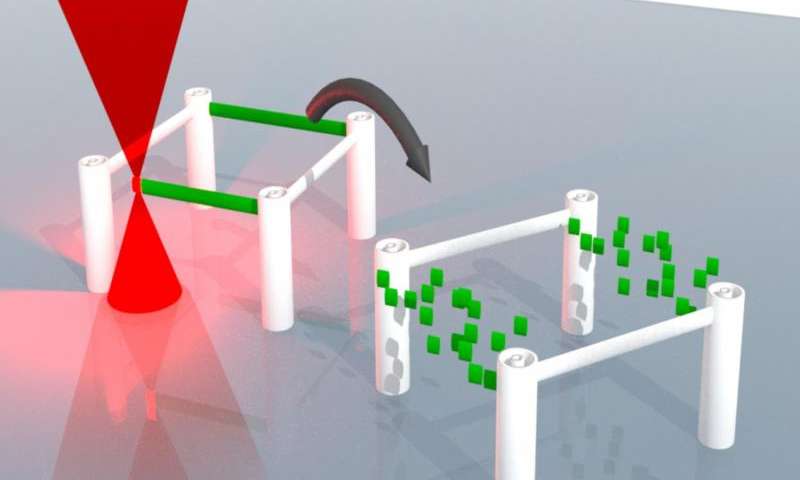
No, your filament spools are not suddenly going to come with erasers that can somehow magically make printing errors disappear, as wonderful as that would be. The ink the KIT researchers have developed is used for direct laser writing, a 3D printing method that uses a laser to produce micrometer-scale, precise structures in a photoresist for applications in fields like biology and materials science.
“Developing an ink that can be erased again was one of the big challenges in direct laser writing,” said Professor Christopher Barner-Kowollik of KIT’s Institute for Chemical Technology and Polymer Chemistry.

“The ink with defined breaking points can be used for a variety of applications,” said doctoral student and first author Markus Zieger.
For example, supports could be 3D printed with the erasable ink for easy removal from structures printed with non-erasable material. The technology can also be used in bioprinting, which the scientists recently demonstrated when they used the erasable ink to 3D print a scaffold for cell cultures in the laboratory.
“During cell growth, parts of the 3D microscaffold could be removed again to study how the cells react to the changed environment,” said Professor Dr. Martin Wegener of the Institute of Applied Physics and the Institute of Nanotechnology of KIT.

KIT has been at the forefront of the development of some highly advanced 3D printing applications recently, particularly involving micro- and nano-scale 3D printing. For example, just a few weeks ago, a KIT-led team of researchers developed a method of 3D printing tiny, high-resolution glass structures using a commercial SLA 3D printer.
The latest research paper was published in the journal Angewandte Chemie. Authors include Markus M. Zieger, Patrick Mueller, Dr. Alexander S. Quick, Professor Dr. Martin Wegener, and Professor Dr. Christopher Barner-Kowollik.
What do you think of this development? Share your thoughts in the Erasable Ink forum at 3DPB.com.