

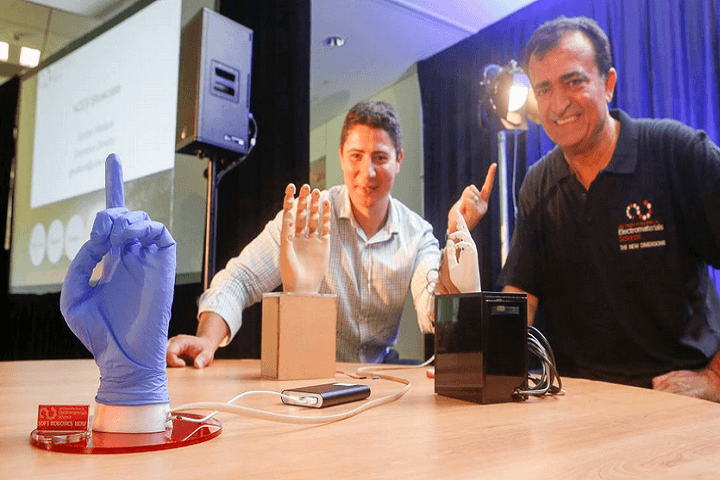
Dr Rahim Mutlu and Professor Gursel Alici with the soft robotic hand which is lightweight, low cost and enables users to make more lifelike movements. [Picture: Adam McLean]
Professor Alici said, “Users of prosthetic hands only use them for about a third of the tasks they could – because they are hard and heavy, and not as intuitive as they’d like. By using the smart materials developed at ACES, we have created a soft robotic hand that can be strong and carry heavy objects, but is lightweight and soft to touch. Current robotic prosthetics also have a number of joins, whereas 3D printing allows us to make one continuous structure which improves functionality and control.”
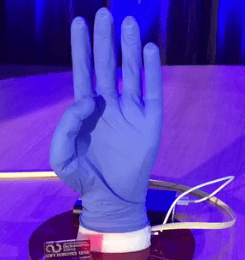
“The hand is one of the most important parts of our body – it’s the most significant interface between a person and their environment. We have used the progress in smart, functional materials to create a robotic hand that has a better interface and interaction with the environment – and allows the user to make more lifelike movement,” said Professor Alici.
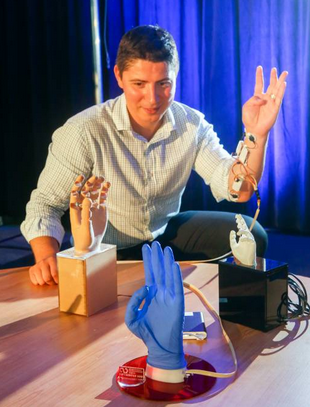
Dr. Rahim Mutlu demonstrates the functionality of the new soft robotic hand developed by a UOW team. [Picture: Adam McLean]
Professor Alici said, “We will be making it even more user-friendly by creating a minimally invasive interface from the brain to the nerves, from the nerves to the muscles, from the muscles to the hand and fingers. So options like an implantable interface, or soft printable material on the arm instead of wires and electrodes.”
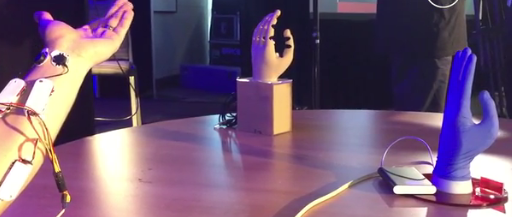
Professor Alici and ACES Research Fellow Dr. Rahim Mutlu demonstrated their prototype at the UOW Innovation Campus during the International Electromaterials Science Symposium this week, which brings together leaders in electromaterials research. According to The Stand, Dr. Mutlu has been designing, optimizing, and 3D printing the team’s soft robotic hand structure. He and Professor Alici have been continuing to explore smart materials as well, which could help position the fingers of the prototype, all of which are able to move individually, and plan to allow for haptic feedback. The hand is also much quieter than other robotic prosthetics, thanks to these smart materials.
Dr. Mutlu said, “Current actuation methods, for example, use noisy, bulky electric motors to generate finger-and wrist in some-movements. Our approach has no gears and motors to create the hand gestures-the smart materials will actuate the hand silently.”
Professor Wallace said, “We have developed a suite of materials that can be used for externally worn prosthetics as well as internal prosthetics, such as better bionic ears and cartilage and corneal regeneration.”
The prototype could be publicly available within the next two years. Take a look at this short video to see the hand in action. Discuss in the University of Wollongong forum at 3DPB.com.
[Sources: Illawarra Mercury, The Stand]