“This maker revolution is cool — but what are you making?”

Handsmith, a nonprofit based in Roanoke, Virginia, is competing with traditional bionic hands that cost from $45K to $75K, and which are not distributed to just anyone who wants one, even if their insurance might theoretically cover it. Connor told me about some of the stipulations in place for the current system, in which an amputee might not qualify for a functional bionic prosthetic hand due to a somewhat sedentary lifestyle or advanced age (“advanced” meaning as young as about 50 years old, hardly out of society’s eye), and have to accept that they can only afford a hook prosthetic. He paused here, and motioned with his own pair of fully functional hands: “You might ask how I became invested in this, when I have both my hands.”
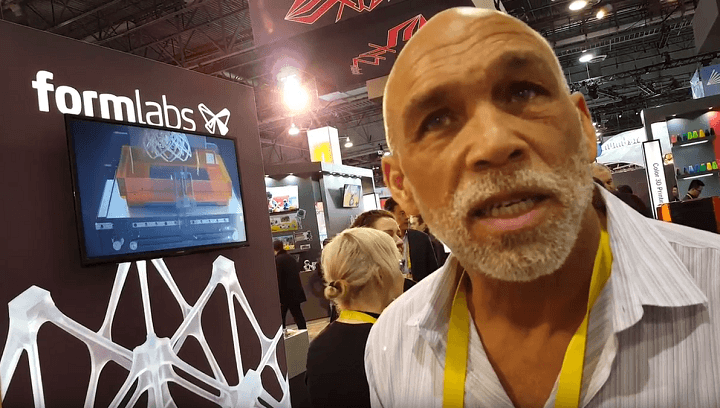
Lyman Connor at the Formlabs booth, CES 2017
In 2013, Connor was hospitalized following a nasty bicycle accident, and it was there that he happened to meet a young boy who had been born without one of his hands, and whose family didn’t have $50,000 to get him a functional bionic prosthetic. Thus began an odyssey, as Connor found a new mission in life. He set out to find out where the costs came from — and noted that a lot of that value proposition comes from stigma. The next questions on his list were to discover who the leader was, who was making these hands. He founded Handsmith to offer the Mano-matic as an alternative to these high-priced, often-inaccessible prosthetics, and was in a unique position to do so thanks to his background. Connor has worked for 17 years at GE writing software, and now after his work at his day job is completed, he turns his impressive amount of energy to Handsmith, putting to work GE’s FastWorks methodology that emphasizes a “build, measure, learn” philosophy.
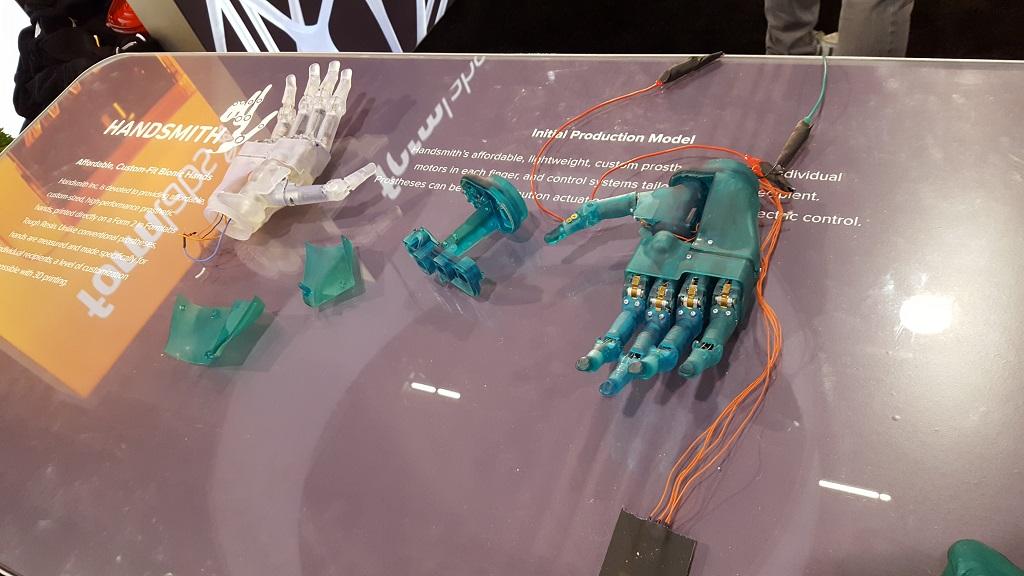
“I took a leap of faith then,” Connor told me. “I purchased four Form 2 3D printers and created my own microfactory in Roanoke.”
Using these 3D printers, Connor is finding that there’s “a lot of room in the medical industry for personal, one-off creations — and that’s going to blow that market wide open.” The 3D printers further proved their use beyond prototyping, and finished hands come right off the machines. The key here is that he can get right to the voice of the customer, a luxury OEMs don’t have, or just a step they aren’t taking, and can create personalized prostheses. While there have been hesitations from those concerned about the hands a single man is making on a 3D printer, Connor isn’t exactly an amateur, and while right now he’s single-handedly (pun actually not intended) doing all of the designing, programming, and validation, he has a supportive team in place with Handsmith, and has gone through the steps to ensure that the Mano-matic hands created offer performance comparable to or superior than the hands already out there; Handsmith’s 3D printed bionic hands are approved by Medicare and Medicaid, and Connor has also spoken to insurers, including at CES where he talked with United Healthcare.
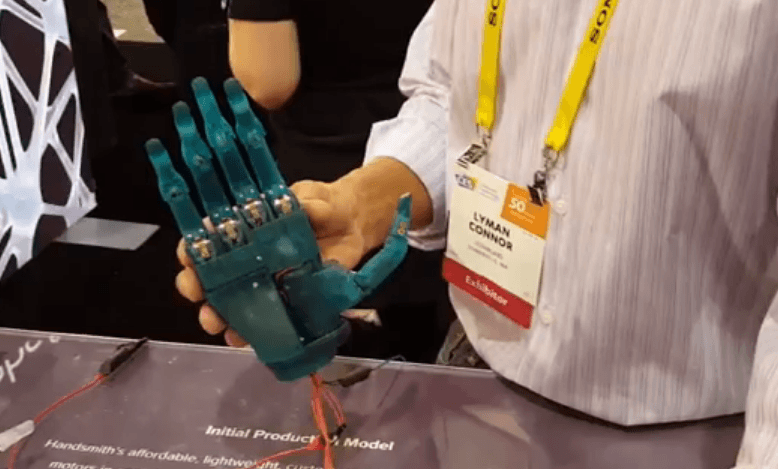
“That’s what differentiates us from e-NABLE, Limbitless,” Connor said. “Those are feel-good stories, but the prosthetics fail often. They make great pictures but people take them off and never put them back on again. They sit on a shelf.”
Because the magic of a bionic hand is in its articulating technology, the 3D printed casing is largely cosmetic, and so Connor notes that Handsmith will not charge a person for a second hand should they outgrow their original prosthetic. Below is a video of Connor demonstrating the functionality of a bionic hand at CES:

Not content even with a full-time job and the massive undertaking of Handsmith, Connor is hard at work ensuring that digital fabrication continues to spread. This summer, he will be teaming up with Dassault Systèmes and Formlabs to present a series of three summer camps focusing on SOLIDWORKS. The first two of these camps will be dedicated to girls, a segment of growing focus for STEAM-based learning as more initiatives seek to engage girls in science, technology, engineering, arts, and mathematics curricula.
After all, as Connor notes of the maker revolution, “making” isn’t just downloading a Thingiverse file and sending it to a plug-and-play printer — the spirit of the maker is encompassed in what one actually makes. And in Lyman Connor’s case, what he’s making is a real difference.
You can read more about Handsmith here as well as in a Formlabs case study and from GE Reports — and you can donate here to the cause. Every bit helps, as Connor has already emptied out his own 401(K) savings to support this initiative and welcomes additional financial support.
Discuss in the Handsmith forum at 3DPB.com.
[All photos/video taken by Sarah Goehrke at CES 2017 for 3DPrint.com]