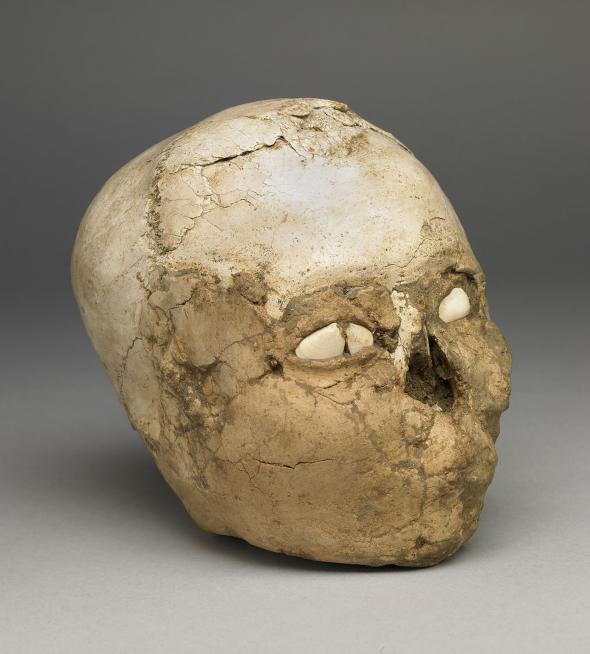
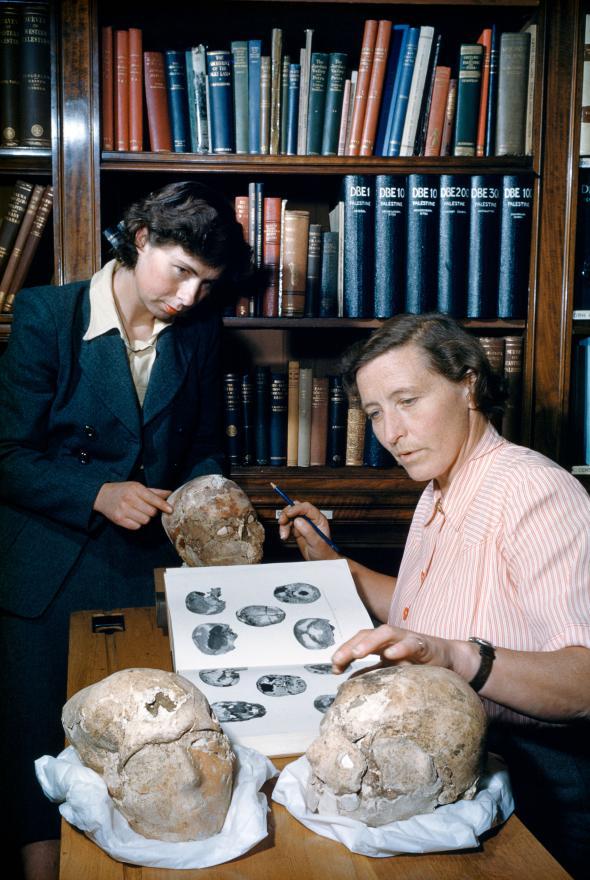
In this 1953 National Geographic photo, archaeologist Kathleen Kenyon (right) and technician Cecil Western examine Neolithic plaster skulls recently excavated at Tell es-Sultan, near Jericho. The British Museum’s Jericho Skull can be seen in the rear.
The Jericho Skull is one of seven ornamented, plaster-covered Neolithic skulls found by archaeologist Kathleen Kenyon in 1953 at the Tell es-Sultan site, and the discovery was reported in National Geographic later that year. She described the exciting moment when the first skull was discovered to readers of the magazine, explaining that no other archaeologists in the world “had even guessed at the existence of such a work of art.”
Kenyon wrote, “We realized with a thrill of discovery that we were looking at the portrait of a man who lived and died more than 7,000 years ago.”
All seven skulls had been originally stuffed with soil, in order to support the delicate facial bones, before wet plaster was used to create individual features, like ears and noses; some skulls even had traces of paint on them. Researchers agree that ornamented skulls like these represent some type of ancestor worship, but little is known about the people who were immortalized in plaster thousands of years ago.
The skulls were sent to museums all over the world for continued studies, and the Jericho Skull was sent to the British Museum. But though they tried, they weren’t able to discern any important information about the skull. Many physical details from the plaster that covered the skull had been erased by the passage of time, and a traditional X-ray scan, which couldn’t differentiate between the bone and plaster densities, looked like “a white blob on an x-ray plate,” according to Alexandra Fletcher, Raymond and Beverly Sackler Curator for the Ancient Near East, who was in charge of the museum’s reconstruction project.
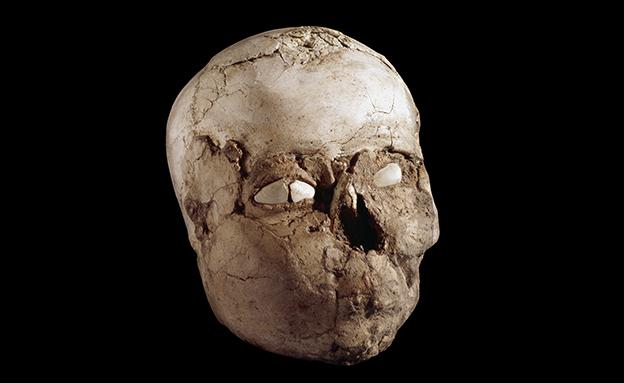
Some other Neolithic plaster skulls have been examined digitally, but the skeletal human remains inside the Jericho Skull are now the first to be 3D printed and forensically reconstructed. Researchers were finally able to see the remains under the plaster after the skull underwent a micro-CT scan in 2009, and they were able to recreate the face of the person inside the Jericho Skull. As it turns out, it’s a man in his forties, with a broken nose.
According to a recent National Geographic article, “The scan revealed an adult cranium (the lower jaw had been removed, more likely male than female. The septum was broken, and rear molars were missing. A hole had been carved in the back of the cranium so it could be packed with soil, and the scans even illuminated 9,500-year-old thumbprints from where someone eventually sealed the hole with fine clay.”
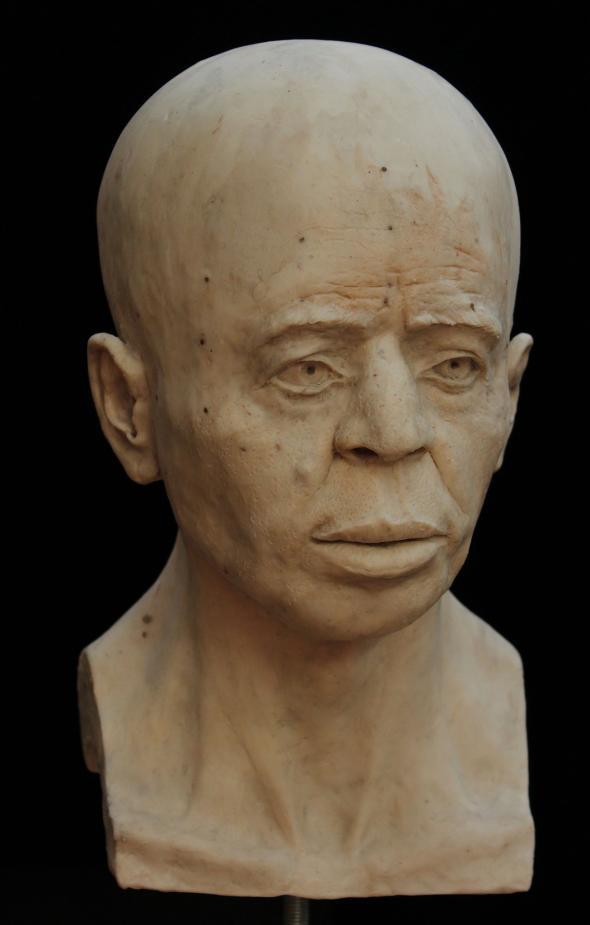
The forensic experts used the 3D printed cranium from the British Museum, and the lower jaw model of a different Neolithic man, to reconstruct the the facial musculature onto the digitally created Jericho Skull remains, incidentally using a similar process to the way people had made cheeks, ears, and lips from plaster and put them onto the original human bone over 9,000 years ago.
Fletcher explained, “It’s as if we did the Neolithic process in reverse.”
If you happen to be planning a visit to the British Museum, the original Jericho Skull and its facial reconstruction will be displayed next to each other in the “Creating an ancestor: the Jericho Skull” exhibit. But hurry, the exhibit will only be up until February 19, 2017! Discuss in the Jericho Skull forum at 3DPB.com.
[Source/Images: National Geographic]