
Last week, the big news on the alternative energy front was a collaboration between Lawrence Livermore National Laboratory and Giant Leap Technologies to produce sophisticated 3D printed microfluidic solar cells that would generate more power than current solar power plants, with less cost and less material. The project is being funded by a grant from the US Department of Energy, and this week the department has announced their own 3D printing project, this time directed at wind turbines.
The Department of Energy’s Advanced Manufacturing Office is a division dedicated to the development of environmentally and economically sustainable technology using the newest manufacturing methods – such as 3D printing. Working with partners including industry representatives, small businesses and universities, they’ve been responsible for the creation and commercialization of hundreds of energy-saving industrial technologies.

3D printing appeals to wind turbine manufacturers for the same reason it appeals to other industries: it’s a much less expensive way to develop an otherwise pricey technology. Right now, the Advanced Manufacturing Office is looking at 3D printing for the creation of turbine molds – really big turbine molds.
The office has borrowed the Big Area Additive Manufacturing Machine (BAAM), a massive and massively fast 3D printer developed by Oak Ridge National Laboratory and Cincinnati Inc. Vastly larger and up to 1,000 times faster than the average FDM 3D printer, BAAM is the perfect machine for the prototyping of six-foot-tall wind turbine molds. While the blades themselves aren’t being 3D printed at the moment, the mold for them is designed in CAD and optimized for 3D printing, with features such as heating air ductwork and assembly holes being incorporated into the design.
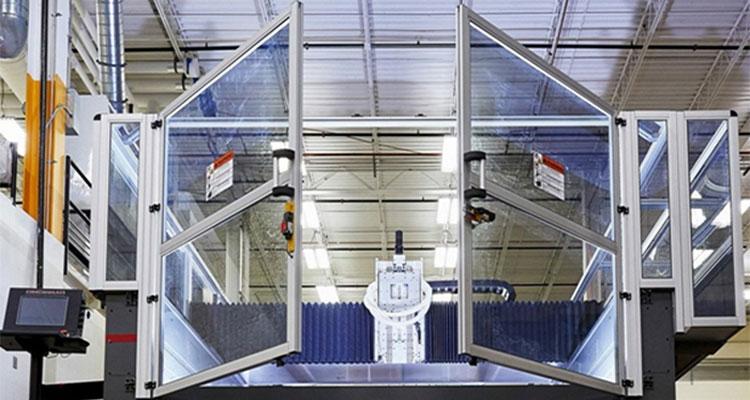
BAAM
Once the mold is 3D printed, a layer of fiberglass laminate is applied to it to create the actual blade, which is then machined to create a custom shape. Each of the mold segments is installed on a frame, where a hot air blower is added in lieu of embedded heating wires, which are traditionally added by hand in an expensive, labor- and energy-intensive process. The blade segments are then patched together, with the added bonus that the hot air blower can be reused for future mold assemblies.
Combined with the work of Sandia and other alternative energy research and development organizations, wind turbine technology continues to advance rapidly. 3D printing a mold may not seem like a huge deal, but in terms of the reduced cost and time required for the production of individual components, it’s another step towards making green energy equivalent to – or better than – current energy production methods, in both cost and effectiveness. Discuss further in the 3D Printed Wind Turbine Molds forum over at 3DPB.com.
[Source: Composites Manufacturing]