
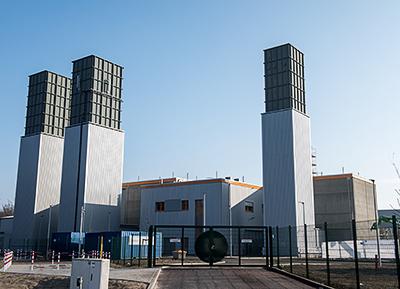
Siemens Clean Energy Center
The Clean Energy Center is the testing ground for Siemens’ gas turbines, one of the central elements in the company’s green technology plan. Gas-powered turbines are more efficient and emit less carbon dioxide than coal, and according to Siemens, their 375-megawatt H-Class gas turbine is the most powerful and efficient in the world. The company is continuing to improve the technology, largely at the Clean Energy Center, where turbine parts are put through rigorous tests involving exposure to temperatures of 1500°C or more.
The tests are aimed at optimizing the combustion process and thus achieving better energy efficiency, but it’s been a slow process, mainly because the turbine components, precision cast from superalloys, can take several months – and a lot of money – to manufacture. This obviously limits the number of tests possible, so a new method of production was needed.

SLM is becoming an increasingly popular process in industries such as aerospace, thanks to its capability for making large, lightweight parts with complex geometries. Fraunhofer, which has been developing laser-based additive manufacturing technology for years, was able to leverage the powder bed-based SLM to produce turbine parts of up to 250 mm with strong surface quality and dimensional accuracy.
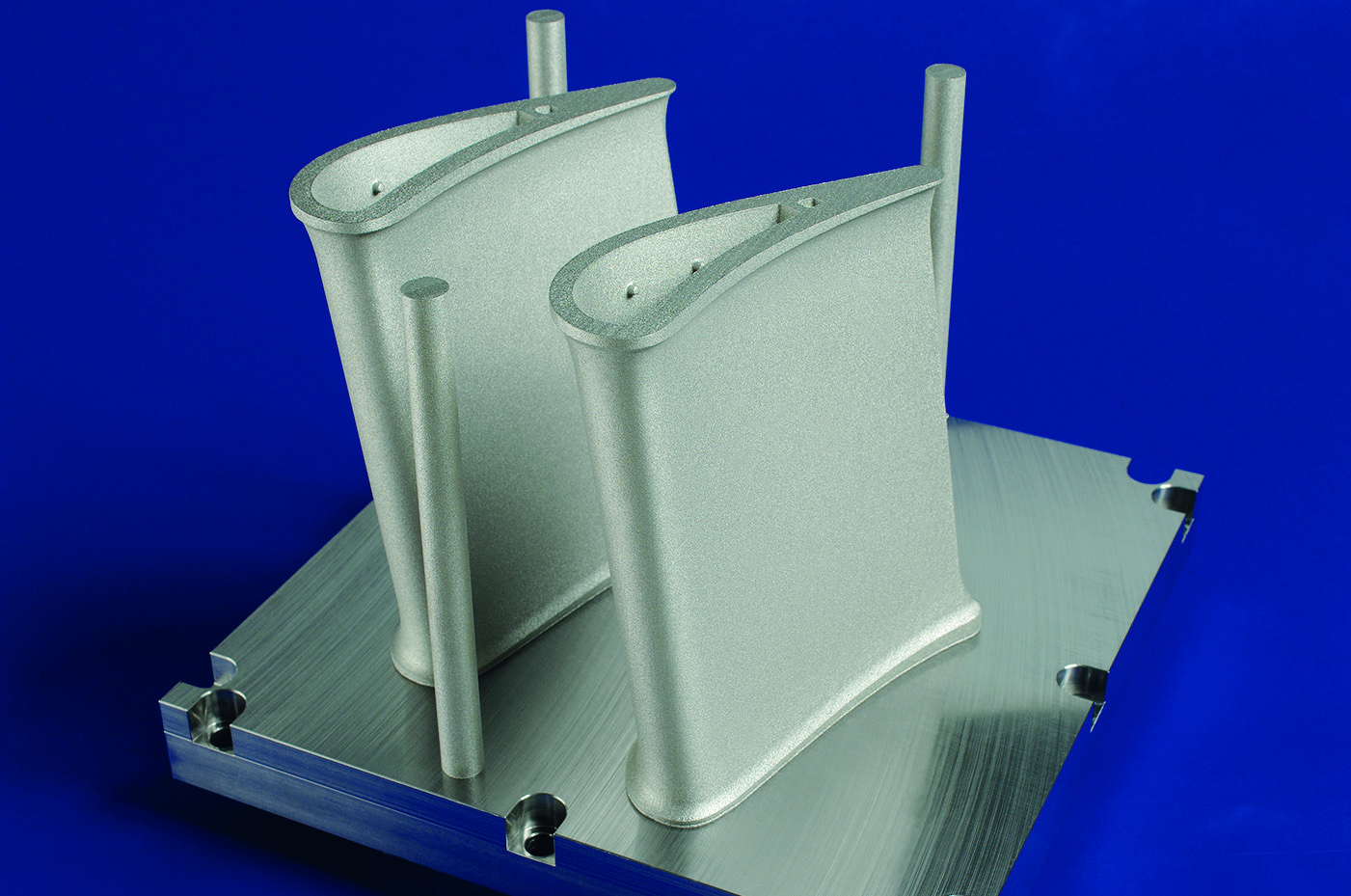
Individually manufactured guide vanes
There were still some challenges, however, The structure of a gas turbine includes guide vanes, mounted on the turbine housing, that channel hot gas to the moving rotor blades. Those guide vanes are massive, difficult-to-manufacture structures consisting of two giant platforms plus an airfoil with a complex cooling structure. That airfoil is a nightmare to manufacture; even SLM requires additional internal supports.
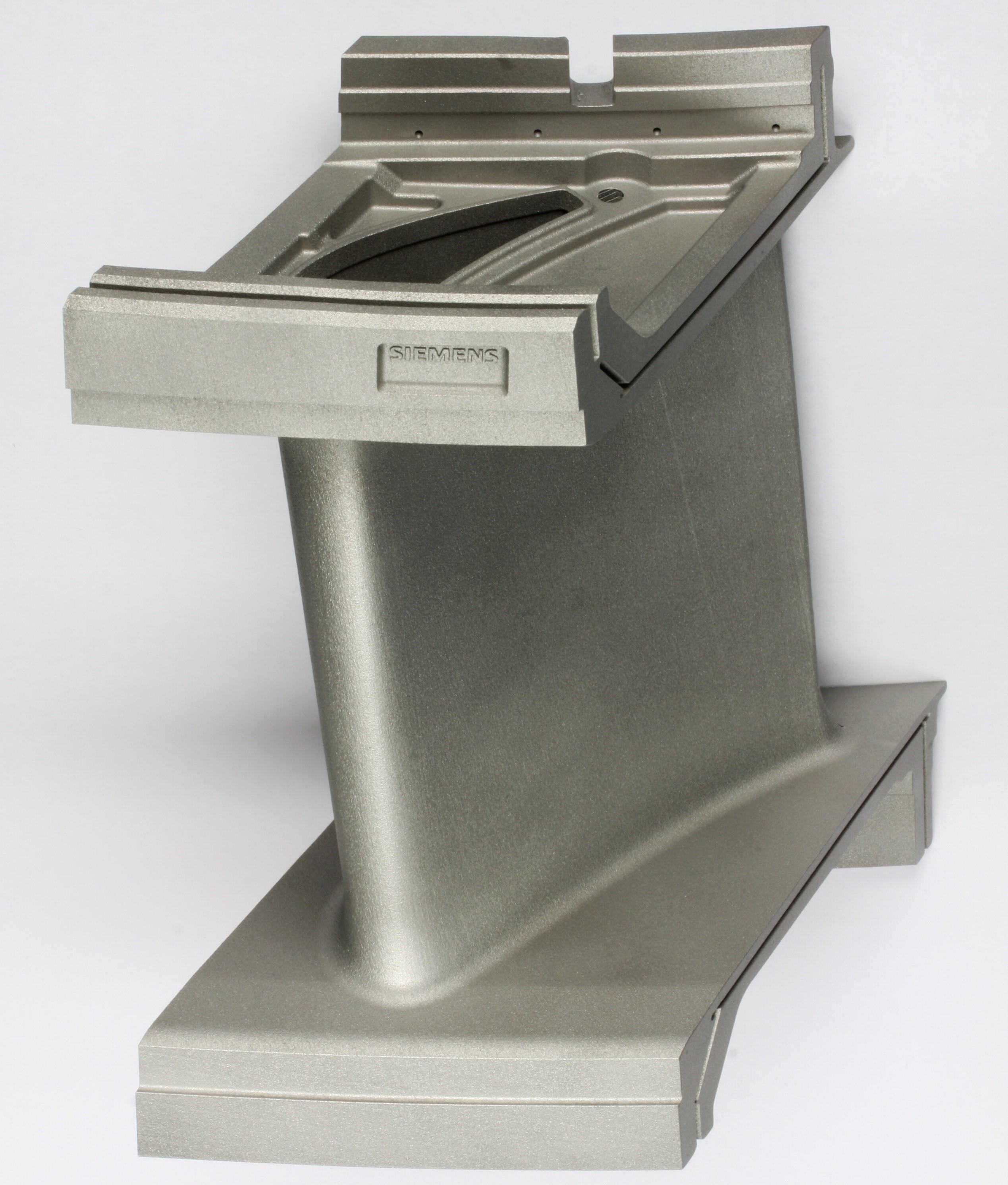
Guide vanes made with new modular process
The solution was to modify the process chain Siemens was using, breaking it down into smaller steps. The platforms and the airfoil were manufactured separately, measured, finished, then brazed together, eliminating the need for supports and improving surface quality as a bonus. The resulting part can be used in hot path rig testing and can deliver fast feedback to design engineers, further speeding up the testing process.
This new, modular manufacturing process has a lot of potential for other components. Parts manufactured with SLM could be easily connected to parts made with traditional casting processes, meaning that SLM – which is still a costly technology – could be reserved for the more complex parts that casting can’t handle as well. It’s an interesting development in the ever-changing world of additive manufacturing, and it’s a reminder that while 3D printing often seems ready to take over manufacturing altogether, it’s sometimes at its best when combined with other, more traditional processes. Discuss further in the Siemens Teams up for 3D Printing forum over at 3DPB.com.