
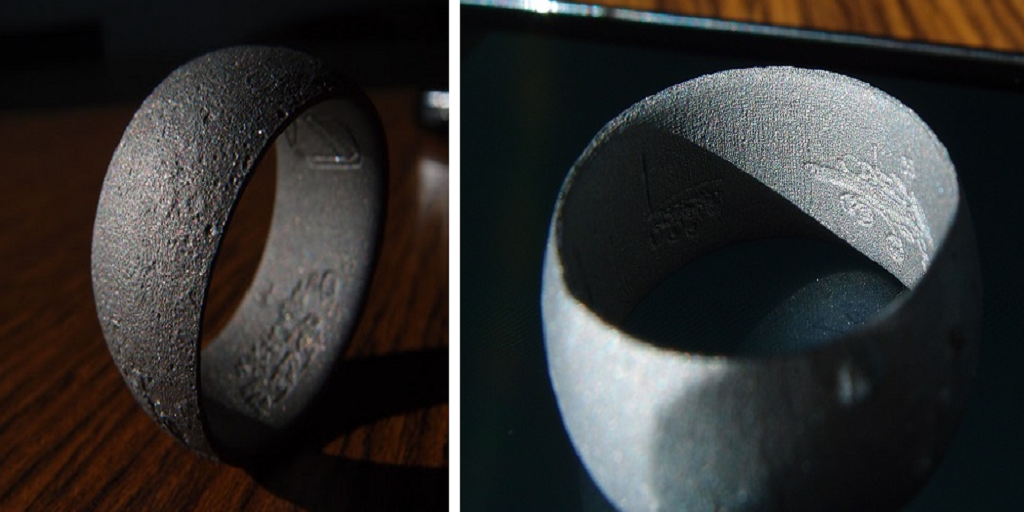
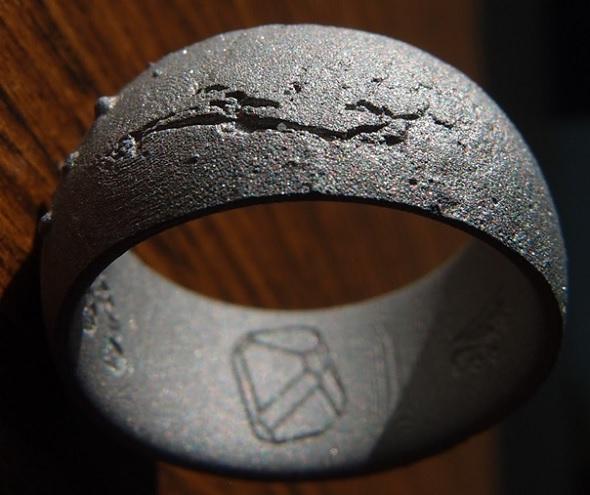
Dr. Handmer has much to say about his Mars Ring project, so let’s start with the basics. As a scientist, he has a general interest in communicating scientific concepts through wearable art: hence, the idea of using Mars data to design a piece of jewelry. Mars also has many unique qualities that Dr. Handmer is drawn to:
“Mars is a really interesting world covered in mountains and craters and canyons. You have to sacrifice the polar regions to make a ring, but fortunately there’s plenty of interesting stuff near the equator. Very few planets or moons are as well mapped or interestingly lumpy.”
Dr. Handmer used several sets of Mars data for the design, including the Mars Orbital Laser Altimeter, NASA’s Mars Global Surveyor probe, and the US Geological Survey. Given all of the available data, Dr. Handmer reports he made the model in a few hours, prototyping the ring in bronze first before finalizing the 3D print in high detail stainless steel — compliments of i.materialise.
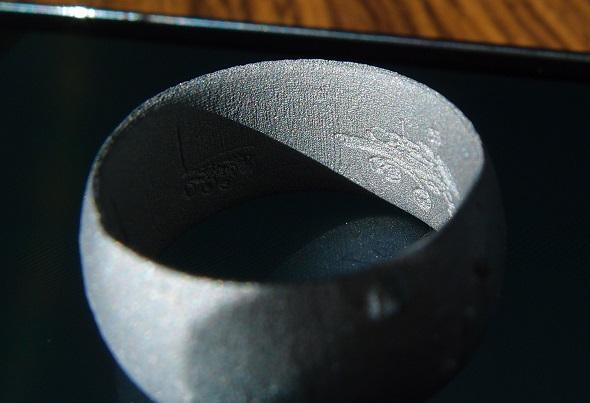
Regarding more technical details, Dr. Handmer explains he uses the software program Mathematica for its versatility:
“I use a versatile software package called Mathematica. It’s not designed for 3D modeling but it enables really low-level control of the data-sets and point positioning. But I don’t know how to use it for efficient mesh refinement or annealing – my models rarely contain such things for a reason!”
It wasn’t the 3D modeling that was the most difficult here, but instead the prototyping of the ring and finding out who should 3D print it. Dr. Handmer settled on i.materialise because he had a hard time while using another 3D printing service, and he says that i.materialise has always been “supportive and responsive” about his experimentation with shapes and materials.
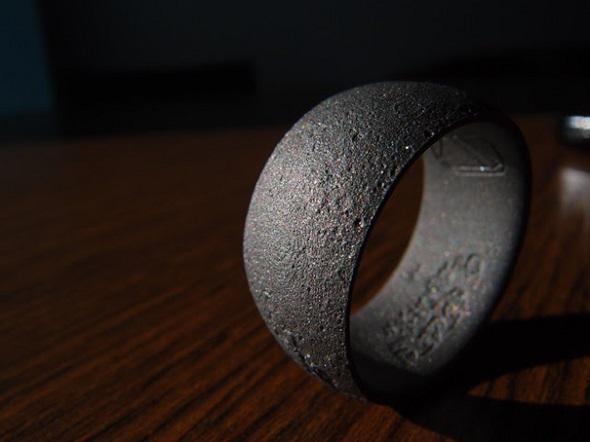
In conclusion, Dr. Handmer describes how 3D printing facilitates his own design process, offering affordable advanced material forming techniques:
“And, for more complicated designs which feature lots of negative space, there is simply no other way. I have designed lots of models specifically for i.materialise’s high-definition stainless steel. It offers a resolution that’s about as good as you can see with your eye, which is the level of detail I need for depicting dense data-sets.”
There you have it. That is the story behind a 3D printed Mars Ring made from high detail stainless steel and engraved with some of the very symbols that keep us looking to Mars for answers about the origins of life in the universe. What are your thoughts on this project? Discuss over in the 3D Printed Mars Ring forum at 3DPB.com.