

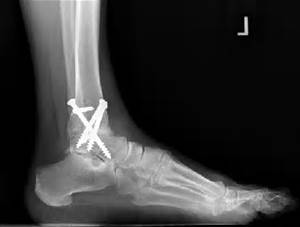
It sounds painful, and it is – recovery typically takes 10 to 12 weeks, and patients have to adjust how they walk to accommodate the fused joint. Usually, screws and/or plates are used to hold the bones together, and they’re generally not removed after the bones have fused, except in the case of irritation or infection. Sometimes bone grafts are required. Bone grafts in themselves are tricky and often painful, but researchers are coming up with ways to significantly improve them using 3D printing. Now the FDA has approved a new system that uses 3D printing to improve arthrodesis procedures.
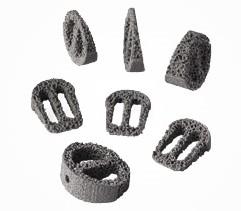
Reconstructive wedges made from OsseoTi
Zimmer Biomet is a global leader in reconstructive orthopedics. Their Unite3D Bridge Fixation System removes the need for the plates, screws and staples used in traditional arthrodesis, instead relying on a 3D printed “osteoconductive matrix designed to provide for biological incorporation.” Out of the many ways that 3D printing has affected implants of all kinds, one of the most important is the ability to create implants made from biocompatible materials that can be absorbed into the body or that mimic the properties of the body’s natural structures. The Unite3D system, which was developed with help from orthopedic surgeons Dr. Greg Pomeroy of New England Foot and Ankle Specialists and Dr. John Early from Texas Orthopaedic Associates, utilizes Zimmer Biomet’s proprietary OsseoTi material, a porous metal that mimics the structure of cancellous (spongy) bone.
“By offering foot and ankle surgeons a construct for osseointegration across the entire fusion site, the Unite3D Bridge Fixation System provides a stable and durable solution for fracture and osteotomy fixation and joint arthrodesis within the midfoot and hindfoot,” said Dr. Early. “Having replaced the plates, screws and surgical staples of traditional foot and ankle fusion, we also wanted to offer the intraoperative benefits of a streamlined procedure with easy-to-use and disposable surgical instruments.”
Because arthrodesis procedures differ according to the reason for the surgery, as well as patient anatomy, the Unite3D Bridge Fixation System offers nine implant size options plus single-use surgical instruments. The internal framework of the implants is made to be extra strong and rigid, with a zero-prominence design and uniform compression along the entire length of the implant.
“The Unite3D Bridge Fixation System is unlike anything in our portfolio, and we are proud to commercialize a true innovation in this exciting clinical area,” said Ben Joseph, General Manager of Zimmer Biomet Foot and Ankle. “This powerful combination of 3D printing technology and our OsseoTi porous metal material is only the latest contribution from Zimmer Biomet’s robust innovation pipeline. We aim to serve the unique needs of patients and surgeons while expanding our presence in every category of musculoskeletal healthcare, including the rapidly growing market of foot and ankle treatments.”
Discuss in the Zimmer Biomet 3D Printed Medical Device forum over at 3DPB.com.